"A star is born": The Government's strategy with Joan Simonet that slows down Vox but not the crisis in the countryside
The closure of companies like Piema, S’Esplet or Carob and the uncertainty about Vox's support for the new agrarian law mark the mandate of the head of Agriculture and Fisheries, who maintains the support of the sector
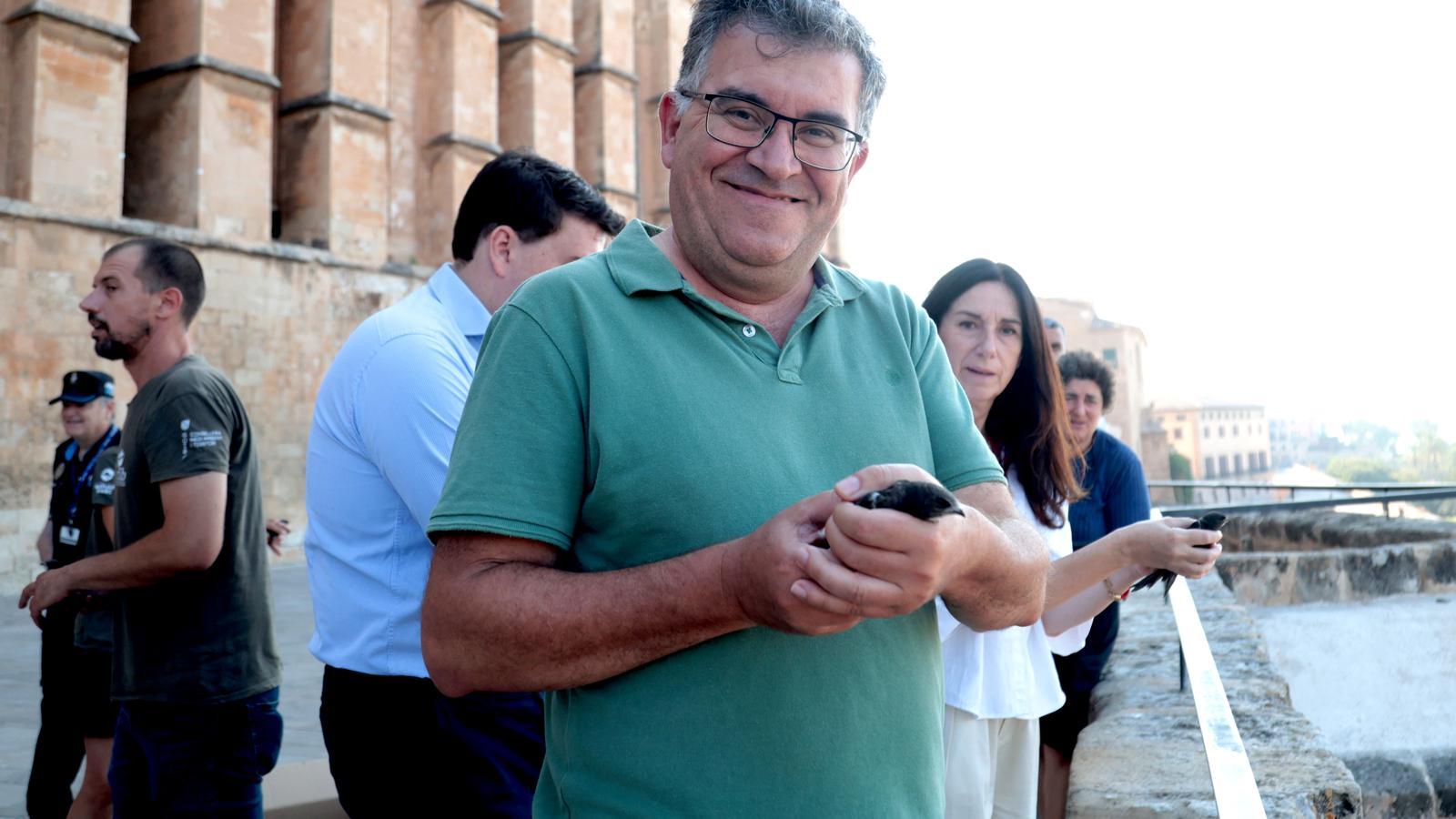

PalmaJoan Simonet has not changed his phone number: almost the entire agricultural sector has his personal contact. The Minister of Agriculture and Fisheries has his own profile that in recent months the Government has tried to exploit by posting videos where he appears hunting snakes, soaking at Es Trenc and walking around the port. “A star is born,” claim sources from the Executive branch, who consider the goal of preventing Vox from making inroads in the countryside, one of the far-right's fixations, to have been met. But despite the minister's popularity, the crisis in the primary sector does not subside. After the closure of iconic companies like Agama, Piema, S’Esplet, and Carob, now it is also in doubt whether the agrarian law will move forward, a regulation on which Simonet has worked throughout the entire legislative term.
For Prohens, signing Simonet was a safe bet. “He is the complete package,” claim sources from the president's team. An agricultural engineer by profession and former president of the agricultural entity Asaja, he was the mayor of Alaró with the PP and managing director of Fogaiba, and he knows the primary sector from the inside. As minister, he has demonstrated alongside farmers in a tractor protest against the bureaucracy of the European Union. Furthermore, various sources consulted claim that it is not unusual for him to personally take charge of managing problems for farmers and fishermen. One early morning, when he had not yet been formally appointed as minister, he showed up at the Fish Market to learn how the fish market functions.
Bureaucracy, one of the main obstacles
“We have a direct line to the minister,” asserts Joan Gaià, from Unió de Pagesos. “He himself, as an engineer, suffers from the difficulties of the sector,” he continues. In his opinion, “Simonet has made a sincere effort to try to accelerate the payments of European Union economic aid.” As he explains, he himself has appeared on several occasions at the Agricultural and Fisheries Guarantee Fund (Fogaiba) to “supervise files.” However, “the excess of bureaucracy” of the Administration has not been resolved in this term, he considers: “That the minister has to go and chase down files is also a demonstration that the system does not work.” “The best measure and the one the countryside needs is the one the Government will not take: implementing landscape maintenance aid,” considers the spokesperson for Unió de Pagesos, Joan Gaià: “This aid worked very well for small farms.”
For the president of the Balearic Federation of Fishermen's Guilds, Domingo Bonnín, that Simonet was already part of the sector is a differential fact. “I knew him when he was not a minister, and that makes the relationship now one of greater trust,” he asserts. He highlights the fact that he kept Fernando Fernández as director general, who had been initially appointed by Podem, as a gesture towards several representatives of the sector who asked him to do so. But also in this area, he has hit the wall of Brussels: “We have the misfortune that all aid for fishing depends on Brussels, and we are very tied up.”
Sources from the Ministry of Agriculture admit that bureaucracy is "one of the great challenges" of the department, in addition to being "one of the main complaints of farmers, livestock breeders, and fishermen." In this regard, they highlight that direct aid to the primary sector through CAP (EU Common Agricultural Policy) subsidies reached 38.25 million euros in 2025, 39.6% more than in 2022, thanks to greater recognition of island status.
Sources from the Ministry assure that the future agrarian law must also respond to this need. "It is not a text that has been prepared in a few months: it is one of the projects we have worked on throughout the legislature and it has been built based on a broad dialogue with the sector," they point out. But for it to move forward, the PP needs Vox. The left opposes the regulation. Among other issues, due to one of its most controversial points: it provides for an increase in tourist places known as agrostays on farms. But the far-right, immersed in the middle of an election pre-campaign, has not guaranteed support for the regulation either. Party sources indicate that this will ultimately depend on the party's strategy in Madrid.
"The sector will miss a great opportunity if the agrarian law does not move forward," laments the president of Asaja in the Islands, Joan Company: "We need solutions for agricultural investments and a clear vision." Although he applauds the minister's management, Company considers that there has been "less" progress in "circular economy and local product" than in other areas. "The hotel sector has not helped us," he laments. Despite Ministry policies such as the Local Product Vouchers, the Tourism Law, which stipulates that at least 3% of the food products acquired by hotels must be local, is not always fulfilled.
Companies in the sector are closing
Simonet's mandate has also been marked by the closure of emblematic companies in the primary sector: Piema, S’Esplet, Carob, and Agama have closed their doors, generating concern within the industry. Sources from the Ministry highlight that these are isolated cases and that the Administration has sought alternatives for producers.
For the president of Apaema, Miquel Coll, these closures are proof that “the food industry is being dismantled.” “If we do not address key elements for the survival of the primary sector, we will not fully resolve issues that affect us transversally,” he asserts. In his opinion, this implies calling upon the Government as a whole. “We have always asked for a serious approach to be taken: a moratorium that prohibits construction in rural areas, if we want to protect agricultural activity,” he explains: “If we do not address this issue, we can make all the agricultural laws we want.”

