The excavations of the Bastida d'Alaró could clarify the unknowns of late Roman Mallorca
The fourth archaeological campaign, which will last until November 27, focuses on a unique dwelling of the late Roman fortification, occupied between the 4th and 8th centuries
-
CAT -
CAST -
DE
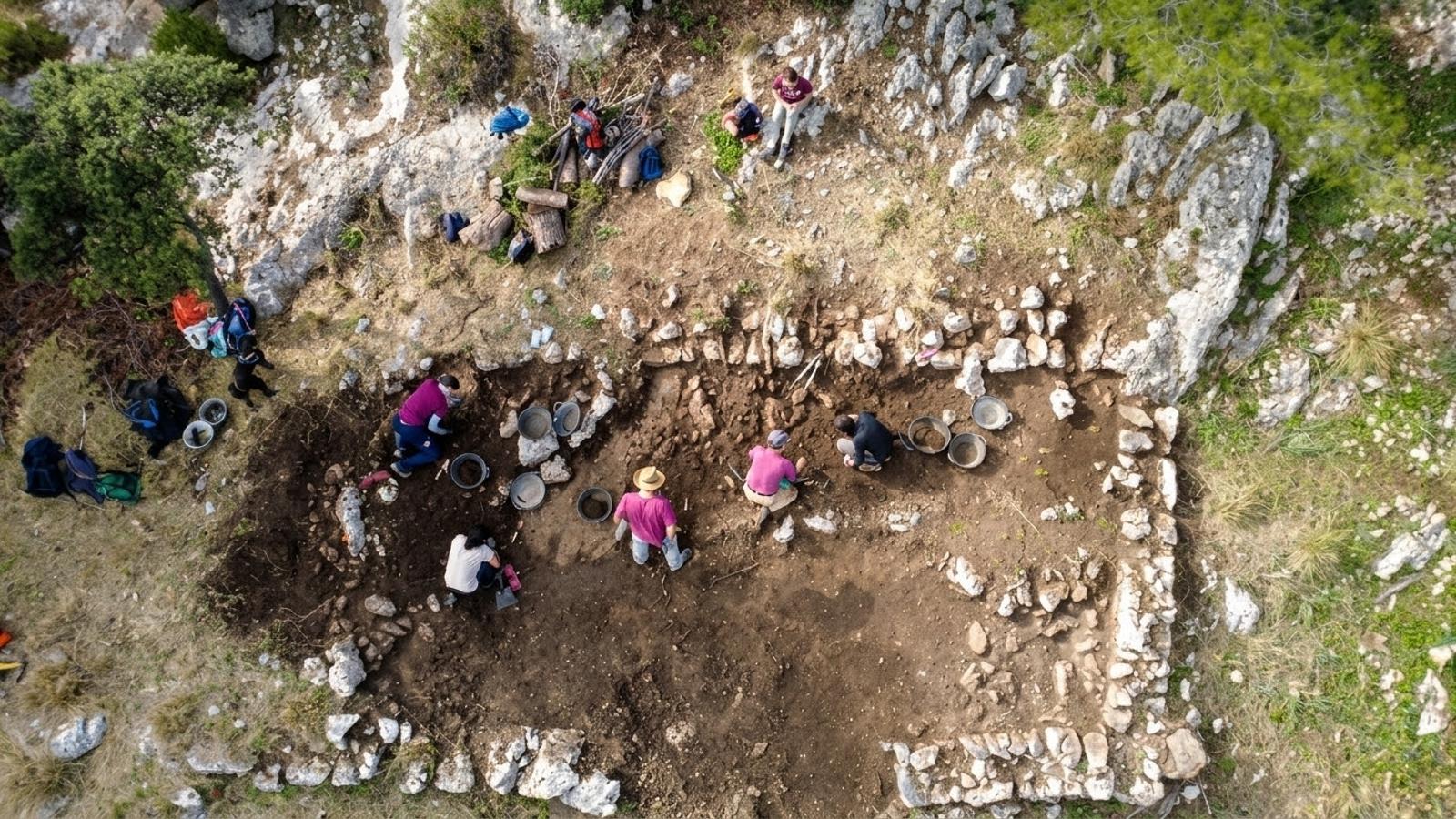
PalmaThe archaeological site of la Bastida, in Alaró, is once again the subject of investigation. This week, the fourth excavation campaign began, which will last until November 27th and which this year focuses on the highest part of the "mola" (mesa), where there is a group of dwellings linked to the wall system of the ancient late-Roman fortification.
The team of archaeologists, led by Biel Llodrà, has focused on a house that, due to its characteristics, seems to differ from the rest of the settlement's buildings. The goal is to deepen the understanding of the daily life of the inhabitants of la Bastida and obtain new clues about the social organization and possible power structures of this community. Until now, archaeological interventions had mainly concentrated on the area closest to the walls and water tanks. Previous campaigns have allowed for the recovery of numerous ceramic and animal remains, as well as the discovery of an aqueduct that carried water from a spring located near the buildings.
The expansion of the excavations towards the housing area will allow for the study of how this settlement was organized and what differences existed between the buildings. The campaign is promoted by the Alaró City Council, with the support of the Heritage Department of the Council of Mallorca and the collaboration of the Al Rum Association. The mayor of Alaró, Llorenç Perelló, has highlighted the municipal will to continue investigating and preserving the site. "The City Council maintains a determined policy of investigation and preservation of this site and everything that has to do with the heritage of Alaró," he affirmed. Perelló also noted that the purchase of the sa Bastida estate by the Balearic Government must represent a boost for investigations and facilitate public access to its landscape, ethnological, and water values, thanks to the development of a usage plan.
A key enclave of the dark ages of Mallorca
The La Bastida archaeological site has been known for centuries, but for a long time it was mistakenly interpreted as a defensive construction dating back to after the conquest by James I. According to this hypothesis, it would have been a provisional refuge for the inhabitants of Alaró in the event that an attack prevented them from reaching the Castell crag. This interpretation was revised decades ago, after Roman-era materials, such as tegulae and coins, were located on the surface. The findings allowed the chronology of the settlement to be placed between the 4th and 8th centuries, a period in which Mallorca was part of the Byzantine Empire, with its capital in Constantinople.
Archaeologist Guillem Rosselló Bordoy defined this stage as the "dark centuries of Mallorca," due to the scarcity of written documentation and archaeological records. For this reason, the excavations at La Bastida have special relevance: they can provide information about a still little-known stage in the history of the island. The work also includes the participation of volunteers, who support the professionals in tasks such as the removal of earth, the recovery of archaeological materials, and the cleaning and reconstruction of the pieces found.
