"The feminist teachers of the Islands should not be so tired"
The Dièresi cooperative defends that coeducation cannot continue depending on the voluntarism of a few teachers and demands time, resources, and meeting spaces to transform schools.

-
CAT -
CAST -
GER
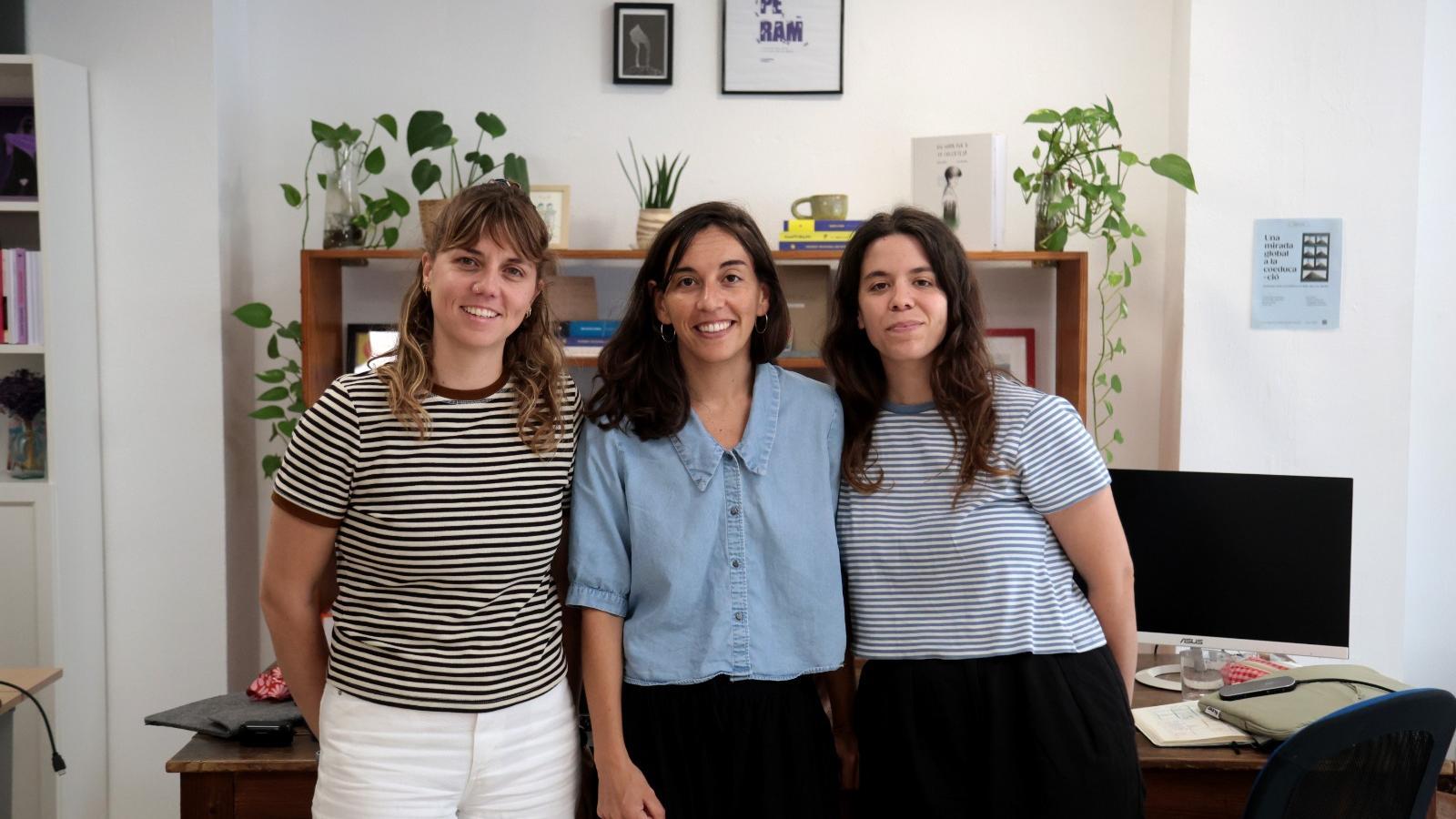
PalmaPsychologist Carmen Tovar and teachers Carme Rosselló and Aina Quintana are at the head of the cooperative Dièresi. All three are part of this critical and feminist thinking project born a few years ago with the aim of promoting social transformations, especially in the educational field. "Our goal is to open cracks to build ways of educating and living more justly," they point out, "from a commitment to childhood and feminism".
Their day-to-day involves accompanying educational centers, training teachers and families, and helping to incorporate coeducation into school projects. But, after years of work, they detect a recurring problem: the lack of time, resources, and training for this vision to be consolidated. "We would like the need for coeducation not to depend solely on the good faith of some, and for feminist 'teachers' not to be so tired," they point out. For the cooperative's members, it is complicated to achieve quality coeducation "if teachers are always up against it, with high ratios and no time to coordinate".
"The school is not a neutral space"
In this regard, they point out that incorporating a feminist perspective does not consist of adding another topic to the curriculum, but rather of rethinking the way of teaching. "School is not a neutral space: even if we don't realize it, it can reproduce the inequalities that exist in society if it doesn't actively question them," they explain.
According to the members, feminisms make visible aspects that are often perceived as natural, such as gender roles, different expectations for boys and girls, and the distribution of spaces. "It's not about adding another topic, but about rethinking how we teach and what we transmit."
Because, they assure, differences in socialization still exist. "We still expect different things based on gender: that girls be caring, empathetic, and quiet, and that boys be active, brave, and competitive." Patterns that are transmitted through games, praise, or even the way playgrounds are distributed.
Supported by volunteerism
Although they remember that coeducation is a legal mandate, Dièresi considers that it still reaches classrooms with many difficulties. "Many conscious and committed 'teachers' complain that it is difficult to mainstream the gender perspective if not everyone rows in the same direction," they explain. This means that feminism is often reduced to specific activities, linked to commemorations or concrete workshops. "Coeducation relies on the voluntarism of a few, and this is not sustainable," they lament.
Educators also detect a gap between discourses and daily practices. "Students have learned a discourse, but in practice almost nothing has changed." They give the example of classrooms where everyone states that boys and girls can be friends, but then, during playtime, they continue to separate and play differently. One of the main resistances they encounter is the feeling that nothing will change. "Despair is what burns out many teachers who coeducate out of pure conviction, putting in their own hours, until they end up alone and exhausted."
Despite this, they try to shy away from the 'all or nothing' idea. "A coeducation commission will not end the patriarchy, but it can make children breathe more calmly today," they emphasize. They also consider that ideas such as feminism being a matter "already overcome" or that coeducating is a form of indoctrination still persist. "It is precisely the opposite: indoctrination gives closed answers; coeducation should provide tools for critical thinking."
Reactionary discourses, through screens
Experts also observe with concern the rise of anti-feminist discourses among young people, especially among boys. "The masclosphere offers misogynistic and reactionary discourses presented as rebellious and groundbreaking, and many young people see it as attractive," they explain.
Despite everything, they recall that behind these narratives there are real discontents linked to precariousness, uncertainty, and loneliness. "We prefer not to fall into discourses like 'we are going backwards' or 'we have never been so advanced.'" "We find it more honest to understand what is behind the numbers." In this sense, they refuse to blame young people and advocate for the need to create other spaces for relationships and critical thinking.
Otherwise, the teachers from Dièresi also consider that families play a key role, but they should be encouraged from a space of trust and not from prejudice. "The way out is not to label them as enemies, but to make them accomplices." They recall that many adults have also been socialized within a binary logic and that they often receive messages that present co-education as a threat. "With families, we have a common goal: the well-being and learning of the children."
Thinking collectively
When asked what they would like to see in schools in the Balearic Islands in a few years, the answer is clear: more spaces for collective reflection. "We would like there to be more meeting spaces between teachers: real time, recognized and within the schedule to think about pedagogical practice." Because, they insist, coeducation cannot continue to depend solely on individual effort. "If precariousness tightens, these spaces will never materialize," they acknowledge.
