The housing encampment, on the general policy debate: "They live oblivious to the problems and demands of the people"
The movement, which enters the fourth week of protest in Palma with between 40 and 50 tents, wants to extend the mobilization to the neighborhoods and proposes expanding the strike to rents and consumption

-
CAT -
CAST -
DE
PalmaThe encampment for the right to housing in Palma denounced this Wednesday, coinciding with the second day of the general policy debate in Parliament, the distance between institutional discussions and the real needs of the citizenry. "We see a great difference between the political debate that the institutions are having and the needs and concerns of the people on the street," stated Miquel Marc Pou, one of the spokespersons for the social movement, who accuses political leaders of prioritizing the interests of property owners and the real estate sector over the demands of the population that needs to access affordable housing.
The spokesperson has demanded that the President of the Government, Marga Prohens, focus her proposals on the needs of the population and stop listening, as he denounced, to business and real estate interests. "We ask her to start listening to the population and stop listening to the business interests, to the real estate agencies and to the classes that seek to make workers precarious," he stated.
The movement considers that access to housing has become a luxury and warns of the increase in situations of residential exclusion and evictions. Therefore, it demands that housing stop being treated as a market commodity subject to speculation and be guaranteed as an effective and enforceable right. Regarding the response of political parties to their demands, Pou insisted that the goal of the encampment is to promote an autonomous popular mobilization, without leaving the capacity to decide the course of public policies in the hands of the institutions. "We want the population to be the ones to take back the course of politics," he claimed.
Assemblies to gather support in the neighborhoods
In light of this situation, the collective has begun a series of neighborhood assemblies throughout the districts of Palma with the aim of gathering support, strengthening popular organization, and paving the way for a general strike. The initiative seeks to move the debate on housing outside of the institutions and involve more and more people in the mobilization. "We want more and more people to become politicized and see that the answer lies in the collective," argued Pou, who advocates for a mobilization with broad popular participation and proposes that it could extend to a rent strike and protest actions linked to consumption.

The neighborhood assembly tour began on Tuesday with a meeting in which about 25 people participated, four of whom were part of the encampment. The calendar plans to travel through different neighborhoods and districts of Palma to make the demands known and add people to the organization. This Wednesday, at 6 p.m., a new assembly is scheduled at the Plaça de Morell. The proposal is to continue the meetings through the neighborhoods until ending the route at the Plaça d'Espanya.

“We want to keep gaining strength to have a strong group to move towards a general strike,” explained Pou. The movement trusts that the people who participate in the assemblies will be able to convey the demands to their neighbors and contribute to expanding the support network. The goal, the spokesperson insisted, is for citizens to regain prominence in political debate and organize themselves to confront policies that, according to the collective, worsen precariousness and increasingly hinder access to decent housing.
Between 40 and 50 tents in Plaça d'Espanya
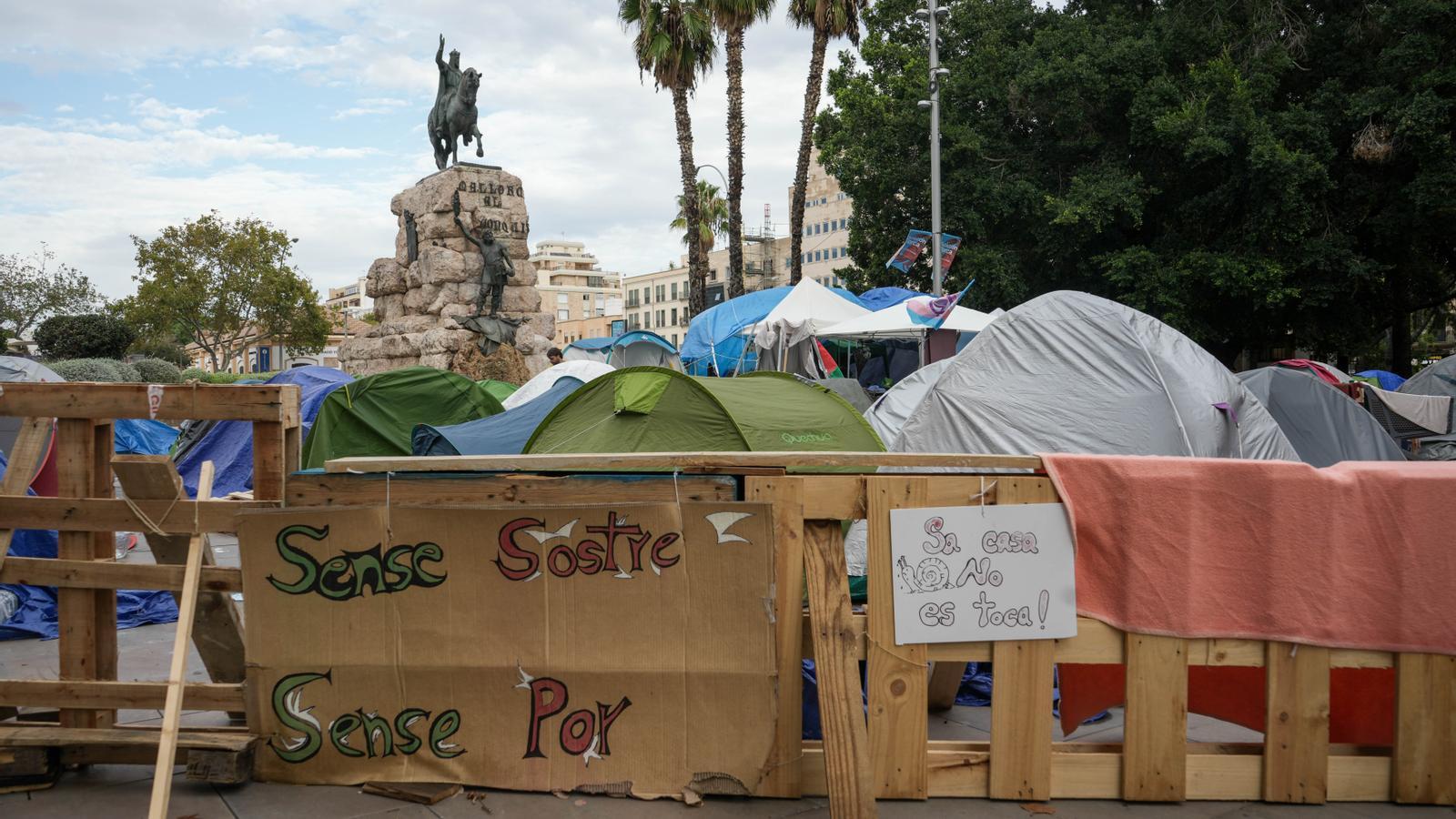
The encampment enters its fourth week of protest with between 40 and 50 tents set up in Plaça d'Espanya. After three weeks of continuous mobilization, the participants are trying to reorganize themselves to maintain their presence at the camp and, at the same time, reinforce work in the neighborhoods and the preparation of new actions.
“We are recharging our energy a little bit,” explained Pou, who pointed out that the campers are taking turns so they can balance the protest with work, family responsibilities, and personal life. The movement wants to maintain the encampment, at the very least, until a general strike is called and, later on, assess whether to extend it until the next elections. The intention is for the protest not to be limited to resistance at the camp, but to become a process of neighborhood organization with the capacity to expand the mobilization to other areas. In this sense, the collective is proposing a general strike with broad participation that could lead to new forms of pressure, such as an indefinite strike or a rent strike.
