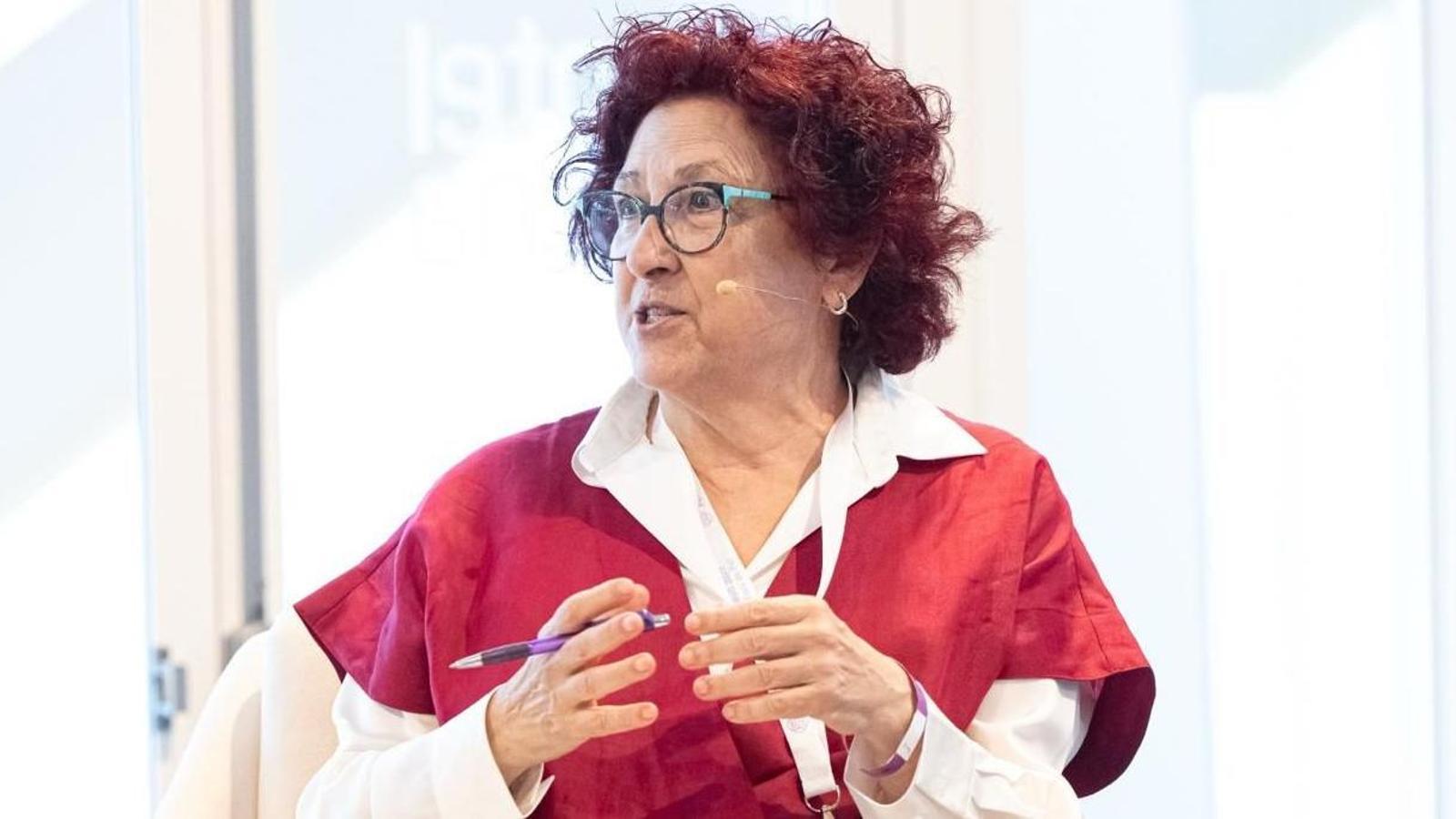
Tica Font: "War is manufactured"
President of the Delàs Center for Peace Studies

-
CAT -
CAST -
DE
PalmTica Font (Vall d’Uixó, 1956) is the president and researcher at the Delàs Centre for Peace Studies. A graduate in Physics from the University of València, she has been the director of the Catalan International Institute for Peace and president of the Catalan Federation of NGOs for Peace. She is an expert in defense economics, arms trade, defense budgets, and the military industry. Font is one of the expert voices at the II Peace Conference organized by the Mallorca per la Pau platform and makes it clear that wars are a pretext for doing business.
In a time of global rearmament, talking about peace seems to go against the current. Is it more difficult to defend it today than a few years ago?
— It's complicated, but it has to be tried. Since Putin invaded Ukraine, Russia has been considered Europe's enemy and the European Union needs a rearmament plan. The question we have to ask ourselves is whether Russia is really a threat. If you compare military spending between the EU and Russia, the 27 spend three times more than Russia. Furthermore, if Putin has been in Ukraine for four years and has not yet won militarily, how are we so sure that he will come to Europe? And the EU still wants to spend 800 billion euros on a rearmament plan between 2024 and 2029. An enemy is needed to justify the annual increase in spending by defense ministries.
But the European Union presents itself as a guarantor of peace.
— The approaches are softer than those of Donald Trump, who conceives negotiations in an intimidating, coercive manner and with threats of the use of force. But the theory of deterrence remains valid beyond Trump. It is a psychological game. Between Europe and Putin there is a spiral, a more continuous threat: one shows that he has powerful weaponry and the other makes it seem that he has a superior weapon. This is where Europe finds itself, despite being more careful with its approaches.
When the USSR fell, some thought it was a good time to improve Europe's relations with Russia.
— Those who have never wanted a good relationship between Europe and Russia are the United States. But Russia is our neighbor, with thousands of kilometers of common border. A minimal relationship is needed, so as not to feel threatened, a neighborly relationship that is not aggressive. We should not interfere in each other's affairs, neither we, nor Putin. Mutual respect is needed.
What role do the media play in the normalization of military spending?
— The policy around the media requires creating an enemy, because, if you don't have one, the measures you must apply will not have the support of the population. You must have a propaganda system so that the population considers rearmament to be justified. Then the economy must be put into war mode: state priorities must be diverted to the defense industry to develop new weapons and increase the production and acquisition of armaments. Wars are manufactured and it takes years to manufacture them. But when you set this process in motion, war ends up being inevitable. Now there are European ministers and generals announcing that, in 2030, Russia will invade Europe. But if we have four years to prepare for war, this means that we also have four years to prevent it.
Argue that the rearmament proposed by the EU is not even efficient from a pragmatic and economic point of view.
— The agreement is that, apart from the defense budget of each of the 27, another 800 billion will be spent, but it doesn't mention what they will be spent on or how. In this way, each of the 27 armies must prepare alone for war against Russia. It's a brutal waste of resources. Wouldn't a single [common] army be much cheaper than 27? Another inefficiency is that each state maintains the same industries to produce armaments, while a single market for production and consumption would reduce costs. Mario Draghi's report [on the future of European competitiveness] indicates that 80% of the armaments Europe buys are from abroad: 70% from the United States and the other 10% from South Korea and Israel, basically. Only 20% remains in Europe. In this way, European industry will not be able to meet the orders that will be placed with the 800 billion that are planned to be spent. The industrial growth timeline that should have existed is not viable. So 70% of this money will go to the US. But the rulers insist on saying that the rearmament plan will generate wealth in Europe: what wealth? Because it won't stay here. Then there's the issue of prices, because you can't compete with countries like Korea or China. If we look at third-generation tanks, the German Leopard costs 28 million euros, while the American Abrams costs 17, the Russian costs 4 million, and the Chinese costs 2 million. Who does Germany think it will sell these tanks to?
What does the increase in military spending imply for citizens?
— The money for military spending comes from states' debt and budget readjustments, which we call cuts. The NATO Secretary General, Mark Rutte, has said that citizens must accept sacrifices. We are talking about pensions, healthcare, education, and social benefits. He says we must accept impoverishment, a decrease in life expectancy, and that everyone should fend for themselves when facing problems like disability, because states must prioritize defense spending. Rutte also points out that the European population, which represents 10% of the world's population, spends 50% of social benefit spending, so there is room for us to become poorer. Are we willing? The question citizens should ask themselves should not only be about rearmament, but they must ask themselves if they want pension, education, and healthcare resources to go to defense.
A characteristic of military spending is the opacity that surrounds it.
— Yes. Arms exports are subject to the Official Secrets Act. Purchases made by the Ministry of Defence should be on the public procurement platform, but a decree has been made so that Defence contracts with Israel are not public. Control is becoming increasingly difficult, even for Congress.
What do you think of the image Pedro Sánchez projects as a defender of peace and international law?
— One problem with this president is that he demobilizes, because he already says what many people think. But between what he says and what he does, there is a margin. He is less militaristic, but one thing is will and another is the ability to do things. For example, with the extended budgets, he cannot restructure them. The Defense budget since 2023 is 14 billion euros, but by the end of the 2025 fiscal year, it had spent 33 billion through credit modifications. The EU's commitment is to reach 3.5% of GDP in defense by 2035: this would imply reaching 80 billion euros annually in Spain. If the 5% commitment with NATO were met, spending should be 114 billion. So, either parts of large ministries are touched or it won't be reached. We will see what happens the next time a budget can be prepared.
The massacre in Palestine does not stop. Are we facing a structural failure of the international community?
— Yes. Humanity will be ashamed of what has happened and of the silence that has occurred, especially in Europe.
Are we entering a new, more unstable global phase with the escalation in Iran and Lebanon?
— It is hypothetical terrain. Trump had no clear idea when he decided to attack. He has followed in the footsteps of Netanyahu, who had a clear idea of what he wanted and has not achieved it. He wants an Iran like Lebanon, with an army incapable of doing anything (in Lebanon, it only responds to Hezbollah). On the other hand, Trump wanted to reach agreements like he did with Venezuela, with a regime change and control of Iranian oil. Along with Venezuela, Iran holds the key to Chinese oil. It should be remembered that China has a monopoly on rare earths, so the U.S. needs to have the oil tap. However, the situation in Hormuz has put Iran in a more advantageous position, as it can easily close the strait. We must also consider that Obama and the EU reached an agreement with Iran in 2015 to limit the development of nuclear weapons and conduct inspections. It was Trump who broke it in 2017.
