"We wanted to recover the enthusiasm to fight for the language and we have achieved it"
The promoters of Correllengua Agermanat highlight the strengthening of networks between territories and the recovery of collective enthusiasm to move towards the normalization of Catalan

-
CAT -
CAST -
GER
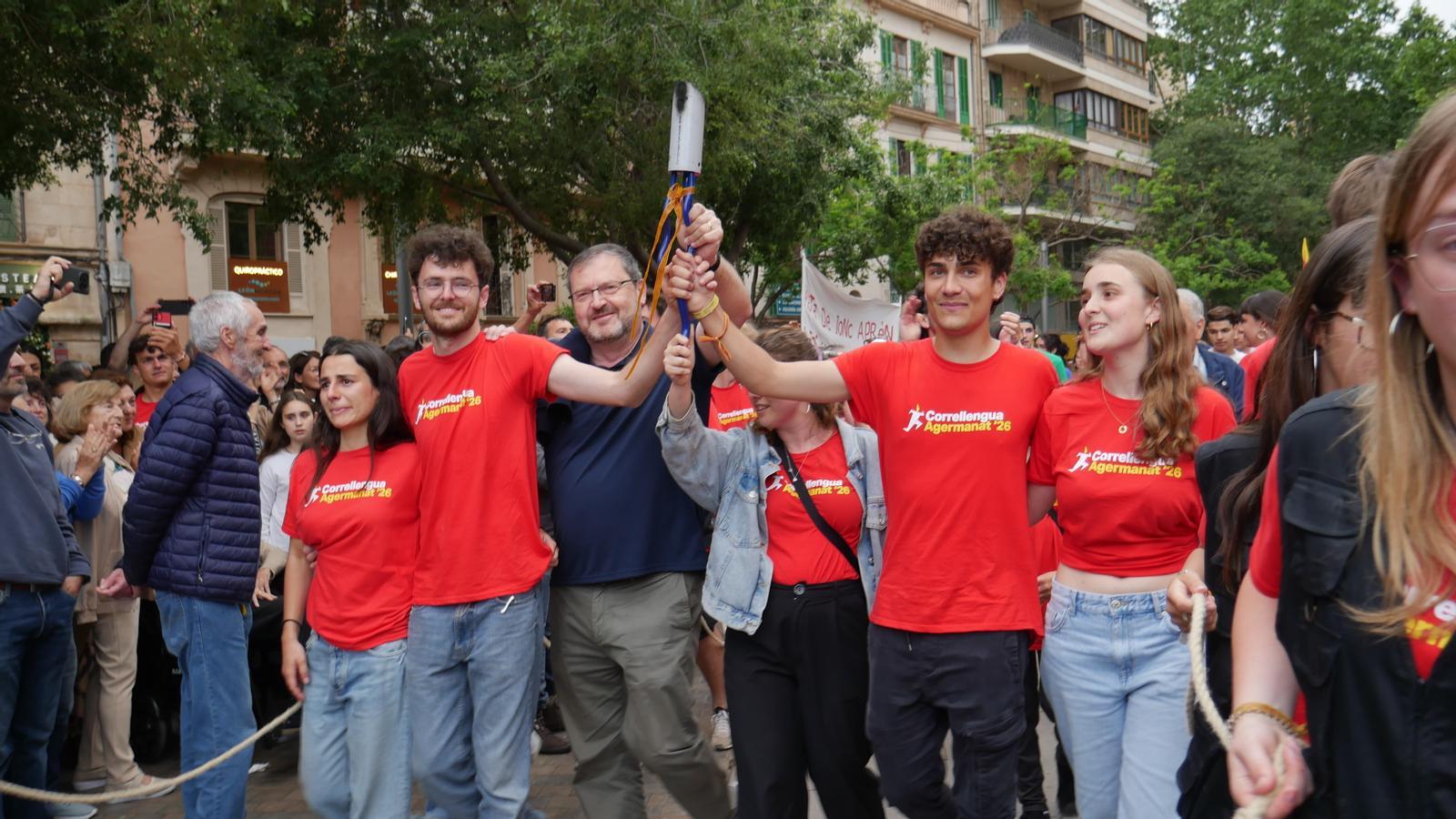
PalmaThe Agermanat Correllengua that took place this spring has left a mark that many will not forget. For two weeks, the Flame of the Language crossed the Catalan-speaking territories in an unprecedented mobilization that brought together more than 180,000 people, covered 1,500 kilometers, passed through 500 municipalities, and had 30,000 flame bearers. The success and triumph of this young, positive, and pioneering initiative, as valued by the jury, has made it worthy of the Guillem Frontera ARA Balears Award for Commitment to the Catalan Language 2026. At the award ceremony, the very long and intense applause received by the two organizers, Pau Emili Muñoz and Josep Buades, was a demonstration of popular recognition.
The project, driven by Joves de Mallorca per la Llengua with the collaboration of other youth and cultural entities, has become a show of strength for the movement in defense of Catalan and has contributed to strengthening the bonds between the different territories of the linguistic community, the jury of the award wanted to emphasize.
For Josep Buades, coordinator of Joves de Mallorca per la Llengua, the balance is clearly positive. "As a society, the Catalan-speaking territories have regained the enthusiasm to fight for the Catalan language and demand its real normalization," he states. The initiative started on April 19 in Prada de Conflent, in front of Pompeu Fabra's tomb, and ended on May 5 in Alghero, coinciding with the feast of Sant Joan de la Porta Llatina. Between these two points, the Flame traveled through Catalonia, the Valencian Country, the Balearic Islands, Northern Catalonia, and Alghero, becoming a symbol of linguistic and cultural cohesion.

The idea of creating a Correllengua that united all territories arose after the success of the Interinsular Correllengua in 2024. "When we finished it, we asked ourselves what the next step should be. We thought it was time to create a Correllengua for all the Catalan Countries," explains Buades. Although the project was born with great ambition, he now acknowledges that the public response exceeded initial expectations. "There have been moments when it surpassed what we imagined. I believe this shows the commitment that exists throughout the Catalan Countries to their own language and culture".
Weaving networks between territories
Beyond the figures, one of the great contributions of Correllengua Agermanat has been its ability to strengthen the awareness of a shared linguistic community. According to Buades, the initiative has contributed to building a broader collective imaginary and establishing new connections between activists and entities from different territories. "We now have friendships and working networks in the Valencian Country, in Catalonia and in Northern Catalonia that we didn't have before. This part is not always seen, but it is also a way of building the Catalan Countries".
In relation to youth participation, sources from the entity point out that it has been one of the keys to success. Far from responding to a specific strategy, Buades assures that the involvement arose naturally. "It is an initiative made by young people, conceived from a young perspective and communicated in a young key. We haven't had to make any extraordinary effort to reach them," he admits. What he does highlight is the ability to bring together diverse sensitivities. "Practically all the important youth organizations in the country have participated in Correllengua Agermanat, and that is extraordinary," he pointed out.
If there is one objective that the promoters consider particularly relevant, it is to strengthen the linguistic self-esteem of Catalan speakers. Buades defends that the normalization of Catalan does not depend solely on public policies, but also on daily use. "The language needs the commitment of institutions, but also the daily commitment of each one of us," he points out. In this sense, he considers that Correllengua has helped to create a social majority favorable to linguistic normalization. "We have laid a very solid foundation to move towards a situation where living fully in Catalan is perceived as natural".
Looking towards the future
For Buades and the rest of the organizers, the memories of the journey are numerous. The coordinator particularly highlights the response received in territories where the social presence of Catalan is more fragile. The arrival in Elx, the crossing of Vinaròs, and the events held in Northern Catalonia and Alghero are among the moments he recalls with the most emotion. There was also space for anecdotes, such as the day a giant ran nearly a kilometer under intense heat and the celebrations with fireworks in the Valencian Community. "Unexpected moments are what also give life to the project," he comments.
Now, Joves is studying the possibility of reviving the Congress of Catalan Culture, which began in 1975 and only ran until 1977. This is one of the projects that has been attempted to revive the most times, so far without success, but the great success of Correllengua Agermanat 2026 opens the doors to reviving it.
After the success achieved and the recognition received with the ARA Balears Guillem Frontera Award for Commitment to Catalan, the future of Correllengua Agermanat is still being defined. A few weeks ago, volunteers met to take stock and begin discussing the next steps. For the moment, however, no decision has been made. "There will probably be a new edition, but we still have to decide how we want to do it and when. It's a debate that has just begun," explains Buades. Whatever format it adopts in the future, Correllengua Agermanat has already achieved one of its main goals: to demonstrate that the defense of the language continues to be capable of mobilizing thousands of people throughout the Catalan-speaking territories.
