Diversifying is possible, according to the few who dare to leave the tourist monoculture
We speak with entrepreneurs who struggle against the current while the dependence on the service sector does not stop increasing (87.3%). The lack of housing and industrial land, the main problems

-
CAT -
CAST -
DE
PalmaAlbert Solaz had been working as a chef for 15 years when he arrived in Menorca. A large part of his career had revolved around vegetarian, healthy, and sustainable food: he ran workshops, worked with local produce, and looked for different ways of understanding cuisine. On the island, however, there was an ingredient that particularly surprised him: xeixa wheat.
He was very impressed by this cereal, “because it is an authentic, unmodified product; it is genuine, which makes it very healthy,” he states. “I decided it was an opportunity to look for a product that I could transform and give commercial viability to,” he explains.

From that idea, Solaz Holistic Foods was born. Its first product is Solaz Bites, snacks made with Menorcan xeixa wheat and other ingredients from the island. Two varieties have been released: carob and salt flower – with salt from the Fornells salt pans – and Menorcan lemon and chamomile. The products are made through slow dehydration and without artificial preservatives, and they were launched on the market this spring. They can be found at markets where Solaz participates and in various local stores. This year, the project has also received one of the Leader Menorca Emprèn Rural awards.
But Solaz is already thinking about the next step. “I'm looking for new formulas and also new products. And this is a bit of a novelty: I'm working on some plant-based milk,” he advances. The idea he defends is almost as important as the product. “It's up to us young people to innovate, to look for new ways to present local products and take advantage of the fact that we have visitors, but also a growing mass of conscious citizens who want to eat well”.
Take wheat grown in Menorca, process it on the island, and manage to sell it with more value. Said like that, Solaz's project seems small. Looked at in the context of the Balearic economy, it's almost swimming against the tide. But the experience also contains a message: “If we are capable of incorporating added value to the products of the field, there is a very wide range of possibilities,” says Solaz. In fact, agro-industry is where there are most counter-current initiatives, but the majority are small-scale.
More and more services
In the Balearic Islands, there has been much talk of economic diversification for years, and even more so now that a growing part of the citizenry is exhausted by the impact of tourist saturation. The data, however, show an economy increasingly concentrated in services. According to the series collected by the Economic and Social Council (CES), services accounted for 85% of the gross value added (GVA) of the Islands in 2014. Five years later, just before the pandemic, they already represented 85.8%. In 2024, they reached a new high: 87.3% of the entire Balearic economy.

Industry and energy have gone in the opposite direction. If in 2014 they represented 7.6% of GVA, by 2019 they had already fallen to 6.4% and in 2024 they only accounted for 5.5%. Meanwhile, the weight of agriculture has remained practically testimonial: 0.42% in the last year of the series.
Not even the pandemic altered the long-term trend, despite the statements from the public and private sectors about the need not to put all our eggs in one basket. Five years after COVID, the Balearic economy is even more service-based than before the pandemic. And it is within this reality that small businesses are trying to do just the opposite: manufacture, transform, and create technology from the Islands.
From repairing ships to printing them
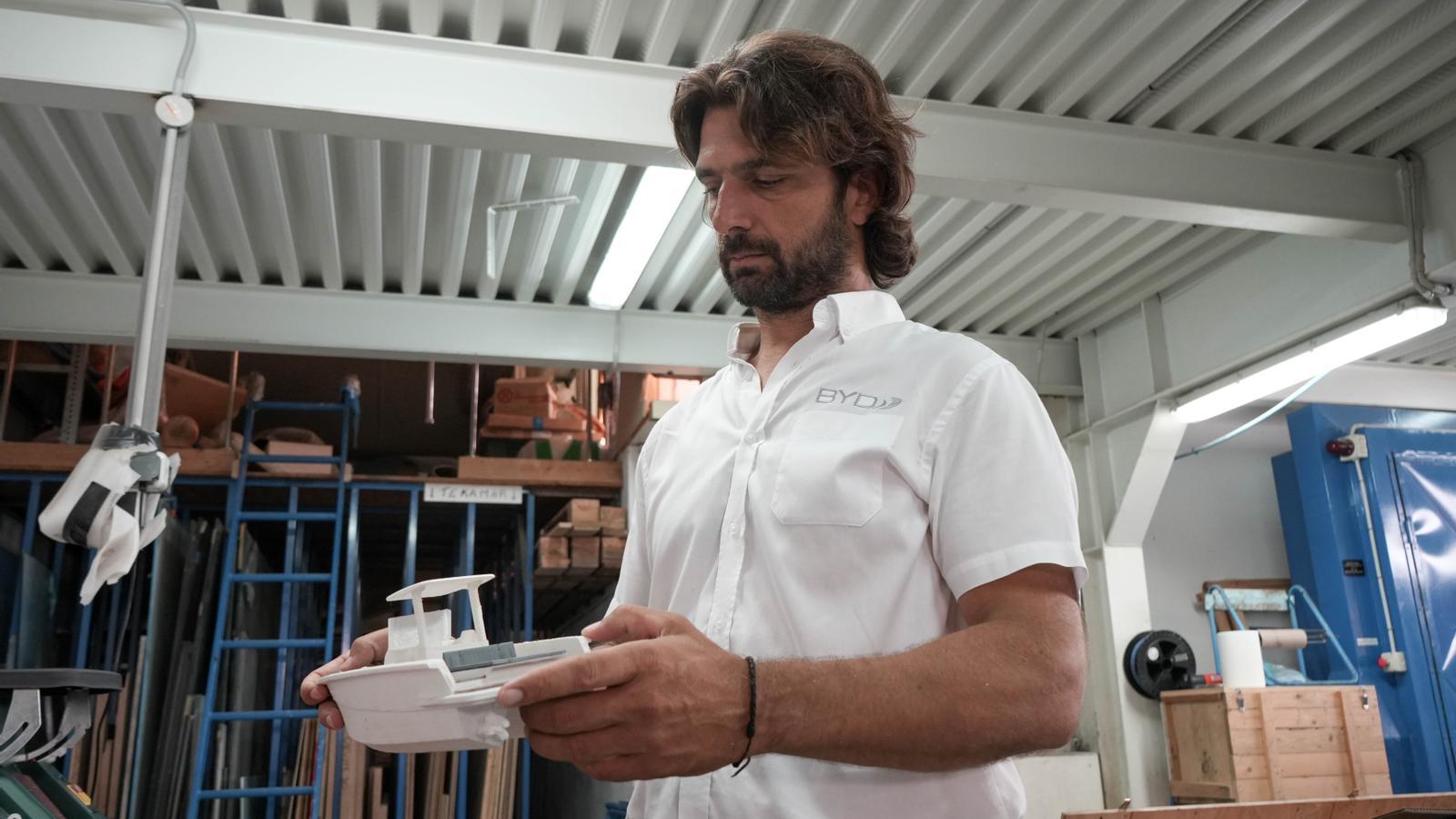
Reality is stubborn, but so are entrepreneurs. Tià Simó is trying it with a completely different industry. A naval engineer, Simó is co-founder of BYD Group, a company dedicated to naval design, engineering, and architecture, and also of V2 Group. “In the nautical world, repairs work very well right now, but we wanted to go further and we are betting on design and industrial solutions. We are very satisfied with it,” he explains.
V2 Group has developed with the Italian company Caracol a functional six-meter catamaran manufactured using large-format robotic 3D printing. The vessel has been printed as a monolithic structure and the project aims to verify if this technology can be industrialized and scaled for application in shipbuilding. “We have driven the entire process from Palma, but we did the final printing with a partner in Italy. Here, depending on the investments and machinery operations, it's not straightforward, because operationally we need to secure spaces that are expensive, and professionals who cannot always come to the Islands,” laments Simó, who personally suffers from housing costs. “We cannot compete if we want to bring engineers and specialists, because we have to pay professionals much more due to the price of apartments”.
But they don't stop, and once a first large-format 3D impression is made, they are already exploring how far this way of producing can be taken. The main obstacles that Simó identifies for industrial production in Mallorca have little to do with a lack of talent or ideas. “We face two big problems: a lack of professionals and a lack of industrial land at a reasonable price,” he assures. And then there's the money. “We have had to seek conventional financing in addition to our own resources, because when we approach investors, it is very difficult to convince them. In the Islands, investors look for high returns and there is no tradition of industrial innovation. Unfortunately, capital goes more towards the real estate market.”

It is one of the paradoxes of diversification. To manufacture a part or a boat, it is not enough to have a good idea and a market. You need a building to house the machines, technicians who can operate them, and capital willing to wait for an industrial investment to mature. “Nothing that hasn’t been done in many other places. Here, however, we must add the costs of insularity,” warns Simó.
At Son Jover (Inca), the family farm managed by brothers Antoni and Margalida Seguí, they have made transformation a way to keep farming viable. It is what some experts consider “adding value to a sector that needs it, like agriculture,” explains Toni. At Son Jover, organic goat and sheep cheeses are made with milk from the farm itself, and they have managed to position the product in a quality segment: direct sales to some local stores. About 40% of the production is sold through a distributor to the restaurant channel. “We have a small structure and a lot of pressure, because you can’t let up for a second,” he warns. Their case summarizes another way to diversify: it is not just about making new products, or more elaborate ones, but also about being able to specialize and focus on quality. “The restaurants that serve our cheese let us know their satisfaction with the product’s level, and that makes us proud,” points out Seguí. Furthermore, many restaurateurs “understand that quality does not allow for intensive production.” “Our production varies throughout the year, and little by little they can explain it to the customer. If a restaurant tells you that one week they can’t offer a product from their menu because there is a little less of it, that’s a good sign, it means that what they have is fresh, high quality, and local,” he concludes.
A problem that goes back a long way
These heroes are forced to be very creative, constant, and even stubborn, because leaving the tourist logic on the Islands is not simple. The institutions know the problem. The H2030 prospective study, promoted by CES and UIB, placed diversification among the future challenges of the Balearic Islands and linked this transformation with more knowledge, innovation, and productive activity. The starting point was weak in research and innovation. The data used at the time placed Balearic investment in R+D+I at only 0.32% of GDP, compared to 1.19% for Spain as a whole and 2.03% for the European Union.
Agri-food, the blue economy, technology, and the modernization of industry have for years been part of the areas identified as possible ways to expand an economy excessively concentrated in services. The results are still too scarce and the fruit of individual initiatives.

The Government's main commitment to combatting the tourist monoculture is the Plan for Attracting and Retaining Companies and Talent – launched in January – which, according to Government data, mobilizes nearly 68 million euros. The project aims to address some of the problems that innovative companies themselves point out when explaining the difficulties of growing in the Islands: space, housing, talent, and technological infrastructure.One of the most visible actions will be the construction of 120 public rental housing units within ParcBit to accommodate workers from companies in the park, researchers, and teaching staff from the UIB. The Government, Ibavi, and the Bit Foundation have already signed the agreement, and the official forecast is to begin construction during the first half of 2027. The development will feature one and two-bedroom apartments, common areas, and other amenities, and aims to respond to the difficulties in attracting and retaining professionals in Mallorca.The Government also plans to build a future university engineering faculty there and assures that it has recovered plots that will allow for an additional 11,000 square meters of buildable area for companies. The Executive considers that there is an initial indicator that the commitment is beginning to take effect. According to figures provided to ARA Balears, between 2020 and 2023, ParcBit received 34 applications from companies interested in setting up there. Between 2024 and April 2026, it has received 91. In less time, the requests have almost tripled.The same strategy is intended to be extended to the CentreBit in Menorca, where the available space for accommodating companies is planned to be doubled this legislative term, while in Ibiza a new CentreBit has been created that houses seven companies.
