Menorca also relies on desalination to have water
Agrees to reduce its supply and prioritize infrastructures to face the increase in consumption, while ecologists warn that the same model as in Mallorca and Ibiza is being followed and that there is no other solution than to limit tourism
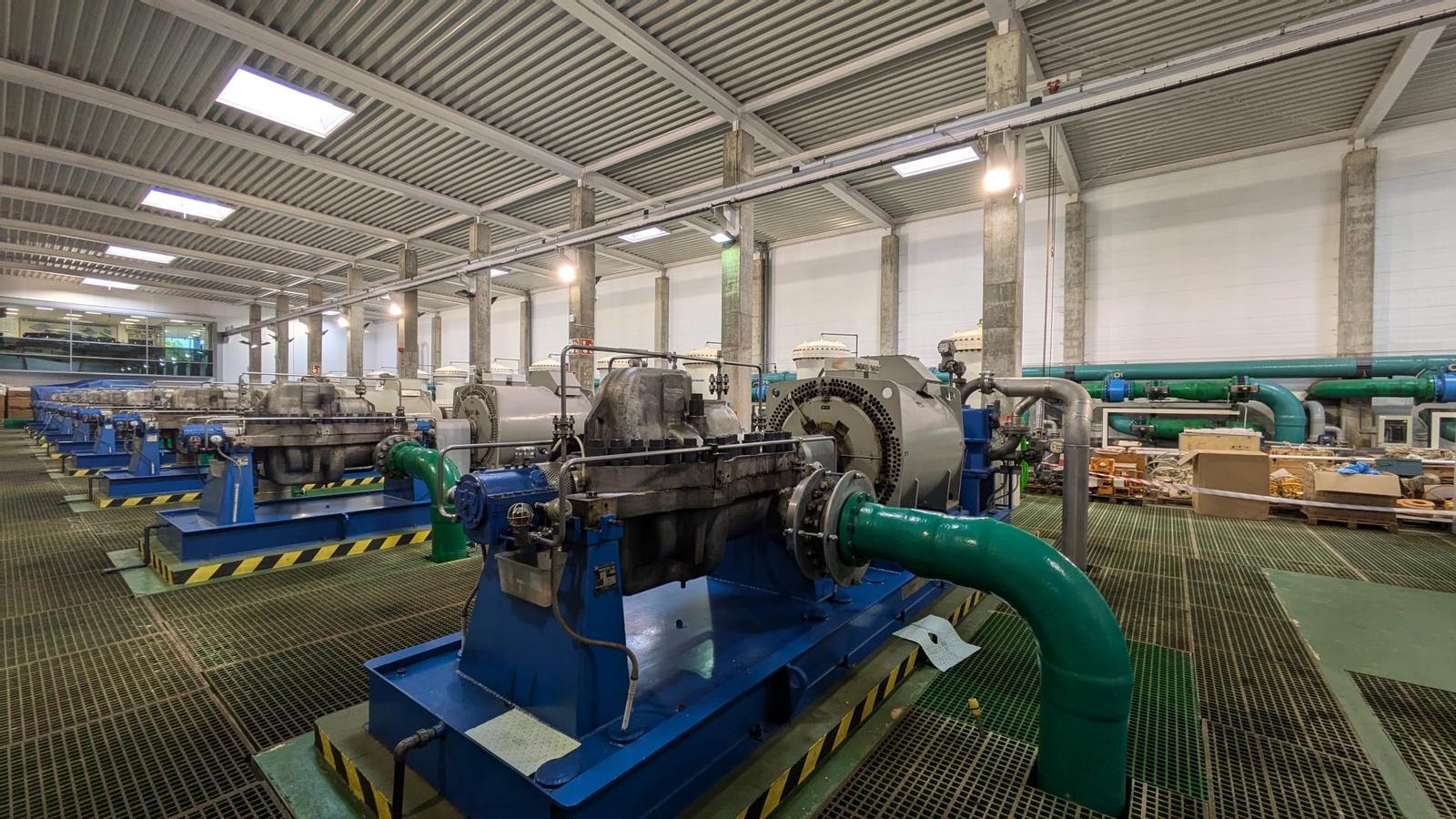

CiutadellaWater reserves have never been so low in Menorca, only at 34% of capacity, and the pre-alert situation is beginning to alarm everyone. The Administration has arrived late to act and has not listened in time to specialists like engineer José Antonio Fayas, who had long warned that in the last decade practically nothing has been done to stop overexploiting aquifers, limit swimming pools, increase the cost of water, and reuse the regenerated water that comes out of treatment plants.
This has forced the political class to suddenly get their act together and force two meetings in just one week to try to harmonize shock measures in all areas. The first and most immediate will be to reduce the water pressure with which the population is supplied and prevent non-essential consumption in public spaces. But the package of actions that the new Comprehensive Water Cycle Monitoring Commission has decided goes further. They want to standardize municipal ordinances to penalize large consumers and are studying the generalization of restrictions such as those already implemented by Maó to also involve the population. In fact, the Council will promote a awareness campaign in the coming weeks to encourage citizens to also help save water.
Smart meters
President Adolfo Vilafranca, who has led these changes from the Council, announces that the installation of smart meters in all municipalities will also be financed to quickly detect overconsumption and possible leaks affecting the supply network. Likewise, investment will be made to reduce the salinity of the water to favor the infiltration of wells and the reuse of regenerated water from treatment plants.
But the most controversial are the medium-term solutions. The Council and the town councils of Menorca are definitively relying on desalination, an option that many governments, especially left-wing ones, have viewed with reluctance until now and have only foreseen as a last resort. Well, this now seems to be the only way.
The Minister of the Sea, Juan Manuel Lafuente, has announced the imminent connection of the Ciutadella desalination plant – the only one on the island so far – to increase its production and the investment of two million euros to install a modular desalination plant next summer in Cala Figuera to temporarily solve the serious water problems in Maó. At the same time, the drafting of the project for the future desalination plant to be built in eastern Menorca has already been awarded.
The Maó Town Council has also been forced to change its plans and opt for desalination more than it had previously considered. For this reason, it has given up building a third denitrification plant and opening new wells to focus on facilitating the start-up of the new modular desalination plant and ensuring its connection to the Turó reservoir. Meanwhile, it maintains the restrictions it has imposed since May. It prohibits companies and establishments from washing cars in the street and individuals from cleaning their boats and watering their gardens. Cruise ships can no longer refill water at the port.
The GOB rejects that the solution is to build more desalination plants. "The promise to solve the problem with desalination plants is a chimera that only serves to follow a path of unlimited urban and tourist growth – it warns. If limits are not previously agreed upon, desalination plants are a passport to a model that is predatory of the territory and economically extractive." This has already happened – it recalls – in Mallorca and Ibiza, "each with several desalination plants," but at the same time "islands more congested than Menorca and with damaged aquifers."
Containing growth
Protectionists predict that, if growth is not urgently contained, "it will be impossible to supply the projected population with water. Trying to solve it with desalination plants is a dead end." And he gives the example of Ciutadella, where the desalination plant "has already become too small" to cope with the planned growth, which has been blocked for years at Water Resources because it is not guaranteed that there will be water for everyone.
Furthermore, the situation has worsened in recent months, since the Government has eliminated the obligation to have a Water Resources report before giving the green light to new urban developments. This measure, says the GOB, "especially threatens Menorca, where most water bodies are overexploited or contaminated." Therefore, it announces, it will appear in all cases where it is intended to benefit from the measure, since the regional provision "clearly contradicts higher" state regulations.
Faced with desalination, the entity believes that the time has come to demand that regulations be complied with and that effective rationalization policies be applied in water use. "Menorca's aquifers are one of the island's invisible treasures. Without the aquifers, the landscape would not be the same, nor would the quality of life be similar to the current one," he states.
The drastic decrease in water reserves in Menorca coincides with a rebound in consumption by the resident and seasonal population. This is evidenced by the latest data from the Socio-Environmental Observatory (Obsam), which quantified in 2025 the largest water distribution figure of the last 20 years, 12,925,193 cubic meters, only surpassed by the 13,145,157 recorded in 2006. In fact, urban consumption is the highest in two decades. Tourists are the biggest water consumers, as, although urbanizations account for only 18% of the population, they concentrate practically 45% of all consumption.
Nevertheless, the Council maintains the forecast of creating 23,800 new tourist places on the island, reaching a ceiling of 107,917 visitors. This is the conclusion of the carrying capacity study commissioned by the island government, a forecast that the GOB considers "nonsense" that would invalidate the tourist moratorium in effect since 2022. "It would lead us to have more than 330,000 people in Menorca during the high season months," warn the environmentalists, triple the resident population.
Ciutadella concentrates 37.5% of Menorca's total water consumption, double that of Maó, but suffers like no other from pressure and overexploitation of resources, despite being the only municipality with a desalination plant. In fact, there is no record that all the measures foreseen in the first year of the Sustainable Water Management Plan have been implemented. This is denounced by the GOB, which recalls that the City Council not only had to approve a new ordinance promoting savings, with measures such as limiting the construction of new swimming pools, but also committed to requiring local businesses and homes to carry out renovations that would implement low-consumption pipes.
The opposition criticizes that the island government of the PP has taken three years to announce effective measures to unify municipal ordinances and penalize overconsumption. The coordinator of Més per Menorca, Esteve Barceló, recalls that in May 2023 the previous left-wing government had already modified the statutes of the Consortium of Waste and Energy, so that it would also harmonize water management with an island vision. A regulation was even drafted, but the current rulers have not picked up the thread until just a month ago.
Barceló asks that “the citizens not be deceived and the reality be assumed”. At the same time, he censures the “contradiction” of the PP, in government. “We cannot ask the Menorcans to make efforts to save water while those in power defend a territorial growth model that ignores the island's environmental limits”.
80.4% of the Balearic territory is in a pre-alert situation for drought. In addition to the case of Menorca, there are also those of Artà, Manacor-Felanitx, Migjorn, Palma-Alcúdia, Tramuntana Nord, and Ibiza. Only in Formentera and the southern sector of Tramuntana is the situation normal.
The Ministry attributes this to the lack of rainfall, 98% below what is usual, and to high temperatures, as this month of June has been the fourth warmest in the Balearic Islands since 1961. Measures are needed, and not only in Menorca.
