Menorca, the island that resists being like the others
The demonstration on June 13th kicks off the summer mobilizations in the Islands in defense of housing and natural resources, and to confront tourist massification
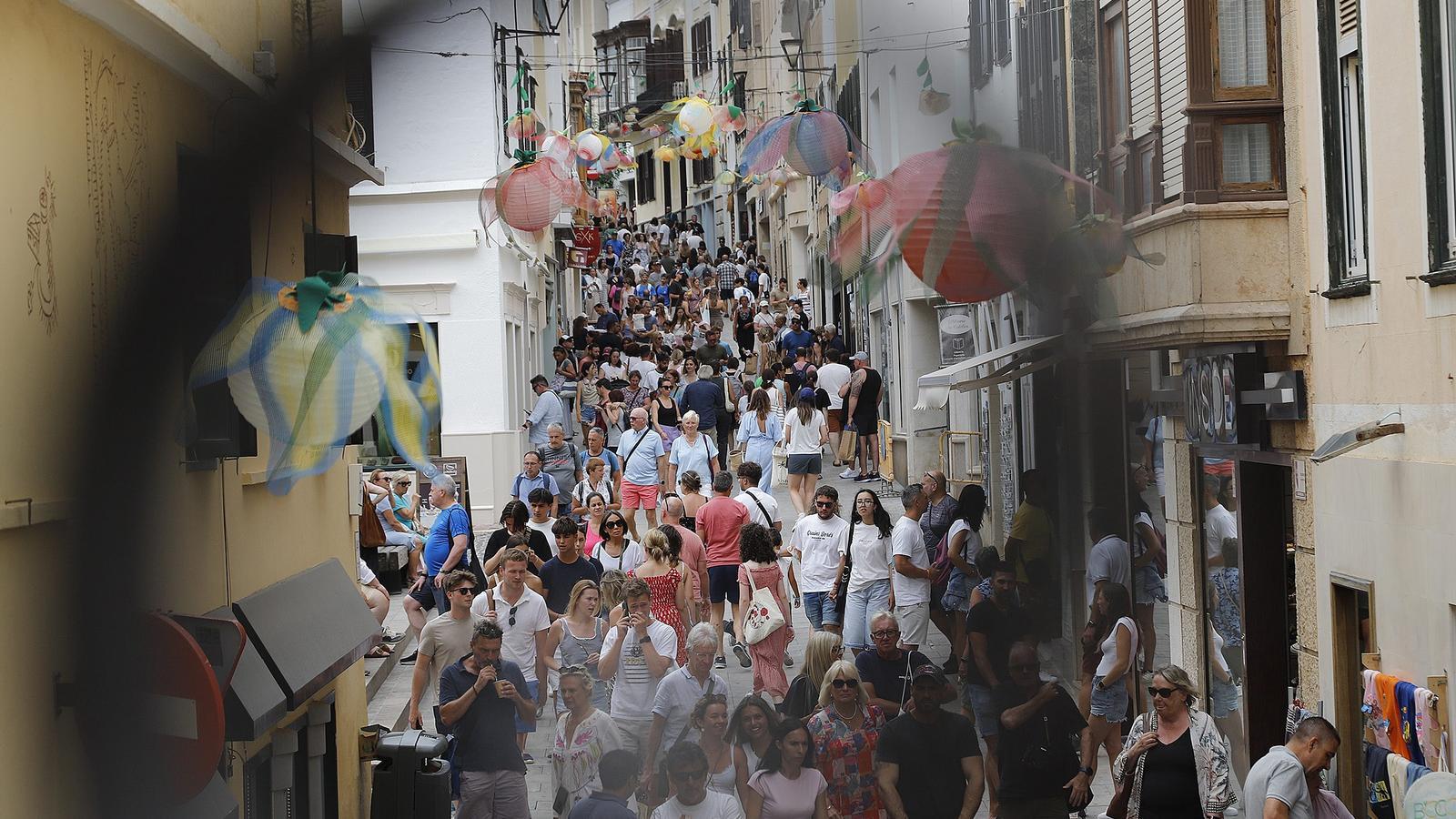

CiutadellaAs summer is about to begin, Menorca is once again knocking on the door of mobilization against tourist saturation. The Via Menorca platform, driven by the GOB and an enthusiastic group of young people, is the promoter of the first of the major demonstrations and protests – that of Saturday, June 13 – which are being announced throughout the Islands to demand effective and immediate measures in defense of housing and natural resources. The first public outcry has been in Menorca, where, says the GOB's territorial policy coordinator, Miquel Camps, "we still have time to avoid becoming a new Ibiza".
The symptoms are worrying. In the last 15 years, the number of tourists has practically doubled in Menorca. The island has gone from receiving 1 million tourists a year to receiving 1.8 million. This means there are 20 tourists for every resident, a proportion that the platform considers entirely "unbearable".
The illegal offer of tourist rentals exacerbates the situation even further, as it doubles the officially recognized offer. The GOB calculates that there are 6,000 houses legally rented to tourists with a total of 30,000 beds, but the problem is that there are another 6,000 houses that escape the Administration's control and operate in the black market. "Only in this way can it be explained that at the peak of summer there are 230,000 people, when there are not so many declared places in Menorca," highlights Camps. "The fact is that these 12,000 houses were previously available for residents, so if we do not reverse this trend, the figure will continue to grow," he points out.
The objective, insists Camps, “is to end the trend of indefinite growth in the arrival of tourists. Because, thus, in Menorca there is a lack of accessible housing for young people, whose life projects are stalled, and dependence on the tourist monoculture is growing”. The ecologist emphasizes that “this growth is not due to much more construction in urbanizations, but to the phenomenon of tourist rentals. Houses are being emptied of residents to accommodate tourists, and we no longer have enough to house the labor force that needs to come work in the tourism sector. This saturation also causes a lack of water and that the entire economy is based on tourism”.
The third piece of data that supports the mobilization is the saturation suffered by the virgin beaches, so that each bather does not have even five square meters of sand. They only have just enough space for their towel. This is a third of the 15 m2 per person that, according to official parameters, marks the minimum quality of tourist destinations.
This situation has already occurred almost from the very moment the season began. In fact, since mid-May, the parking lots of Ciutadella's virgin beaches have been full by mid-morning, forcing the closure of access to the coves of Macarella, Turqueta, and Son Saura for a large part of the day.
Without vehicle limitation
To all this is added that, one more year, the entry of tourist vehicles to the island is not limited, a measure that was within the Council's reach at the start of the term, but which has not yet been implemented. “It has been done in Formentera for years and, with only one year of application, it has managed to reduce tourist pressure in Ibiza. This, which is already done on two islands governed by the same party as Menorca, has just been approved in Mallorca as well, while Menorca continues to be the only island that has not yet limited the entry of cars,” states Camps. “It is a very clear demonstration that there is no one at the helm in Menorca,” he concludes.
The fact that the Council has let the entire term pass without restricting the arrival of cars, despite having the Biosphere Reserve Law that allowed it, has also shifted the debate to the political arena. The general secretary of the Menorcan PSOE, Pepe Mercadal, has accused Adolfo Vilafranca's government of being “asleep and immobile” in the face of a problem “that is getting worse and worse. Every year there are more cars and, therefore, more chaos and saturation on the roads. The Council has been able to start road works against UNESCO's mandate, but not to promote a measure that 80% of Menorcans demand. It is a problem that the PP does not know how to or want to face,” he says. As an alternative, the socialists propose promoting public transport to ensure that tourists do not travel by private vehicle and thus reduce traffic on the roads.
“Menorca opens its doors to collapse by not limiting the entry of vehicles,” adds the coordinator of Més, Esteve Barceló, who also denounces “three years of excuses and unfulfilled promises” from the popular party, when the island is already beginning to suffer the effects of saturation in the first month of the season. For this reason, Miquel Camps asks that we do not settle “for the discourse that we are not as bad as other Islands, when what we have to do is not wait until we are to take measures. We need, whoever governs, for certain parameters to be controlled. If we want to look to the future, we must look at Ibiza, where tourist rentals are promoted by investment funds that take all the business and leave the problem on the island. We still have time for Menorca not to become another Ibiza”.
Ibiza no longer believes it
But Ibiza seems to have discovered that it can no longer follow the same path as before. The data from 2025, the first year of the vehicle entry restriction, demonstrate this. Daily human pressure on the largest of the Pitiusas decreased last summer by 13,000 people, 18,000 in August, but despite this, occupancy and tourist spending by visitors increased by 8%. The vice-president of the Pitiuso Council, Mariano Juan, understands that "sustainability, managed rigorously, does not imply decreasing, but rather correcting distortions that reinforce the destination's competitiveness." Neus Prats, vice-president of GEN-GOB of Ibiza, says she has learned that "big capital imposes itself and that making big mobilizations, which even manage to make historic political shifts, only serve to change faces, but not the policy of destruction that continues, whoever governs. Ibiza does not surrender – she concludes –, but it is very tired of traitors." It is not coincidental, therefore, that Ibiza, where the proportionally most numerous demonstrations in defense of the territory have occurred, has so far distanced itself from the large mobilizations against saturation that entities from Mallorca and Menorca are announcing this summer.
On all the Islands, the mobilizations are convened by entities that have left the Pact for Tourist Sustainability promoted by the Prohens Government. “Very soon we realized that it was just a way to entertain people so as not to have to make any decisions,” justifies the GOB coordinator in Menorca, Miquel Camps. “There has been no dialogue and 90% of the participants are for-profit entities,” adds Joan Femenia, from the platform Menys Turisme, Més Vida.
Even more so, “the Government has tried to criminalize the protests,” says Camps, who denies any politicization on his part, since the actions on the island began years ago, under the mandate of the socialists Armengol and Susana Mora, and it was before 2022 that the tourist moratorium was decreed in Menorca, which significantly increased tourist rentals on the island. “We are not demanding a change of government, but a change in the way of governing,” he points out. “They say that environmentalism is left-wing, when it is not. The problem is that the Spanish right-wing parties are very un-environmentalist. They have very little environmental commitment,” criticizes Camps and accuses the conservative government of Menorca of “intending to polarize the debate as an excuse not to make any decisions”.
Political Disappointments
Aina Llauger, from GOB Mallorca, also urges to "change the policies" of the Balearic government, which "has done nothing to contain growth, but rather the opposite. It is taking steps to deregulate and make it easier to urbanize. But – she clarifies – we are not in favor of one party or another. There is also a lot of disappointment with the policies of the Pacte de Progrés of these last eight years".
"They want to make it seem like we are tied to the left, but we run away from that and do not allow any political party to participate in our platform's network," says Femenia. Menys Turisme, Més Vida "was born under the Prohens Government, but as a reaction to the European presidency of the Spanish government, which is socialist," she remarks.
In Mallorca there will be specific actions starting in the coming weeks, but it will not be until July 26 that the major demonstration against tourist saturation will take place. Half a hundred entities linked to the platform Menys Turisme, Més Vida want to bring Palma to a standstill to present their protest. It will be the third summer they have massively drawn attention "against the tourism model that causes multiple social, ecological, and labor problems". In fact, many workers in the sector usually join the protests to denounce the precariousness they suffer.
'Mallorca, on the limit' is the slogan chosen for the demonstration, precisely the same one that GOB already used in 2000 to denounce the dangerous obsession that the island was following. Now, a quarter of a century later, the trend has increased and growth "is already unsustainable". 20 million tourists are received per year, a situation that means there are 13 for every resident, the number of cars per inhabitant is also among the highest in Europe, and resources are so limited that, without desalination plants, there would be serious drought problems and restrictions everywhere," says Joan Femenia, spokesperson for the platform. Added to all this is the external dependence on both food ("we only produce between 10 and 20%") and energy ("renewables are insufficient and the electricity cable with Valencia is needed"). "If we intensify the protests, it is because the discontent is also greater," concludes Femenia, for whom "there is no other solution than degrowth and a change in the tourism model".
Aina Llauger blames the Prohens Government for “not promoting any measures to curb saturation and urban growth, which are closely linked. Although the number of hotel places has practically stabilized, the growth of tourist and residential places on rural land continues.” Llauger notes that “the displacement of tourist pressure to rural land also increases pressure on natural resources and causes dispersed growth across the territory. Between tourist rentals, cars, and social networks, everyone moves a lot and saturates everything: roads, the coast, and natural spaces.”
The great novelty, however, of the mobilizations in favor of the environment in recent years is that they are linked to housing because, as Llauger says, “they are two sides of the same problem. Tourist growth has aggravated the difficulty of access to housing, and this makes participation in demonstrations more intergenerational, as young people see their life projects in danger.”
Faced with this fact, “the response of civil society, but not the only one, is to take to the streets.” Also in summer, a different time than usual for the main mobilizations in the Balearic Islands, which have always occurred in autumn and spring. “This is the main symptom that society is fed up,” she concludes. She emphasizes that “people of all political tendencies are fed up,” because “everyone suffers from housing problems, and employers see that society is becoming impoverished. We no longer live off tourism. Now tourism lives off us.”
