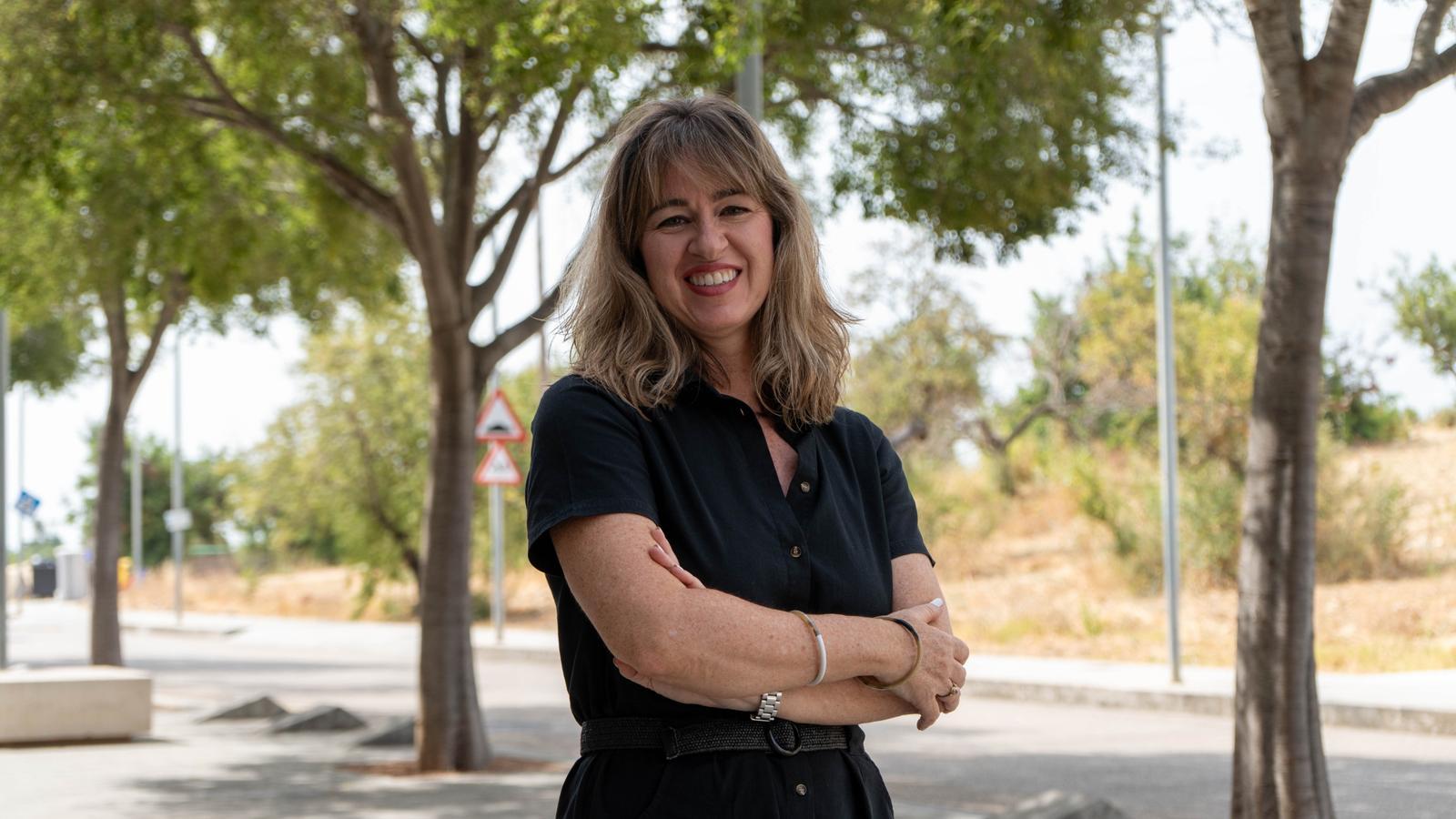
Catalina Barceló: "It's not about working more hours, but about better quality"
Director General of Economy and Statistics

-
CAT -
CAST -
DE
PalmaThe Director General of Economy and Statistics, Catalina Barceló, considers that productivity is one of the main problems of the Balearic economy. She provides some data in conversation with ARA Balears, in which she warns that despite economic indicators indicating growth, the Islands have lost competitive strength in recent years.
Are the Balearic Islands productive?
— One of the things we explained in the latest economic outlook report is the challenge of productivity and GDP per capita that the Islands face. The Balearic Islands are one of the communities that have grown the most in recent years, with increases of 4% and 3% in 2024 and 2025, and 2.9% in the last quarter of 2026, which means we multiply the European growth rate by four. A lot of economic activity is generated there. But we also see that there was a structural problem related to citizen well-being, which is one of the variables we try to monitor, which is in these two indicators. GDP per capita is an indicator of well-being on an economic scale, and it is what can best explain the current situation of the population. In the Islands, economic growth has not led to a significant improvement in GDP per capita. Citizen well-being is not reflected in economic growth. Population growth has something to do with it. If we have a GDP growth of 44% between 2001 and 2024, but the population increase has been 48%, then, automatically, the ratio falls, decreases. For this reason, GDP per capita has decreased by 3.2% between 2001 and 2024. What happens? That this real improvement in production, if it is not transferred to GDP per capita, this feeling that exists and that citizens perceive well appears, which has other consequences such as inflation, the increase in prices.

Where do we stand in comparison to the State?
— If we compare ourselves with Spain, the GDP of the Islands has grown more: 44% compared to 41%. But since the Spanish population has increased by 20%, its GDP per capita has increased by 17.4%. Our behavior is negative. What derivative should be made? Well, productivity increases. That is, the numerator exceeds the denominator. That people manage to have more and produce more. This is done through labor productivity and capital productivity. When a person works, we can know the amount of GDP per occupied hour they generate, in addition to the Value Added of Production (VAP). Labor productivity is 36.7 euros per hour worked. Each hour someone works, they generate this, and in Spain, 34 euros. But the difference is that 20 years ago we were clearly above Spain, and now we have lost strength. We have grown more than Spain, we have a higher population growth than Spain, but we are among the last communities in labor productivity. Then there is capital productivity. In this case, the capital productivity of the Islands, calculated by the Directorate General of Economy and Statistics from the data of the BBVA Foundation and Ivie, continues to be in the last places of the state ranking and below the average in Spain. If in 2001 productivity was 332 euros for every 1,000 euros of productive capital, in 2023 it fell to 257 euros. While in Spain it has gone from 330 euros to 258. This means that the Balearic Islands would need to extract more productivity from their capital, with technological innovation and continuing to invest in natural capital.
What is meant by capital productivity?
— I will use the example of a traditional company: a hotel. You have the labor factor, related to the people you have hired. It turns out that you have a cook and they are producing a certain number of menus: this would be labor productivity. If you decide to have a domotic kitchen and buy many robots, and you manage to get the same cook to produce double the menus, you increase capital productivity.
So, is the capital's worse than labor's?
— Yes, although both have rebounded since the pandemic. In Spain it has been an upward line, with a gentle trend, while that of the Balearic Islands has been more U-shaped. The minimum peak was in 2005, 2006, 2007, and from here it rose gently again. Then there was a significant drop in 2020, 21, with COVID, of course. And then, a very significant acceleration.
How is productivity improved by the Government?
— For a couple of years now, promoting measures related to both employment space and innovation: these are two very strong levers to improve this productivity. Promoting work-life balance, flexibility, administrative simplification, making procedures agile, technological training, courses related to technology so that workers can improve their skills. Then, capital productivity is related to technological innovation, digital and physical structures. Making these investments as demanding as possible, ensuring that infrastructures are well-equipped. Then, natural capital is extremely important. In tourism, containment in volume, and betting on value. Keeping overnight stays stable from January to May, implementing containment while increasing tourism spending.
What does natural capital include?
— The environment. It is necessary that our capital infrastructures respect the environment in which we live. There is an intangible part which is the natural environment: the better it is, the more productivity it will have. If we have a hotel located in the best possible environment, that room's price has more value.
Why is work-life balance so important for improving productivity?
— Work-life balance and flexible hours are two elements that can improve it, within the possibilities of each occupation. We have a service sector that demands a lot of presence. In professional services, advisory, and consulting, measures related to work-life balance and flexibility could improve productivity. Also, the free childcare for zero to three year olds. Everything that facilitates the relationship between personal and work life favors productivity. You end up doing more work per hour. Also the climate. A good team, with a good atmosphere, technological training. To increase productivity, it's not about working more hours, but about making the hours you work of higher quality.
