Son Forners rewrites prehistory by unearthing the fourth talayot
The removal of the compact garrigue has revealed an impressive cyclopean structure that until now was hidden from the eyes of visitors
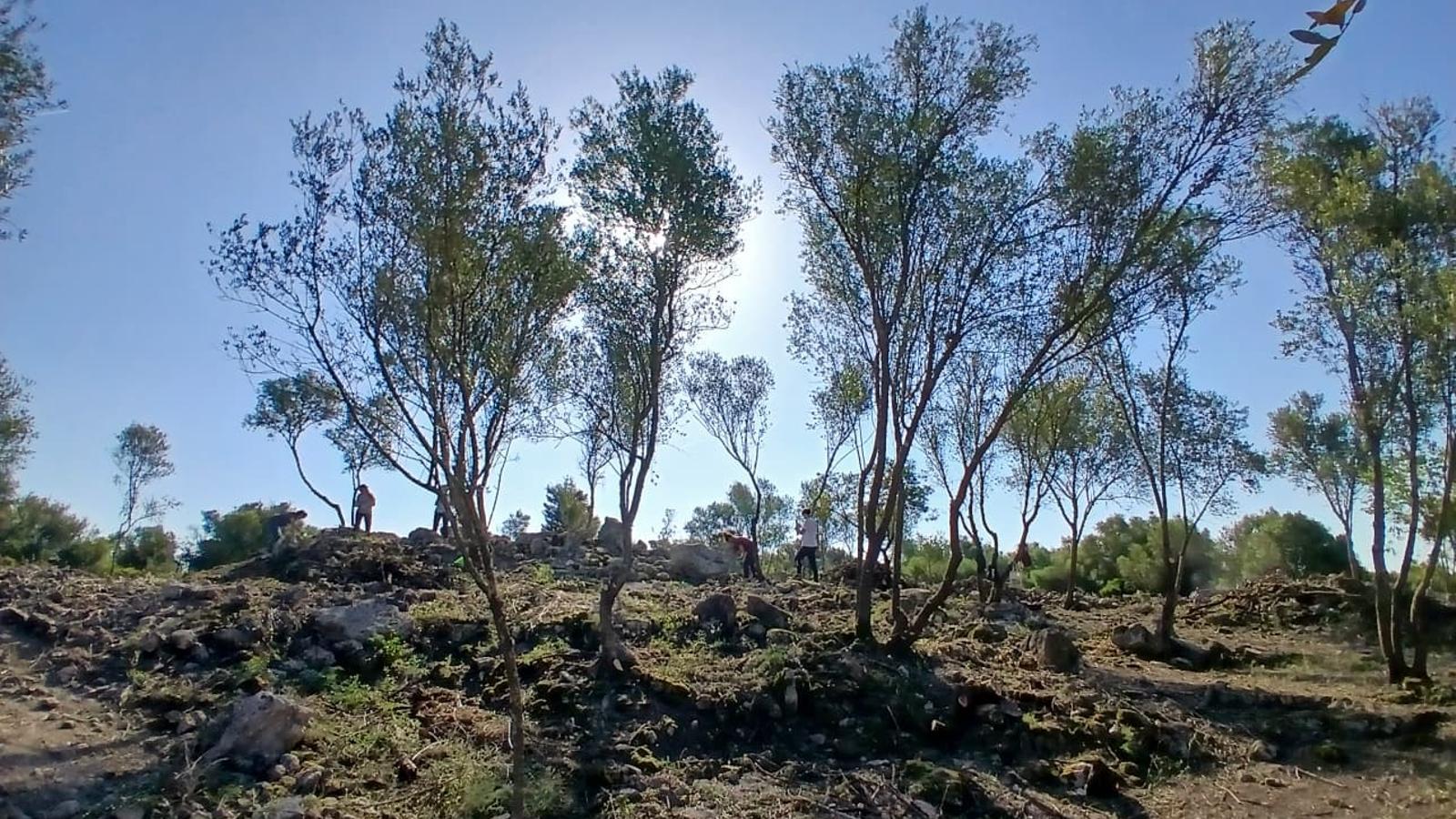
MontuïriThe archaeological site of Son Forners in Montuïri continues to write golden pages in the history of Balearic prehistory. Just as half a century is completed since the start of the first systematic excavations (1975-2025), the settlement is once again shaking the research world with the unearthing of the fourth talayot.
This new milestone has been made possible thanks to the intensive cleaning, clearing, and vegetation control tasks carried out by Ibanat (Balearic Institute of Nature) in the upper area of the archaeological estate. The removal of the compact scrubland has revealed an impressive cyclopean structure that until now was hidden from the eyes of visitors.
The first impressions of the team of archaeologists are of great enthusiasm. As they have explained, everything suggests that this fourth talayot is in an exceptional state of conservation, practically "intact". The visitor can recall the vision that Vicenç Lull and the first archaeologists had upon seeing the two stones at the top of the central column. Inside, the pile of stones. Undoubtedly a vision that moves. Going to Son Forners these days is to visit what we already know of the site, but as it was in that distant 1975.
One of the most significant data from this first phase of study is the total absence of Roman-era pottery remains on the surface and in the first strata. This suggests that, unlike other areas of the site where the footprint of Romanization or later phases is very evident, this sector could have remained sealed or free from late reoccupations, offering a very pure "photograph" of the Talayotic era. It seems that neither Guium nor Tucis reached this area of the site.
Furthermore, although the structure is only at the beginning of its study phase, the work has already made it possible to clearly identify the first two stones of the central column. "We don't know the depth of the talayot, we don't know how many stones this central column will have," explains Cristina Rihuete. Likewise, she explains that the talayot has, on one side, a very important part of rock, while on the other side a large wall has been erected to give shape to the talayot.
Watchtower
The strategic location of this fourth talaiot opens new avenues of interpretation regarding the organization of space at Son Forners. It is probably situated on the highest part of the estate, a preeminent spot from which much of the Pla de Montuïri and part of Algaida can be visually dominated.
This high position directly connects it with the environment beyond the current limits of the public site. The monument is located a very short distance from the neighboring estates bordering the enclosure, private properties where archaeologists are aware that there are other talaiots and structures yet to be excavated. Thus, we find it almost a stone's throw from the talaiots of Sabor or the column of the so-called Campanar dels Moros.
Uncovering this fourth talaiot is the best example of the passion of the Son Fornés Archaeological Museum team, committed to continuing to beat and dignify the site stone by stone. After the 50th anniversary of scientific research, and with the horizon of the new and definitive headquarters in the old houses of the Son Forners estate, this finding becomes the ideal spur to demonstrate that the archaeological park is possible and that the great treasure of Montuïri was only waiting for the moment to be unearthed.
