
Great artists have emerged from Son Gotleu. Back in the 70s, a host of groups appeared in the neighborhood offering musical training to residents. One of the first was Banda de s’Almudaina, founded in 1977 in the parish of Corpus Christi. It grew so much that in 1995 it became the largest in Mallorca, with 72 members. Drummer Mané Capilla Fernández, 64, feels indebted to it. Multi-award winner at the Pop Rock contest in Palma, he is now part of the group Clara Ingold & The Silver. Previously, he played for Furnisch Time, Trazom Tzara, Wonkhï Palma, Sunflowers, and Rock&Press. In 2024, he starred in the documentary Brushes and Drumsticks.Capilla is the ninth of nine siblings. He is part of the first generation of mainland Spaniards who settled in Son Gotleu during the tourist boom. He arrived in 1968, at the age of six, with his parents, from Granada. His father worked as a stonemason, and his mother as a cleaner. The whole family had to live in a 110 m2 apartment with four bedrooms and two bathrooms. “I,” he says, “had a happy childhood. At a time when school was still in Spanish, I learned Catalan on the street, playing football with the sons of Majorcans. We also got along with gypsy children. The coexistence was good.” From the 80s onwards, the neighborhood succumbed to the heroin epidemic. “One of my brothers got hooked and ended up dying of AIDS.”Son Gotleu did not have a public school until 1972, CEIP Joan Capó. “I,” says Capilla, “still had to go to the one in Son Canals. I coincided there with some of the Balboa brothers. They were the first Africans I saw in the neighborhood.” The Balboas were seven and came from Equatorial Guinea, which was a Spanish colony until 1968. In 1969, the father, poet and politician Juan Balboa Boneke, was forced to exile his family from the African country, fleeing repression. Among the children, the one who has excelled in the world of singing is Concha Buika, born in 1972. Her music is influenced by the gypsy and flamenco culture she knew in the Palma neighborhood. Her brothers Amando and Boré Buika have gone into acting, and Guillem (Balboa), the eldest, into politics – in 2017, at 52, he became the first black mayor of the Balearic Islands, in Alaró, for MÉS.Linked to Concha Buika's rumba are other singers raised in Son Gotleu, such as Azuquita (Pedro Bermúdez), who died in 2025 at the age of 47, and percussionist Benji Habichuela. In rap and hip-hop, singers Maik Marel and Magno Palacios, and the group Los Talegueros stand out. However, the most powerful voice in this style is Rels B. Born in 1993 under the name Daniel Heredia Vidal, he has become one of the leading exponents of urban music in Spanish globally. In 2018, the Palma native revisited his humble origins in the documentary Thanks from Son Gotleu. Toni Pastor is of a different genre; he has played the lute in groups such as Daniel y la Quartet de Baño Band and Música Nostra. He has also collaborated with Marta Elka and Joan Miquel Oliver.
The forgotten agricultural past of Son Gotleu
During the tourist 'boom' of the 60s, the arrival of workers from the Part Forana and the Peninsula would turn the rural area on the outskirts of Llevant de Palma into a dormitory town. Now an exhibition gives voice to the testimonies of that transformation

-
CAT -
CAST -
DE
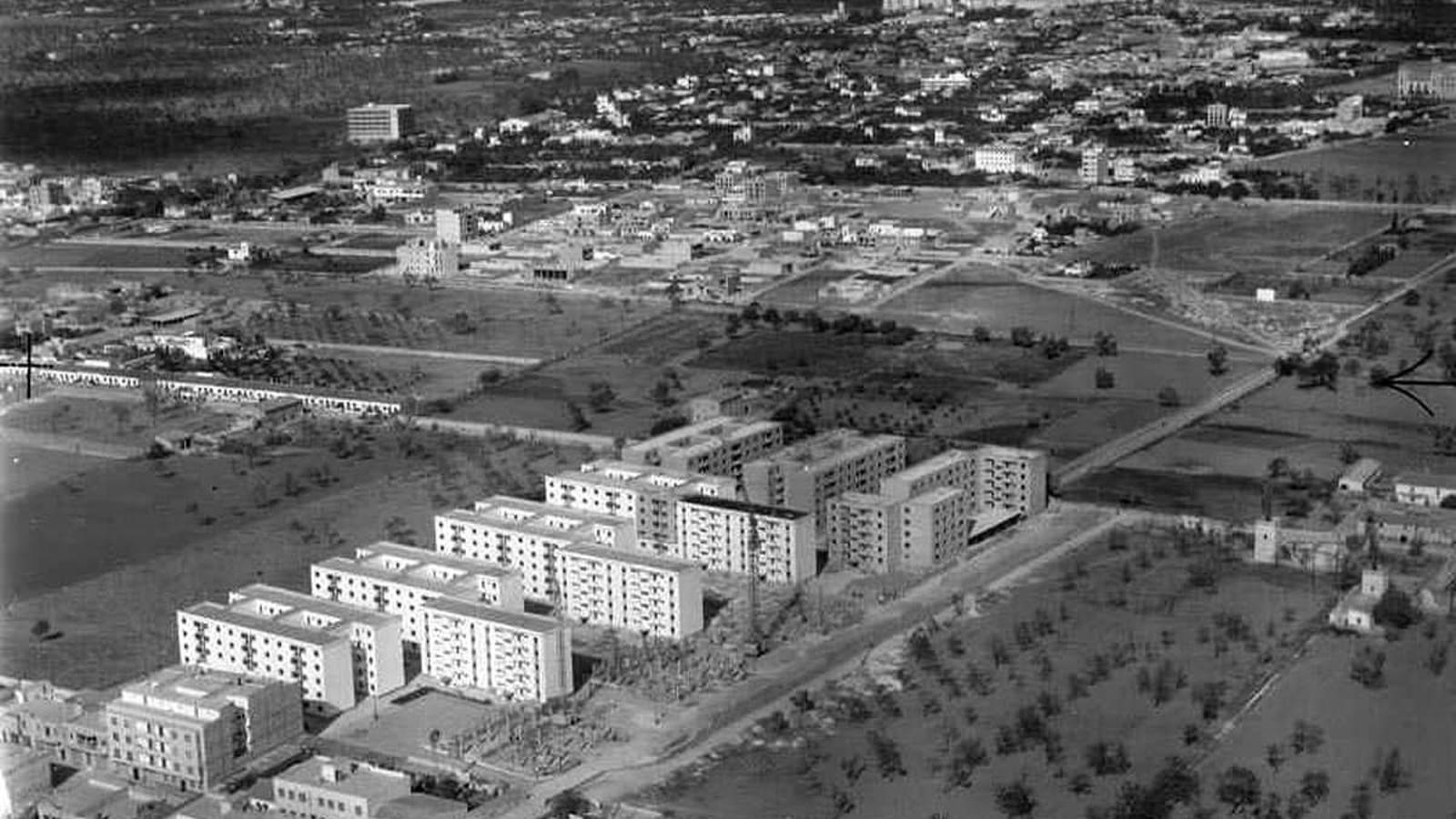
PalmaBetween 1960 and 1980, in just two decades, the population of Palma doubled. It went from 150,000 inhabitants to 300,000. The tourist boom, with its epicenter in l'Arenal, turned the Balearic capital into a kind of promised land not only for peninsulars, especially from Andalusia and Murcia, but also for families from the Part Forana, who were fleeing the harshness of the countryside. One of the suburban neighborhoods that was suddenly colonized was Son Gotleu, located in the Llevant district, between Aragó street and La Soledat. Its transformation can be traced in the exhibition Son Gotleu, beyond the headline. The origins of a welcoming neighborhood (1960-1980). Until the second week of June it will be at the neighborhood's health center and then it will move to the Mater center. It is a project by Palma XXI and Arquitectives, coordinated by the historian from Pollença Leyla Dworkin with the support of Caixa Colonya and Fundació Iniciatives del Mediterrani.
Today Son Gotleu is the third most densely populated neighborhood in Palma, with nearly 11,000 inhabitants. It owes its name to an old estate in the area. On the current Son Gotleu road, houses built in the 50s with a rural air can still be seen. They are ground floor houses with a garden at the back. Cati Jordà Ramis, 53 years old, was in time to know that agricultural past. "I – she says – am the fourth of eight siblings. My father is from Sineu and my mother, from Llubí. In 1966, he, at 24 years old, came to Palma to be a taxi driver. He was encouraged by some relatives who already ran a taxi. After three years, with what he had earned, he was able to buy an apartment in Son Fortesa, where he settled with my mother and the children. We used to go to Son Gotleu, a kilometer away, a lot. My maternal grandparents worked as caretakers at the Ses Sorts estate, where the Germans Escales sports center is today. At the beginning of the 80s, when my grandfather died, the whole family moved there. At the end of the decade, when the farm was expropriated, we had to return to the apartment in Son Fortesa".
Jordà felt nostalgic for his childhood in Ses Sorts, which from 1973 onwards would see the ring road built in front of it, where the train to Llucmajor and Santanyí used to run. “The eight siblings used to swim in the washhouse. We helped sow in the vegetable garden and raise animals. Neighbours from Son Gotleu and El Rafal used to come to buy from us. I remember selling many live rabbits that we would slaughter on the spot. At Christmas, the piglets were a hit. Those who also acted as sellers were the owners of the La Rafalera estate, where the current health centre would be built”. By the end of the 70s, the new demographic reality of the neighbourhood was more than evident. “Many peninsulars came to buy from us. They were delighted to be able to acquire local products like those they had in their home villages”.
First homes
In Son Gotleu, the first subsidized housing units began to be built in 1962. Located between the current Indalecio Prieto street and Orson Welles square, they would be known as 'the white buildings'. They were apartments integrated into 19 isolated, box-shaped blocks, with five floors. They were in line with the developmentalist model of the time, which contrasted with the traditional architecture of single-story houses. The same model would be implemented in other neighborhoods on the outskirts of Palma with a strong influx of workers arriving from the Peninsula. This was the case of La Indioteria, in the Son Castelló industrial estate, and Son Roca and Son Ximelis, in the Ponent district. In the 1950s, Antoni Roca Cabanellas, the architect of the fascist monument of La Feixina (1947), had already built subsidized housing in Corea (1955), in El Camp Redó, and in Verge de Lluc (1957), on the border with Marratxí.

Born already in Son Gotleu is Antònia Amengual Vidal, 56 years old. “My parents –she assures– were from Llucmajor. He was a civil guard and in 1967 they assigned him to Palma. Then they learned that some properties with all kinds of amenities were being built in a neighborhood that did not stop growing. They bought an apartment off the plans. When they first moved in, my mother was fascinated by it. Before that, my father had been assigned to Colonia de Sant Pere, where they lived in a house that had neither electricity nor water.” Amengual’s parents were completely monolingual. “They learned Spanish here, in contact with the peninsulars. However, most of the neighbors in the building were Mallorcans like them who had left the Part Forana with the idea of giving their children a better future. At the end of the 70s, given the increase in conflict, they sold the apartment to buy another one in the neighboring district, Pere Garau”.
Jordà didn't fear the degradation of Son Gotleu. “I went everywhere quite calmly, to the bakery, to the ice cream stand, to the stationery shop... I knew everyone. I never felt unsafe nor did I ever see any drugs. I did hear, however, people complaining that at night they couldn't sleep because of the noise and some incidents that happened”. In those years, the streets were full of shops run by Majorcans: Ca na Bel, Joieria Fortuny, Ferreteria Payeras, Ca na Paquita's haberdashery and Ca sa Sinevera bar, a name that betrayed the owners' origin.
Mater Misericordiae
The parish of Corpus Christi, built in 1967, would be the soul of Son Gotleu. Leyla Dworkin, responsible for reconstructing the neighborhood's memory with testimonies like Jordà i Amengual, explains it: “The church provided shelter for various cultural and social initiatives. Among them were L’Infant Club Son Gotleu, Iris Club, and the hiking group L’Orfe Club. The Centre for Women's Promotion would also be created. And in the sports field, football teams like CE Son Gotleu were founded.

In 1964, the Franciscan nuns of Mercy inaugurated their first Mater Misericordiae center in Son Gotleu with the aim of attending to girls with special needs – at that time Sant Joan de Déu only attended boys. In 1968, the Cine Novedades opened, with a capacity for 400 people – the sessions dedicated to films by François Truffaut were very memorable. In 1982, after fourteen years of existence, the fantasy ended and the building began to house an office of the Social and Cultural Work of Sa Nostra. Currently, it is the headquarters of the Association of Elderly People.
In 1972, the neighborhood had its first public school, CEIP Joan Capó, near the neuralgic square of Fra Joan Alcina. Until then, children mostly went to the subsidized centers of La Milagrosa, in Son Canals, and Corpus Christi. The public offering would be expanded with CEIP Gabriel Vallseca (1975), CEIP Es Pont (1988), and IES Josep Sureda i Blanes (1990). Between these last two centers is Joanot Colom park, presided over since 2003 by a large bronze statue of the main leader of the 16th century Germanies revolt.
The magazine Eco Viu would serve as a mouthpiece for that frantic development. It was published bimonthly and reached a print run of 500 copies. It included readers' letters, humorous cartoons, press clippings, and a section on the origin of street names titled Conozca su calle. “In its origins –Dworkin points out– it served mainly to denounce the problems affecting the population of Son Gotleu and to simultaneously present proposals for improvement. The installation of a sewage system, individual water meters, street paving, and the construction of schools, green areas, sports courts, and play areas for children were claimed”.
Against the stigma
In 1977, in the midst of the Transition, the Son Gotleu Residents' Association was legalized. In 1993, another one would be created, that of Orson Welles, led by the combative activist Ginés Quiñonero (1935-2022), known as 'the voice of Son Gotleu'. The entity took its name from the neighborhood square, located on the grounds of the old Son Negre estate, which was at risk of being urbanized. In 1985, one of the great neighborhood demands became a reality: a health center. It was built on the grounds of the old La Rafalera estate. 'From the 90s onwards,' states Dworkin, 'the growing demand for labor motivated the arrival of non-EU migrants, mainly from Nigeria, Senegal, and the Maghreb. They settled in Son Gotleu because it was where there were cheaper houses. And it still happens. However, the City Council has it totally abandoned. Today, the sense of belonging to the neighborhood is fragile because people can barely survive, make ends meet.'

In 2003, to manage the needs of so much multiculturality, the Platform of entities and services of Son Gotleu was created. "They do -says the researcher- ant-like work to combat the stigma of a troubled neighborhood. All their good work, however, is dynamited when the news of some brawl comes out in the newspapers." Cati Jordà and Antònia Amengual, two of the historic residents of Son Gotleu, continue to be linked as occupational educators at the Mater center. Amengual sees a completely surprising new transformation in the neighborhood: "Next to the clinic, clinging to the ring road, they are building buildings with swimming pools." The EMT bus service offers another contrast. Line 7 connects Son Gotleu with the luxurious neighborhood of Son Vida.
