
The Llucmajorer Francesc Adrover Fullana, Floquet, is the son and grandson of shepherds. At 55 years old, he still follows the family tradition at the head of a farm with animals, including 120 sheep. He also dedicates himself to the cultivation of nuts and cereals. He defines himself as a farmer. “Today, however, this word is frowned upon. The few people who work the land prefer to present themselves as farmers or businessmen.” Adrover no longer keeps sheep as he used to. “Now the farms are fenced and there's no need for anyone to watch them anymore. I also don't practice transhumance. When the sheep finish the grass in one enclosure, I move them to another nearby.” The ritual of shearing when the heat sets in has also changed. “A professional handles that. However, today Mallorcan wool is worth nothing anymore and is no longer used in the textile industry. For the wool of 100 sheep, they might give you 50 euros. Besides, you often have to burn it because it's full of dirt.” The business of keeping sheep is still about meat. “Every two years they breed three times. I sell the three or four-month-old lambs to someone who takes them to be slaughtered at a butcher shop. Then it all goes to the butchers. From each lamb, you can get 16 kilos of meat.” Adrover believes that the old figure of the shepherd is totally contaminated by nostalgia. “It's part of pre-tourist Mallorca, where a different way of understanding life prevailed. In Llucmajor, Miquel Tomàs, ‘Pastoret’, who is 75 years old, twenty years older than me, is the last representative of a trade that still survives in some parts of the Peninsula. Here, we farmers bother.” Adrover speaks from experience. “Sometimes I have accompanied Pastoret during his transhumances towards the old road to Cala Pi. When we occupy the road, cyclists and cars look at us badly. It's clear that we are the great outcasts of society. Politicians only want us as gardeners of rural areas that can be photographed for tourist promotion campaigns for the island. With the subsidies we receive, we can only survive. Mallorca is pure urban speculation at the service of tourism.” In the era of turbocapitalism, the largest of the Balearic Islands is already close to a million inhabitants, triple that of the early 20th century, before the tourism boom. The Llucmajorer laments the lack of strategies from the ruling class. “If livestock farming were promoted, a certain food sovereignty could be achieved. The meat from our lambs is very good, as they are not fed feed. Much of it, however, doesn't stay here. It goes to North Africa. In Muslim countries like Tunisia, Egypt, Morocco, and Algeria, a lamb represents almost 70% of their diet and is a ‘delicacy’. It costs 400 euros, while here, 100. We, however, prefer to eat chicken, hamburgers, kebabs, sushi...”.
The last shepherd in ancient Mallorca
From his estate in Llucmajor, Miquel Tomàs ‘Pastoret’, 75 years old, takes stock for ARA Balears of a trade that has become an anachronism in today's tourist society
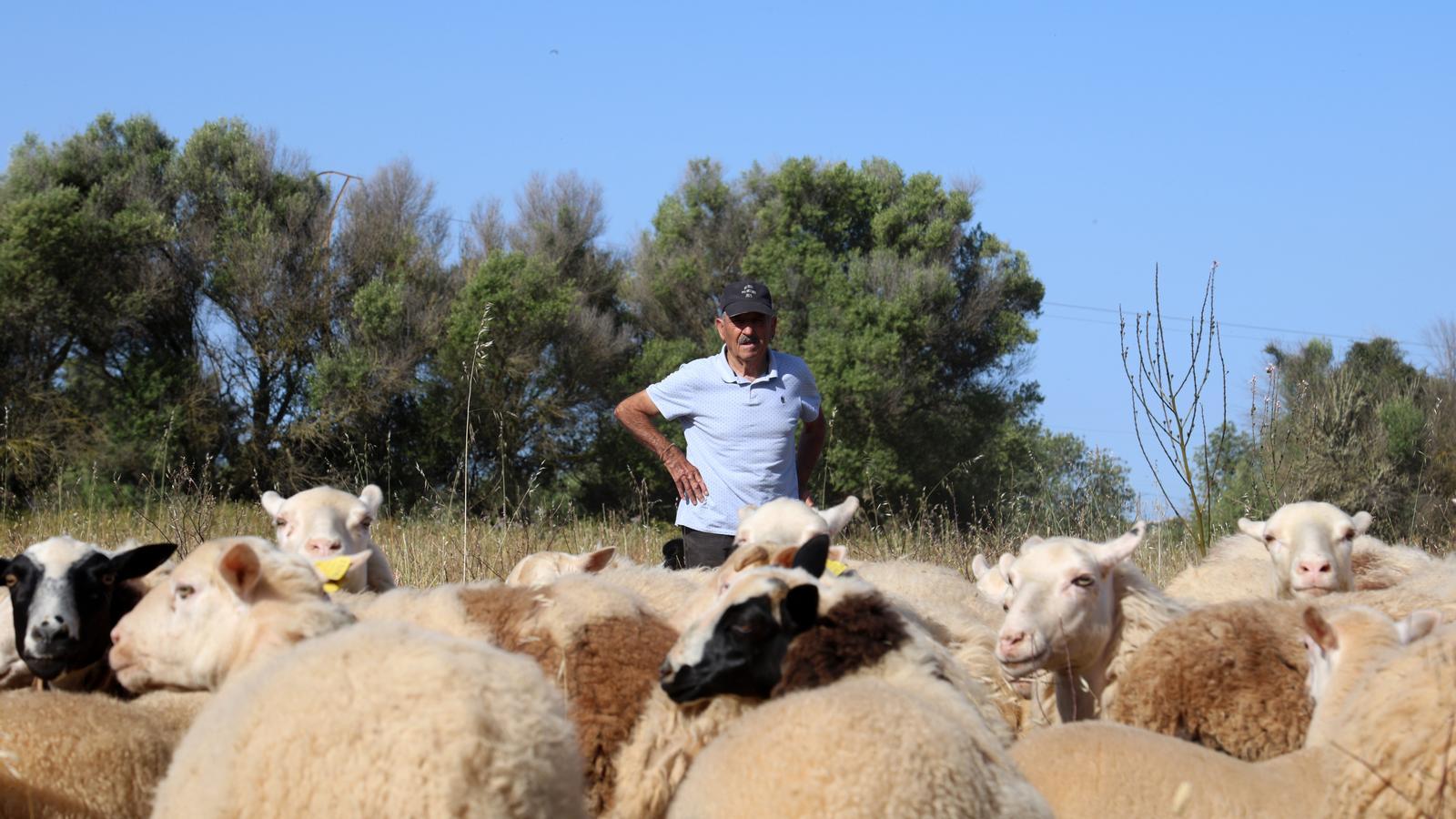

PalmLlucmajor still preserves vestiges of rural Mallorca. Four times a year, a flock of 100 sheep crosses the town center towards a farm on the old Cala Pi road, nine kilometers away. They do so under the watchful eye of Miquel Tomàs Garau, Pastoret, 75 years old, and his dog. “Everyone takes photos of me,” he says with a smile. “It’s something that catches the eye. When the grass runs out on my farm, I take them there.” The Llucmajorer is one of the last old-fashioned shepherds practicing transhumance, an activity that consists of the seasonal movement of livestock in search of better pastures. Traditionally, sheep flocks from the large estates spent the winter in the Migjorn plains of the island and the summer in the mountains. On the roads, there used to be cisterns, reservoirs, and ponds that allowed animals and shepherds to drink.
Tomàs receives us early in the morning at the Son Marió estate, located at the exit of the Llucmajor to Algaida road. He appears with a sports cap on his head and holding a crook in one hand, while the other is constantly giving orders. From a distance, the bleating of the sheep can be heard, which he has just penned. The overexcited dog runs up and down. Suddenly, it stands still with a single shout from its master. “Without him,” he assures, “I am nobody. I love him madly. The sheep are my workers and the dog, my foreman. He understands me perfectly. From a distance, he knows how to herd the sheep just by me saying a word or making a gesture or a whistle. Some people bring me their dogs to train them.” The Llucmajorer speaks with resignation of a Mallorca that has already disappeared. “Before, in the municipality, there were about forty shepherds. I was the youngest, and now I am the only one left. At eight years old, I was already looking after 120 sheep. I learned the trade from my father, who learned it from his. My sister, on the other hand, started working in a shoe factory in town.”

“I was never bored”
At 16 years old, Tomás was already emancipated. “I stopped being under my father's orders and was hired out to a gentleman who had 190 sheep. With him I stayed for 17 years. That's when they gave me the nickname Pastoret. After that, I took charge of 450 sheep on another farm”. In summer, sleep was always changed. “I rested during the day and looked after the sheep at night, which is when they graze to escape the heat. Sometimes I met up with companions from other farms to have dinner of bread and cheese. We chatted and played the flabiol. Then we would leave to guard them”. Under the starlight, the responsibility was immense. “I couldn't fall asleep because I had to be very alert that no sheep jumped from one farm to another at a time when there were no fences. Otherwise, I would get two slaps from the master and my father would punish me”. Despite everything, the shepherd found his calling in that bucolic environment. “I liked being all alone with the sheep and hearing the bells. I had a lot of time to think. I was never bored. I could tell the time by the position of the sun”.
Tomás also took care of the crossings with a good ram, the male of the sheep. In May, when the heat begins to bite hard, it was time to shear, to remove the wool with scissors. “We had a big party. It was time to have a good lunch with the rest of the shepherds. We sold the wool in a warehouse in Llucmajor.” The sheep were sacrificed when they were six or seven years old. “We took them to the slaughterhouse. The butcher shops in the village also asked for them. They could offer up to 2,000 pesetas for a sheep.”
The immobility in how they kept their flocks and the calm life of the shepherds would be associated with laziness, which was reflected in the expression ‘shepherds piss lying down’. However, as attentive observers of the cycles of nature, they were also seen as keepers of an extraordinary popular culture, with which they masked their illiteracy. They even dared to predict the weather. “I know what the weather will be like / just by taking a look / and seeing the clouds,” says a folk song.
The pre-tourist Mallorca that Tomás knew was very austere. “At night we used an oil lamp. After dinner, we entertained ourselves by doing some silly things. Soon, however, we went to bed. We got up at five in the morning with the crowing of the rooster.” At that time, a frugal diet from the land prevailed. “I never went hungry. There weren't as many things as there are now, but we ate healthily: soups, stews, rice... It was seasonal produce. Today, on the other hand, you can eat anything at any time of the year. We hardly ate meat.” There were also moments for small pleasures: “The slaughter days were eagerly awaited. Very early, before killing the pig, we drank mistela and had chocolate with ensaimadas. In winter, when it was cold, I really wanted to sit by the fire and roast a good sausage, which I accompanied with a small bottle of wine. And in summer the only luxury we had was eating an ice pop every two weeks.”
To the sound of cowbells
The soundtrack of those slow-paced times was the sound of cowbells. “Once a week, at the Sunday market, Master Miquel used to come to sell them. He was from Búger, known for being the ‘town of cowbells’. All the shepherds in the municipality would gather around him to choose the best one”. Tomás also misses the old human warmth of the countryside. “Now you pass someone and they don't even greet you. Before, that was unthinkable. We all knew each other and when we heard the sound of a horn we would gather to eat and chat. At night we also spent the evening together. Each one did their tasks, knowing that there was a feeling of camaraderie and solidarity”.
The shepherd. The poetry, music, customs and traditions of the Majorcan shepherdTomás declares himself a man of the dry land. “I’m not one for swimming. When my children were small and my wife wanted to go to the beach, I always sulked. And if I had to carry little signals, I sulked even more”. The trend of going to the sea gained strength with the tourist ‘boom’ of the 60s, which also signified the beginning of the end of a whole world. “In Llucmajor, everyone fled the countryside. People sold their animals and left, mainly to work in the hotels of El Arenal. The same happened with many of the workers from the town’s shoe factories”.
‘Beatus ille’
The sheep herder did not succumb to the siren songs of a modernity that made him forget the calluses on his hands with day labor, eight hours a day and with a fixed salary. “Being a shepherd was enough for me to live on, although without excess. The problem is that today's consumer society causes everyone to have continuous expenses. I was able to contribute to Social Security thanks to a contract that the owner of the farm, for whom I worked as a sharecropper, made for me. When he died, I was able to acquire it. Now I would be incapable of living in an apartment. I need to be outdoors.”
At 75 years old, Tomás feels privileged to have retired in good health. However, he cannot stop keeping an eye on his flock of sheep, aware that he is the last representative of three consecutive generations of shepherds. “My two sons are dedicated to other things. I understand. Work in the field is very hard, very sacrificial. Besides, now there is more bureaucracy than ever to slaughter animals or to sell anything.” The sheep herder feels overwhelmed by the new digital age. “I carry a mobile phone to be located. It is, however, very simple. It only serves to make phone calls. It does not have any of these applications with which people are so fascinated today. Now everything is noise. I, on the other hand, have learned to be silent.”
The current owner of Son Marió is the living image of the Horatian cliché of beatus ille (‘happy is he’), a whole apology for the quiet life in the countryside. “I am very well with the sheep. I am not at all attracted to people who travel every other day to the other end of the world. I have no need. I would go back. I don't like the times we live in at all, nor the Mallorca we have.” In 1981, the folklorist Inquer Bartomeu Ensenyat managed to capture this entire lost livestock world. He did so in the book The Shepherd. The Poetry, Music, Customs, and Traditions of the Majorcan Shepherd.
