Abel Matutes: from Franco's mayor to minister of democracy
30 years are completed of the designation of the Ibizan businessman as head of Foreign Affairs, the last stage of his political career

-
CAT -
CAST -
GER
Palma“N’Abel wants it all”. That’s what a veteran journalist from Ibiza, referring to Abel Matutes Juan, said years ago: a man who, in addition to his multiple businesses, certainly became practically everything in politics over three decades: mayor of Vila, a prominent figure of the Transition, senator, deputy, negotiator of the Statute of Autonomy, European commissioner, minister... We review his career as the thirtieth anniversary of his appointment, on May 5, 1996, as head of Foreign Affairs in José María Aznar’s first cabinet is celebrated.
A cacique and destroyer of the territory for some, a statesman with a dialogue-oriented and conciliatory temperament for others, Matutes, like Antoni Maura –another islander prominent in Spanish politics–, presents the dual aspect of ‘Matutes, yes’ or ‘Matutes, no’. His business activity has been spectacular: banking, hotels, construction, a travel agency, a water park, a newspaper –El Día de Baleares–, food, livestock, transport, foreign investments... All this, in addition to being a professor at the University of Barcelona and a player for Espanyol.
The Matutes name in Ibiza is not like saying Marí or Tur. Around the 18th century, three brothers of this lineage are recorded and one of them was already named Abel. One of the corsairs honored with a monument in the port of Ibiza was a Matutes. His godfather, Abel Matutes Torres, was the great family reference: shipowner, banker, and builder of the first theater in Ibiza and the first electricity factory.
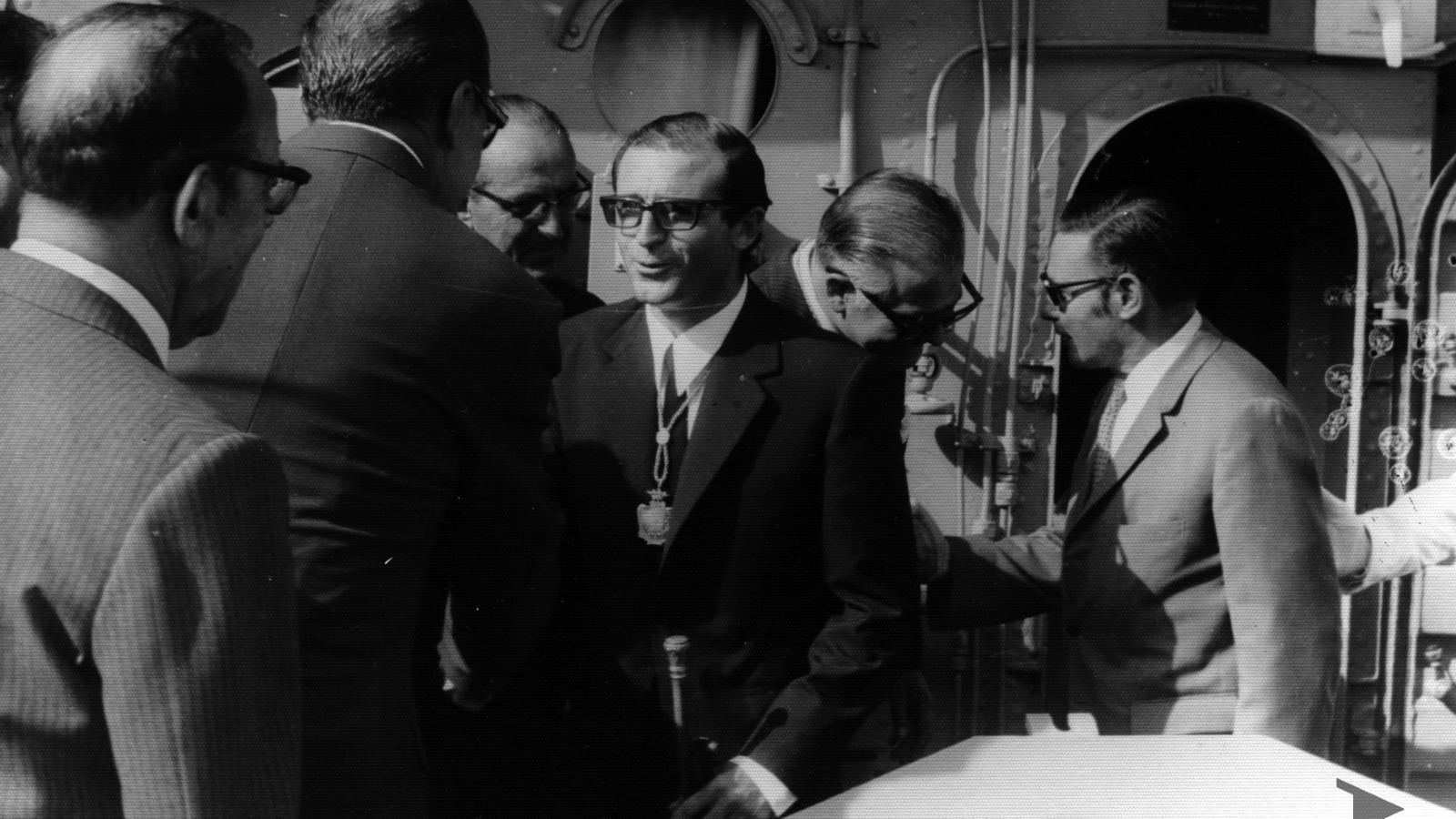
The grandson’s political career began under Francoism. He was 24 years old when, as he himself recounted, the state government delegate in Ibiza called him every day, and kept him in his office for two hours, so that he would accept being mayor of Vila. He considered saying yes, just to be left in peace. But he had not yet reached 25, the minimum age, at that time, to be one.
The gold medal to the dictator
In 1970, he was 28, and he was able to be mayor of Ibiza. But he didn't even last a year in office: he resigned –“before they kicked me out,” he used to say. During those months, he was a front-row witness to the arrival of the statue of the medieval conqueror Guillem de Montgrí and paid a visit to the dictator, at the El Pardo palace in Madrid, to present him with the Vila's gold medal. He also experienced a surreal episode: he was involved in the demolition proceedings of the hotel Ínsula Augusta – as it was located in a problematic spot, at the head of the airport runway –, of which he was the owner. He received the corresponding compensation for the demolition.
Five years earlier, in 1965, Matutes had met a character who would be key in his political life: the then Minister of Information and Tourism, Manuel Fraga, on a visit to Ibiza. At that time, the Ibizan already suggested to him the creation of ‘cabildos’, that is, councils in the Balearic Islands – like those already present in the Canary Islands. When Fraga was made ambassador to London, Matutes visited him several times. One of those times, accompanied by Ramón Tamames, who, of course, he was unaware was already a member of the Communist Party – and, judging by his recent career as a Vox candidate, no one would ever have guessed it.

Matutes returned to political life just after Franco's death and at the beginning of the Transition. In March 1976, he was one of the 15 founders of Concurrència Democràtica Balear (Codeba), a collective of prestigious professionals who advocated for democracy and autonomy and which would become the nucleus of Unión de Centro Democrático (UCD) in the Balearic Islands. However, he preferred to approach Aliança Popular (AP) of his friend Fraga: not directly, but with the parenthesis of the Unión Liberal, Popular y Democrática de Ibiza y Formentera, ‘Sa Unió’, which would integrate into AP.
Towards UCD, a door remained open, as his brother Antoni leaned towards this formation. A kind of “you in AP and I in UCD”, with which there would always be a Matutes on board, whatever the formation that gathered the moderate vote. Antoni Matutes would take charge of the family businesses when politics took his brother away from Ibiza.
Just a few days before those first democratic elections, in Palma, practically all the forces that were running signed a document, the Pacte per l’Autonomia, in which they committed to demanding a statute of self-government from the future Courts. From the Pitiusas, they expressed their protest for not having been invited. It was not until June 11, four days before the elections, that it was possible to reach a definitive document and incorporate those demands. Among the signatories, from Aliança Popular, Abel Matutes, who added two clarifications in his own hand: Catalan should be used “in a co-official regime with the Spanish language” and “accept no other nationality than Spanish”. He received congratulations from Fraga for signing the pact.
Matutes was practically the only candidate of some weight – and not a little – that Alianza Popular, the nucleus of the current Popular Party, presented in those elections in the Archipelago. The results made it very clear: the AP brand in Congress obtained 4,891 votes in the Pitiusas and he, as a candidate for the Senate, 8,862, almost double. Some Ibizan farmer wondered why that man, so important, now wanted to become a ‘healer’, that is, those who castrate domestic animals.
The resounding rejection of 23-F
Then, the former mayor of Francoism had become, along with the rest of the elected deputies and senators –all men; so common at the time– the only democratic representation of the Islands: the Assembly of Parliamentarians. From this emerged, in 1978, a kind of provisional autonomous government, the Consell General Interinsular, to which Matutes was assigned the Ministry of Finance, a decision that the Comissions Obreres union expressed its disagreement with. In 1979 he would be elected senator for the second time with an overwhelming victory: 10,265 votes for him in the Senate for the Pitiusas, 5,872 for his party's list to the Congress.
On February 23, 1981, the attempted coup d’état occurred and, as Joan Cerdà and Javier Uli recount, the man from Ibiza was one of the first politicians in the State to step forward –those who were not detained in the Congress, of course. “Whatever deviates from the constitutional path, no matter what happens, I cannot approve of it,” he declared to Diario de Ibiza. “I knew very well what I was doing when I voted yes to the Constitution and, therefore, I reject any contrary act.” The journalist offered to ‘freeze’ his statements, waiting to see how things turned out, but he refused.
In the following general elections, those of 1982, Matutes stepped aside from the Senate to head the Popular Party list to the Congress for the Balearic Islands. During that legislature, the processing of the Statute of Autonomy took place, and it was Matutes and the socialist Gregori Mir who led a certainly complicated negotiation: AP did not like the designation of ‘Catalan’ for the co-official language and demanded parity, that is, the same number of representatives in the future parliament for Mallorca and for the rest of the islands combined. Mir and Matutes would call each other at the most untimely hours to negotiate. Finally, the project went ahead, and Mir invited all the parliamentarians of the Islands to a restaurant in Madrid to celebrate. And Matutes attended.
In 1986, forty years have passed since then, Spain joined the European Community, the current European Union. Two members of the Commission, the management body, were to be appointed as representatives: one corresponded to the governing party, the PSOE, and another to the main opposition force. Fraga wanted this position for a brother-in-law of his, Carlos Robles Piquer. But Moncloa preferred the peripheral businessman.
He was European Commissioner until 1994, successively in charge of Credit and Investment, Financial Engineering and Policy for Small and Medium-sized Enterprises; Mediterranean Policy and Relations with Latin America and Asia and North-South Relations; and Transport and Energy Policy. In Brussels he was known as “the Spanish ant”, for putting in many hours of work. Although his rating, awarded by The European, was quite low: 1 out of 5.
During a visit to Ibiza, José María Aznar convinced him to lead the list in the 1994 European elections. These were the first, at a state level, that the People's Party won: seven and a half million votes, compared to just over five and a half for the PSOE, which was on the decline.
The experience of almost a decade in European institutions was no small matter. So it is not surprising that, when the right finally managed to beat the PSOE, in 1996, Aznar, already president of the government, appointed him Minister of Foreign Affairs. His historic visit to Cuba in 1998, with Fidel Castro still in the presidency, stood out. If a Spanish minister were to do the same now, the same conservatives would probably say anything to him, except nice things.
In 2000 Abel Matutes ended his thirty-year political career, on a journey that took him from a brief peripheral mayorship during the dictatorship to the representation of democratic Spain in the world. No one from Ibiza has come this far, and probably no one else has generated so many comments, both for and against.
Abel Matutes's name was floated as Fraga's possible successor when the latter stepped aside in 1986. But Matutes himself thought it unlikely that a banker could become president of the government, which was the next step for a conservative leader. After Hernández Mancha's interim, it would be Aznar who, already leading the People's Party, would occupy the main office on Genoa street in Madrid.In 1979, Matutes had already become vice-president of AP. He also chaired the economic committee. The 'Matutes Plan' for the Spanish economy envisioned less public spending, lower taxes, less bureaucracy, reduced Social Security contributions... Much in line with what Reagan and Thatcher were proposing at the time.It was also Matutes who convinced his colleague Gabriel Cañellas not to throw in the towel after the 1979 election failure and to continue leading the party in the Balearic Islands. He who would later become President of the Government predicted Matutes's destiny in a statement in the biography of the Ibizan, by Alfonso Salgado: “He could be a minister of anything, of industry, of economy, of foreign affairs...
Information prepared from texts by Joan Cerdà and Javier Uli, Alfonso Salgado, Miquel Payeras, Anna Schnabel, Joan Carles Cirer Costa and Pere Vilàs Gil and information from the Municipal Image and Sound Archive of Ibiza (AISME).
