Jimi Hendrix in Mallorca and our failed Woodstock
This November the In-Edit Barcelona festival premieres a documentary short film about a concert that has become a legend
-
CAT -
CAST -
DE
PalmaDuring five days at the end of July 1968, a year before Woodstock, Palma could have become the setting for a festival with renowned international artists that was to be opened by Jimi Hendrix. The American musician did indeed close, a year later, at nine in the morning –on Monday, August 18– the legendary festival that brought together the spirit of the counterculture of the summer of '69 and which took place on the outskirts of New York, for more than three days and with some thirty top-tier artists.
The previous summer and in Mallorca, The Jimi Hendrix Experience appeared on the lineup for the first day of a failed festival attempt. However, he was the only artist who arrived in Mallorca in those days to perform, precisely three months before he released one of the most essential albums of rock, Electric Ladyland, which he had already recorded by then, his third and final record that contains ‘Crosstown Traffic’, ‘All Along The Watchtower’, ‘Voodoo Chile’ and the apotheosic ‘Voodoo Child (Slight Return)’, among others. Two years later, on September 18, 1970, Hendrix died at 27 years old.
Only concert in Spain
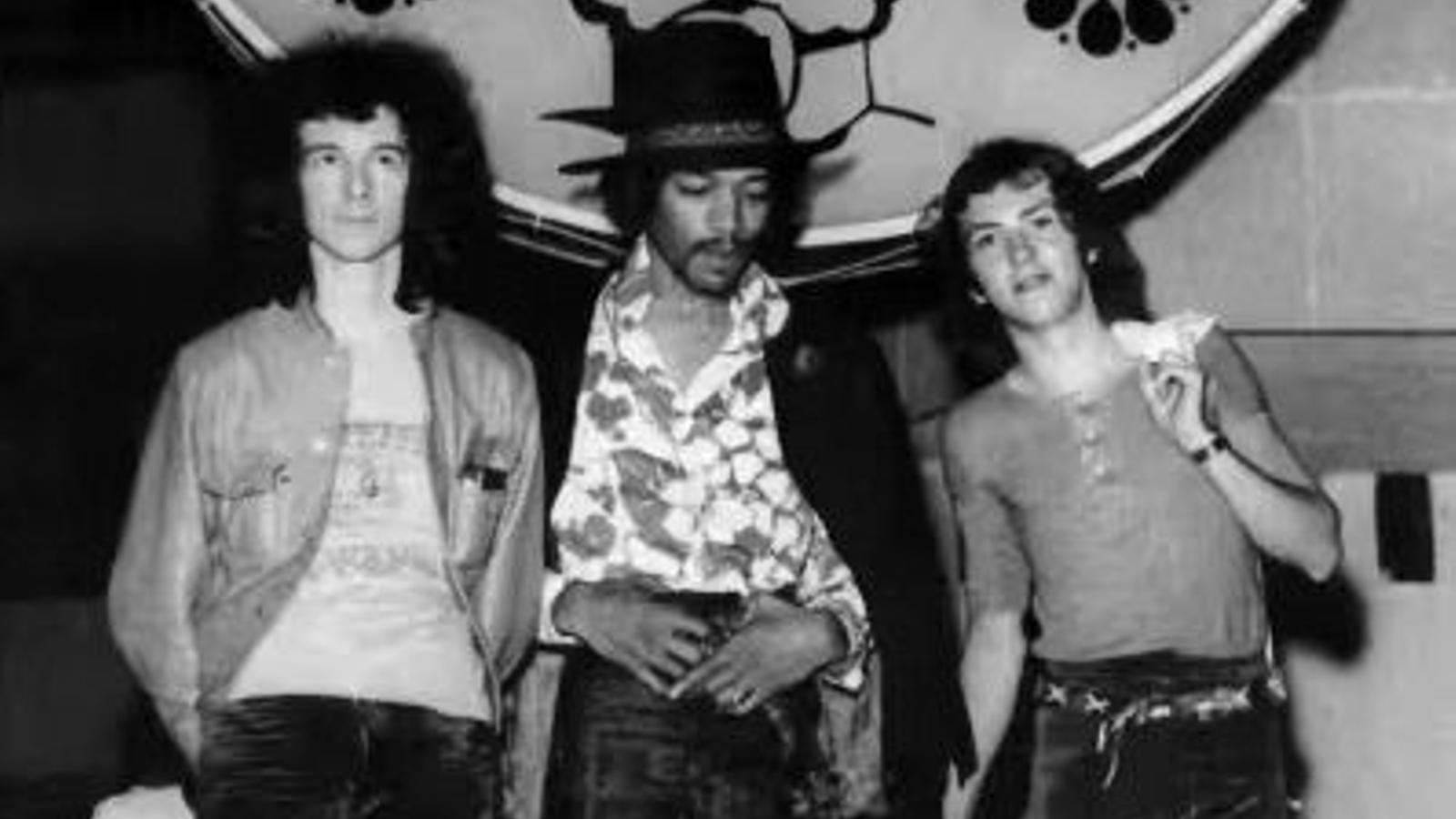
On July 15, 1968, the Sgt. Peppers nightclub was inaugurated in Palma, in the Neptuno building at the Plaça del Mediterrani in Gomila. It was owned by Mike Jeffery, manager of The Animals, and featured a performance by the artist whom the Englishman also represented: a Jimi Hendrix who was unknown to a good portion of the attendees, who were mostly English, among them the footballer George Best—a regular in Mallorca—and very few local Mallorcan members of the public. That said, the Z-66 were there, having played beforehand, along with, among others, the journalist Miquel Vives.
Iconic is the memory of the headstock of his Stratocaster crashing into the room's ceiling. A year earlier, images of him setting fire to his guitar at the Monterey Pop Festival in California had already gone around the world.
“Hendrix, who used to play the guitar behind his back or with his teeth, in one of those movements behind his neck, lifted it unintentionally and pierced the ceiling. The English interior designer that Jeffery had brought in to decorate the room put his hands to his head. It was the comical part of it,” recalls Vives, a broadcaster and music journalist of the time at Ràdio Popular and the newspaper Baleares.
“We were all quite scared,” admits Llorenç Santamaria, then singer for the Z-66. “I sang two Hendrix songs: ‘Fire’ and perhaps ‘Purple Haze.’ We admired him; especially Vicenç Caldentey was amazed by him. Although the reviews were bad because people were not used to this type of performance with distorted guitars, those of us who followed him were amazed,” he reminisces.

“I was quite disappointed, I was expecting to hear the true Hendrix,” reflects Miquel Vives. “I didn’t doubt his virtuosity on the guitar, but he was showing off. I saw an extraordinary guitarist with potential, but I didn’t like his stage presence: he came out with horrific ostentation, he was winking at the girls, sticking out his tongue…,” he recalls.
“I am convinced that he didn’t usually act like he did at Sgt Peppers, that he took it seriously and not in a party way. We shouldn't lose sight of the fact that he came to perform for free,” points out Vives. Jimi Hendrix agreed to play in exchange for a few days of vacation on the island. “The owner of the J&J club in Madrid wanted to hire him and left horrified, and Jeffery, who thought it would be a bombshell, got pissed off: it was the start of a tour,” he comments. Thus, the one in Mallorca became Hendrix’s only concert in Spain.
“If everyone who claims to have been there had actually been there, the Sgt. Peppers would have gone unnoticed. Most of the audience didn’t know who he was, he was known only by the four local musicians and those of us who were reporters. There were 150 people at most –out of the 700 capacity–, among whom were about seventy American marines. They had handed out advertising for the concert around the port,” recalls Vives: “It had no repercussions. A myth about the concert has been created.”
The person corroborating this is historian Tomeu Canyelles: “It has been oversized due to the Hendrix myth and his influence as an icon. Even so, it cannot be reduced to a simple anecdote. The unique circumstances that brought him to the island are highly descriptive regarding how the music industry worked back then and provides a high number of interactions with the Palma of the sixties beyond Sgt. Peppers. It is also an episode that activates the deceptive mechanisms of popular memory: stories that become distorted as the years pass and in which it is already difficult to distinguish what was true from what is part of the legend”. Canyelles has written the script for a film about to be released about that historical visit which has been portrayed by filmmaker Edu Biurrun. “I was interested in showing how memory works. Everyone remembers the events in their own way and over time memories transform, mix, and sometimes, become legend”, remarks the director.
The legend, in documentary
The Night of the Voodoo, Jimi's lost pedal, the documentary short film by Edu Biurrun, premieres on November 2nd at the 24th edition of In-Edit, the reference international music documentary film festival in Barcelona.
“The performance ended; the dressing rooms, small, were under the stage and there were trunks with guitars and pedals, and I remember that Jimi Hendrix gave Vicenç the pedal that everyone is looking for and no one finds,” says Santamaria about the Fuzz Face that ended up in the hands of the Z-66 guitarist Vicenç Caldentey.
“Everything revolves around this pedal, but it is an excuse, a common thread to talk about that evening, about an era and a generation that experienced a kind of cultural awakening. It works a bit like a Hitchcock MacGuffin: an object that sets the story in motion, but that ends up leading us to other places. It is also a symbol of how an object can end up becoming a legend,” comments Biurrun.
Of the distortion pedal, “the last record that exists is from the mid-eighties, when Luis Massot, from the group Taifa and Elikat, saw the pedal in Vicenç Caldentey's recording studio,” says Biurrun. “At that time, some fifteen years after the Hendrix concert at Sgt. Peppers, it showed significant deterioration. It is not bold to think that a half-rusted, half-peeled object ended up, unfortunately, in the trash. But it is not the pedal itself, but the search for it, as if it were a Holy Grail,” adds Canyelles. “I have followed the trail both in Mallorca and abroad, and that is as far as I can tell,” concludes Biurrun.
The documentary also features testimonies from the photographer Joan Torrelló, the author of the only eight photographs of the concert; the deputy director of the venue, Sandro Fantini, and the musician Ramon Farran.
“I am convinced that when the documentary is screened, new clues will emerge. Maybe we will have to make a second part. I have hours and hours of testimony, there is material to make a long documentary,” explains Edu Biurrun.
