Cars are already invading the surroundings of Rafal Rubí, heritage of Talaiotic Menorca
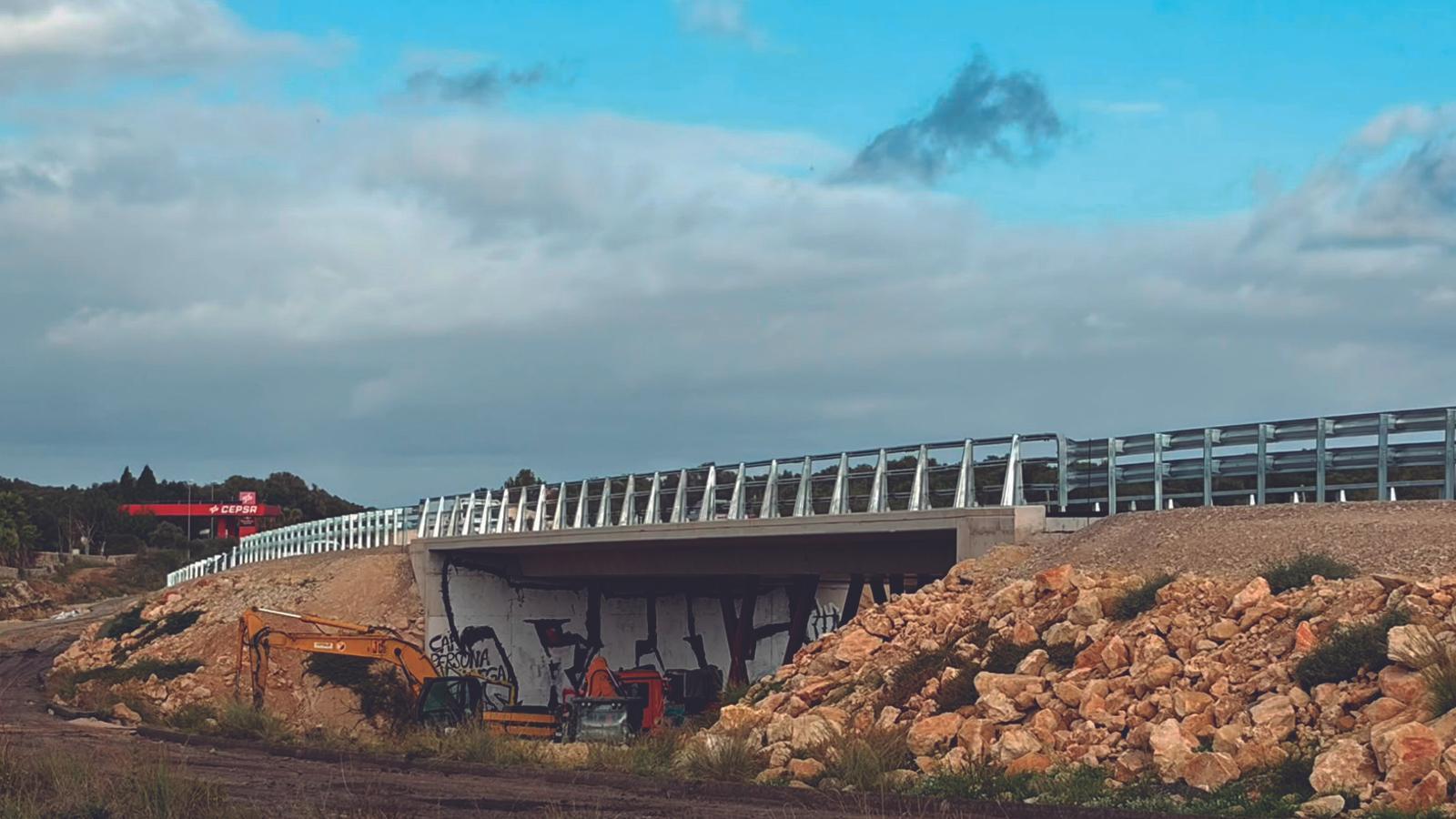
The Island Council finishes and opens to traffic the viaduct that UNESCO demanded be demolished, putting the World Heritage declaration at risk

-
CAT -
CAST -
DE
CitadelThe warnings have been of no use, nor the fear of losing the World Heritage recognition that UNESCO granted in 2023 to the valuable archaeological legacy of Menorca. The Popular Party government at the Island Council has disobeyed UNESCO and the Ministry of Culture and has gone straight ahead with the construction of the viaduct over the prehistoric navetas of Rafal Rubí, one of the sites included in the universal candidacy. Instead of demolishing the structure, as was demanded of it, it has maintained it and has traced over the viaduct the new section of the main road between Maó and Alaior. A policy of *fait accompli*.
For 12 years, since 2014, the bridge had been half-built. Specifically, ever since disagreements with the first contractor for the project and significant citizen mobilization against the four viaducts –former general Luis Alejandre, converted into a councilor, projected them on a stretch of only 10 kilometers– paralyzed work in the area. No one had acted there again until the current Council government relied on the internal favorable report from the Department of Highways to disregard all other technical and institutional pronouncements and commission the execution of the works for 6.5 million euros.
Formal complaint from the Ministry
A few days ago, the first cars passed over the bridge. On the same day, the representative of the Ministry of Culture to the Governing Council of Menorca Talayotic, Pablo Eduardo Jiménez Díaz, filed a formal complaint regarding the fact that the island government of the PP had pushed ahead with the works despite the repeated warnings from UNESCO and ICOMOS. And also from the Ministry, which is the only valid interlocutor in Spain before these international organizations. This was also made clear by the Minister himself, Ernest Urtasun, in a letter sent just as the works had begun, but all his warnings and public requests to the Council have been ignored by its president, Adolfo Vilafranca.
The specialists have not been listened to either. This December it will be a year since a hundred experts in Archaeology and Landscape from across the State made public a statement in which they warned the island Council of the “grave error” that meant wanting to finish the double-level roundabout at Rafal Rubí and thus face the criteria of UNESCO. The international body supported their complaint, as did the Ministry, but the Council did not.
“The entities,” explains Miquel Camps, from GOB, “can do nothing but wait for the steps taken by the involved institutions. The pronouncement from UNESCO demonstrated that our theses had foundation,” he remarks. But “the policy of accomplished facts” of the Council’s government has frustrated them, at least for now.
The Councilor for Culture and government spokesperson in the institution, Joan Pons Torres, already made it clear months ago that the Council would not rethink the project. He criticized the Ministry for not having sent all the documentation to UNESCO and clung to the legal report against demolishing the bridge to justify that the works should go ahead. “It cannot be torn down because, if one day there is a serious accident and it has not been finished, asset-based liabilities can be claimed,” he stated. He also insisted on prioritizing the opinion of the Roads department over that of Heritage to defend that the road reform would be carried out as planned “in order to ensure the safety of all Menorcans.”
The former president of the Menorcan delegation of the Architects' Association, Enric Taltavull, does not give up and, although he is still waiting for an intervention from the Ministry of Culture, he is looking for a way to file a contentious-administrative appeal in the courts against the Council. “The problem is that I might be considered a legitimized party to be able to take this action in the courts,” he explains.
Taltavull, who already legally warned the Council in April that it could incur in prevarication if it did not modify the project, admits to being “baffled by the island government's attitude”: “It is surprising that, despite the risk that UNESCO might take away our World Heritage designation, it has persisted in finishing the works and giving the surroundings of Rafal Rubí the same level of protection as any other site that is not included within the Talayotic Menorca. If in most cases only agricultural activity is permitted in the surrounding area, in this case, it has been allowed to build a viaduct which, most strongly, does not lead to any inhabited center”.
His suspicion is that the decision “responds to economic interests in order to favor the managers of visits to Rafal Rubí”. He alludes to the company Menorca Natura Turisme i Cultura, shared between Rafel Duran, former PP spokesperson in Palma who resigned due to his indictment in the Palma Arena case, and the former general secretary of the PP of Menorca, Salvador Botella, who is the owner of the service station closest to Rafal Rubí. Duran also manages Pendent Serveis i Gestió SL, in charge of managing the fortress of La Mola.
Architect Enric Taltavull insists that the Council should have modified this link in the same way it did in the area of the Biniaiet waste recycling center, where it ended up designing an at-grade solution. “It is not a technical issue, but a political one. The road project can no longer be the same as 12 years ago, when Councilor Alejandre and his team made the first design, since we are now a World Heritage site, but the Council has overridden everything”, he complains. The Rafal Rubí viaduct will thus remain, he says, “as a monument to the Council’s ignorance, having built a bridge to solve an intersection that leads nowhere”.
The nullity of the process invoked by Més per Menorca has also not been addressed by the secretary of the Council and the appeal filed to the same effect by the Federation of Neighborhood Associations of Menorca remains unanswered. “We have made it very clear that there was an alternative to what they have done and that the Council has not complied with the Unesco mandate”, says the coordinator of Més per Menorca, Esteve Barceló. “So the consequences that may arise will be solely the responsibility of the current government of the Council”.
