
The kilns of the Lloseta cement factory were largely fueled by aggregates extracted from nearby quarries, such as Can Negret (Alaró). Currently, the Balearic mining registry lists 220 quarries. Only a quarter (59) of the total are active, and another 47 are undergoing restoration, meaning they are in the process of recovering part of the landscape ravaged by exploitation. Of the remaining, 60 have expired, 29 are inactive, and 25 are paralyzed. Mallorca is the island with the most registered quarries (164), followed by Menorca (31) and Ibiza (21). Formentera has 4.Of the active quarries, the oldest is Son Amat (Porreres), with over a century of activity. Along with Serra Llonga (Felanitx and Manacor) and Can Negret, it is the largest in Mallorca. According to a 2020 study by the Balearic Natural History Society, between 1984 and 2018, these three consumed 135 hectares. The latest quarry to start operations is Can Vicens (Llucmajor), three years ago.Following the Balearic Mining Regulation Law approved in 2014, all quarries have had to undergo a regulation process. In our archipelago, the aggregates extracted from the stripped mountains are not exported. They are used for the construction of homes and roads, but also for the production of other products such as glass and plaster. Joan Estrany, Professor of Physical Geography at the UIB, offers the following diagnosis of the current situation of quarries in the Islands: “Having quarries means we don’t have to export raw materials for construction. The number can be resized according to our urban development, which doesn’t necessarily mean building more, but rather restoring existing housing. The demolition waste from these homes can be recycled as new building materials, which would reduce our dependence on quarries”.Estrany assures that the impact of quarries is not only visual but also ecosystemic. “As they are closed, it is very important that restoration processes are carried out correctly. Often, the excavated mountains are filled with rubble that has passed relevant environmental controls to prevent, among other things, the contamination of aquifers, which have already suffered damage from aggregate extraction. Work is being done to create new soil that favors the regeneration of the vegetation that was there before, whether it was garrigue or holm oak forest.” An old quarry now undergoing restoration is that of Campassos, in Biniamar (Selva). Inactive since 2003, it covers a degraded area of more than eight hectares. In 2023, Son Bernadí in Felanitx was recovered and converted into an agricultural farm.
"Lloseta was like Las Vegas": 60 years of cement and environmental struggle
60 years ago, in the midst of the construction frenzy of the tourist 'boom', a monumental cement factory was inaugurated in Lloseta. In 2005, a group of neighbors imposed environmental measures on the company through the courts, which has now specialized in the generation of renewable energies.
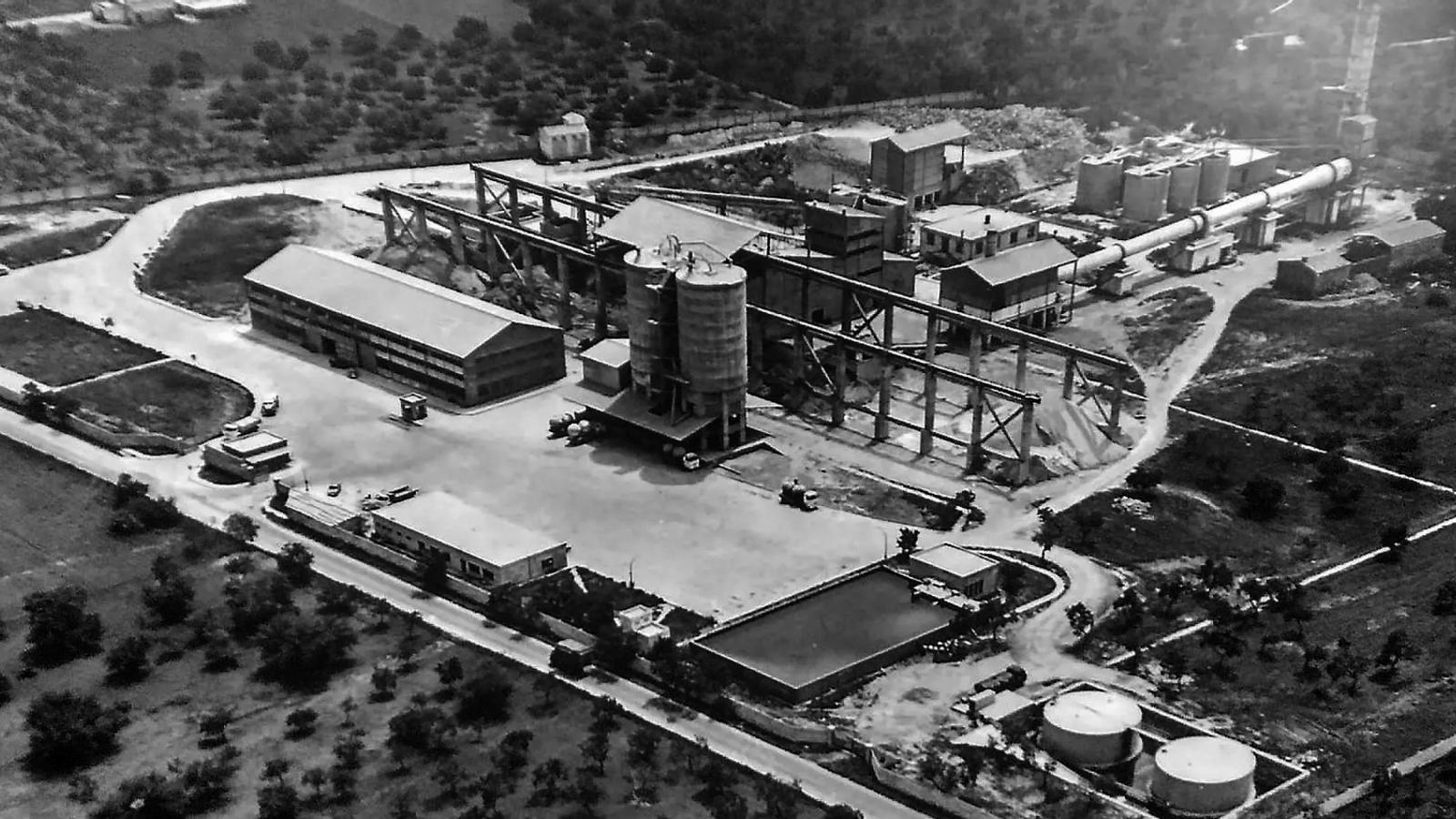

For 60 years, the gigantic tower of a cement factory has presided over the heart of Raiguer, at the foot of the Tramuntana mountain range. The emblematic industrial complex of Lloseta recalls the smoky nuclear power plant of Springfield, where the character of Homer from the mythical animated series The Simpsons works. The inauguration of the infrastructure in August 1966 was celebrated as a great milestone of progress. The same had happened in 1958 with the commissioning of the Alcanada (Alcúdia) thermal power plant, with which Gesa brought electricity to a large part of Mallorca – in 1981 it would be taken over by the Murterar plant, located about 10 kilometers away, near l'Albufera.
The Lloseta cement factory allowed the dictatorship to be more self-sufficient. In the 50s, with the outbreak of the boom in tourism, Franco did not hesitate to sacrifice his furious anti-communism to feed the concrete mixers of hotels and developments. This is explained by the Inquer researcher Joan Buades, author of the book On brilla el sol (2004): “The bulk of the construction materials curiously came from communist states, the mortal enemies of Spanish fascism. Ormein-Cemento, for example, could bring 10,000 tons of cement from Ceausescu's Romania to Palma on the ship Anthas, in one go”.
Initially, the first cement factory in Mallorca was to be built in Biniamar (Selva). In 1958, the company Cementos Portland laid the first stone. That location, however, would be discarded in favor of land on the outskirts of Lloseta with an important vein well. The municipality, halfway between Palma and Alcúdia, also had mines and quarries, from where the raw material for the factory was extracted. Since the end of the 50s, not far from the chosen location, there was the Foro de Mallorca, which gave the impulse to consumer society on the island.
La fàbrica Portland
In 1971, five years after its inauguration, the already named Portland factory was expanded with a second kiln. Supervising the works was Antonio Robles Rubio, a native of a small town in Jaén. “When I was young – he recalls today at 78 years old – I had studied hydrometallurgy in Seville and immediately went to work in Bilbao, which was the industrial epicentre of Spain. From there they sent me to Lloseta”.
Upon completion of the second kiln's construction, the Andalusian returned to Bilbao. However, after a short time, he decided to settle in Lloseta. “I saw that I could have a good future here working at Portland. The town was small, but with enviable industrial activity. There was a very strong footwear industry, with about thirty factories, and mining sustained mainly by people from the Peninsula who arrived in the 60s after the mines in their towns closed. The majority were from Puertollano (Ciudad Real) and Antequera (Málaga). Many miners ended up working at the cement factory”.
Portland reached almost 200 employees on staff. “The majority were residents of Lloseta. We had to be specialists in mechanics – says Robles. Our salary doubled that of a stonemason, a waiter, or an employee in a shoe factory. The industrial complex also employed external companies. That activity, along with that of footwear, generated a lot of prosperity. Lloseta was like Las Vegas, with about twenty bars, which closed at three in the morning. The streets had a great atmosphere and a lot of money circulated. Some people were able to buy a second home on the coast. I ended up marrying a woman from Lloseta, with whom I have had two children”.
‘No dust, no noise...’
Portland's pace of work was frantic. “The factory never closed. It was open seven days a week – says the veteran worker, retired for 20 years. We worked day and night shifts. In the 70s, some years 700,000 tons of cement could be produced. Construction was in full swing. Trucks didn't stop entering and leaving the premises, loaded with cement. Builders were going wild to make money”. In the autumn of 1977, the gargantuan infrastructure would be the target of criticism from the nascent environmental movement. The leading voice was that of the entity Terra i Llibertat, which in July of that same year had already occupied the small island of Dragonera in Andratx to prevent its development. One of its members was Miquel Fiol, an architect by training. “For a few days – he recalls today at 82 years old – about fifty people, including people from Unió de Pagesos, gathered in front of Portland with the slogan ‘No dust, no noise, no holes in the mountains’. We were not against that industry. We only demanded that the factory be resized to reduce the nuisance to neighbors and CO2 emissions”.
Those ‘green warriors’ did not hesitate to demonstrate in the streets of Lloseta. “There were neighbors – Fiol points out – who supported us. The women complained that they couldn't hang out the laundry because of the dust and that the shutters were always dirty. It was a very corrosive dust that also caused the death of many trees on nearby properties. Although our demands were ignored, at least we were the first to, in the midst of the construction frenzy, ask for things to be done differently”. One of Terra i Llibertat's spokesmen was Robles himself, who was then president of Portland's works committee. “I – he says – understood them. In the meetings, however, I always told them that we accepted their proposal to resize the factory as long as they could guarantee us jobs in other equally well-paid sectors, which was difficult”.
David versus Goliath
In the year 2000, the struggle of Terra i Llibertat was continued by a new entity, GADMA (Group of Friends for the Defense of the Environment). 23 years later, about eighty residents from Lloseta, Binissalem, and some from Inca rescued the slogan ‘No dust, no noise, no holes in the mountains’ from oblivion. The spokesperson for the group is Bernat Fiol from Binissalem, 68 years old: “We also demanded that the multinational Cemex, the new owner of the Lloseta cement factory, adopt environmental measures. We were tired of the dust that, due to the wind, affected the Binissalem area more. That infrastructure was legal. What was not legal was the atmospheric, acoustic, and light pollution and the dirt it generated for the neighbors”. Those activists had to be patient. “There were people who told us that without cement we would have nowhere to live. However, it was not about going against any industry. We just wanted public health and that of nature to prevail”.
In 1996, four years before that new environmental struggle, Greenpeace had already mobilized against the inauguration of the Son Reus incinerator in Palma. The environmental organization, then led by the Mallorcan Xavier Pastor, managed to secure an important commitment from the island's Minister of the Environment at that time, the socialist Francesc Antich. To avoid so much pollution, Tirme, the company that held the concession for the facilities, would reduce dioxin emissions and, at the same time, would bet on a strong recycling campaign.
With Greenpeace's partial success, GADMA felt empowered to take Cemex to court. “We did it through the civil route – assures the leader – because the right to live without disturbances had to prevail. Through the criminal route, the chances of success were minimal. Meanwhile, we started an information campaign for the citizens with assemblies and interviews in the media”. Finally, in 2005 a sentence confirmed the damages caused by the cement factory and obliged the company to pay compensation to those affected and to apply corrective measures.
After that investment, in 2018, with the hangover from the real estate bubble crisis, Cemex announced a workforce regulation file (ERO) with the intention of starting to transfer cement production from Lloseta to a branch in Tarragona. In 2022, it adopted a renewable energy generation plan and specialized in green hydrogen. In 2024, the infrastructure's furnaces were definitively closed and the company committed to the Government to dismantle the two cyclone towers before 2031.
Now, in Mallorca, all cement is imported. There is only the Sa Cimentera de Campos factory, founded in 1985, which produces it artisanally. “The closure of Portland – concludes Fiol – was David's victory against Goliath. It shows that citizens have more strength than we think. We must persevere and not be discouraged by things that seem impossible”. Now GADMA's fight continues on other fronts: it provides environmental education in schools, organizes cleaning tasks in forests, beaches, streams and other natural spaces, carries out restorations of cultural heritage and works on the recovery of public paths that, due to some individuals, are not freely accessible.

