
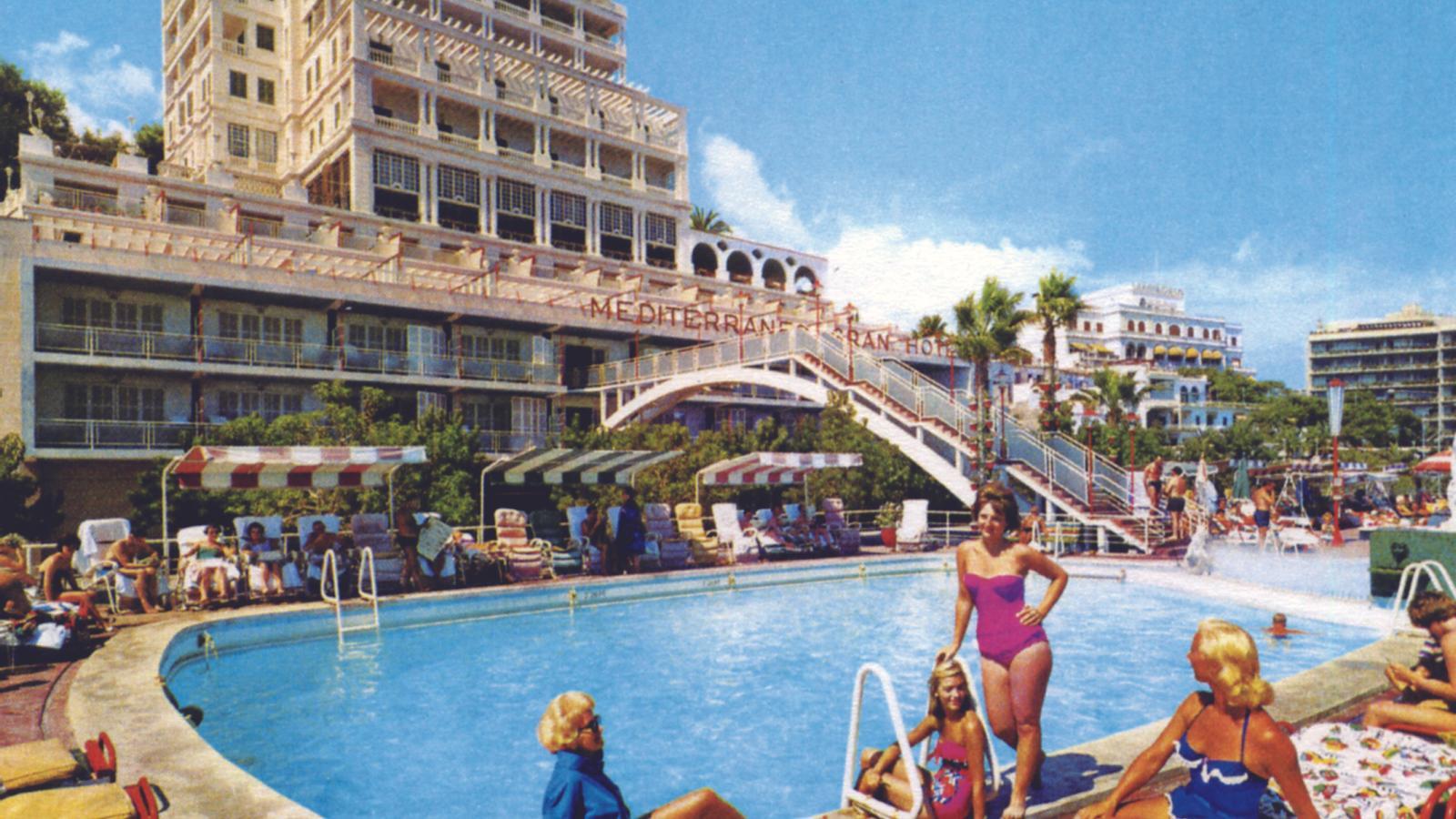
Hotels, the great monuments of consumer society, were the undisputed protagonists of tourist postcards, which visitors usually bought at the reception of the establishments themselves. They were constructions that represented the fulfilled dream of the middle classes to enjoy a holiday in an idyllic setting. In a time when there was no Instagram, it was a way of saying “I was here”. It mattered little that the desired destination was a country with a dictatorship that continued to sign death sentences. In 1963, the communist leader Julián Grimau was shot, while the anarchists Francisco Granados and Julián Delgado were executed by garrote vil. That same year, the Valencian filmmaker Luís García Berlanga dared to denounce the double face of Francoism in the film El Verdugo, set in the glittering sun and beach Mallorca.Postcards with images were born at the end of the 19th century with the tourism industry. They immortalized different places in the country being visited. Francoist Spain of the tourist boom did not hesitate to use them as a great advertising tool to project a benevolent and modern image of the regime, often under the heading Spain is different – photographs of bullfighters and flamenco dancers alternated with those of paradisiacal beaches, hotel swimming pools, and historic buildings such as palaces, churches, and cathedrals. In Mallorca, the Catalan Josep Planas was the main supplier of these 10.5 x 15 cm full-color cardboard souvenirs. In 1948, he opened Casa Planas on Colom street in Palma, which would have branches in El Terreno, Son Alegre, Can Pastilla, and Antoni Maura avenue. Orders came from everywhere, from media outlets and hotels to institutions such as Foment del Turisme and the Ministry of Information and Tourism. The company, which closed in 2002, reached over 200 employees. Planas eventually associated with the publishing houses FISA and Escudo de Oro, responsible for national guides and postcards.Although there was no photoshop at that time, some tourist postcards were manipulated. The colors of some swimsuits could be changed, and the blue of the sky could be made more intense. Images from other tourist destinations were also used. Thus, a sunset from the Caribbean could be used to promote Formentera and Mallorca at the same time. The scene was completed with a palm tree (a symbol of exoticism) and a loving couple strolling along a calm sea (the image of absolute happiness). Another recurring theme of tourist postcards was photographs of women in bikinis and, in democracy, directly nude. They were a sexist attraction that presented the Balearic Islands as a theme park of carnality under the lens of the heteropatriarchy. The result of all this was the trivialization of the landscape in the service of the industry of desire and happiness that capitalism devised to continue exploiting the working class.
Hotels, the 'monuments' of the tourist 'boom'
Many tourist postcards featured the large masses of concrete that rose in the Balearic Islands as a symbol of prosperity after the well-known 'years of hunger'. The Casa Planas archive has just held an exhibition on this at the Toni Catany Foundation.

-
CAT -
CAST -
DE
PalmaThe paradigm shift that the tourism boom caused in Spanish agrarian society is reflected in the film El turismo es un gran invento (1968). Its protagonist (Paco Martínez Soria) is the mayor of a small Aragonese village who wants to turn the municipality into a large modern tourist center. His role model is Marbella, where he travels with his secretary (José Luis López Vázquez) to take notes. Both are amazed not only by the bikini-clad Swedish women, but also by the monumental hotels on the Andalusian coast, the great icon of progress at the time.
The history of hotel projects in the Balearic Islands can be traced in the doctoral thesis La construcción turística en las Islas Baleares (1939-2005). Arquitectura, urbanismo y fotografia (2019). Based on this line of research, its author, UIB professor María Sebastián, an architect and art historian by training, has just commissioned the exhibition Arquitectura de postal. Arxiu Casa Planas. It can be visited until October at the Toni Catany Foundation/International Photography Centre (Llucmajor). It is a selection of the enormous production of Josep Planas i Montanyà (1924-2016).
Originally from Cardona, Planas arrived in Mallorca in 1945 to do his military service. He was in the right place at the right time to be the first photographer to capture the developmentalism that allowed Francoism to emerge from autarky. With color images (a real novelty at the time), he used postcards as a tool for the tourist promotion of his adopted island – he would produce more than 50,000, currently in the process of being cataloged. In the late 50s, the Catalan also stood out for being the first photographer in Europe to buy a helicopter to capture aerial shots.
‘American way of life’
In 1951, the I Assembly of Tourism of Mallorca took place in Palma, which was to lay the foundations for the reactivation of the tourism industry initiated in 1903 with the inauguration of the Gran Hotel de Ciutat. It was necessary to take advantage of the new consumer society born after the Second World War. With the generalization of paid holidays, the act of travelling, which was previously reserved for a wealthy minority, became democratized. For the occasion, many military aircraft were converted into commercial ones. In 1953, the ground for exploiting the well-known goose that lays the golden eggs was more than ready with the signing of the famous Madrid Pacts. The United States undertook to economically aid the Franco dictatorship in exchange for it acting as an anti-communist bastion in the West during the Cold War. Among the agreements sealed were the installation of American bases in Spain (including Puig Major) and the entry into the country of tourism companies, which would be the conduits of the American way of life.
Encouraged by his American friend, Franco sacrificed the morality of national Catholicism to enjoy the succulent foreign currency provided by the tourism industry. For his doctoral thesis, Sebastián has studied more than 900 island hotels built at that time. Many colonized the frontline of the sea in a process of territorial destruction known as 'Balearesization'. The concept emerged in the late 50s from a smear campaign disseminated by the French press. Its creators were a group of hoteliers from the Côte d'Azur, fearful of the competition offered by establishments in the Balearic Islands. In order to dissuade tourists from visiting the Archipelago, they warned them that it was an unattractive destination due to being overcrowded and saturated with buildings. The reality, however, was that the south of France was just as built up.

Shameful architecture
Faced with the concept of ‘balearization’, a new one emerged in 2002: ‘shameful architecture’. It was coined by the Catalan Ricard Pié, Professor of Urbanism and Territorial Planning at the UPC, in the book La Arquitectura del sol. “With this expression – assures Sebastián – Pié wanted to claim the need to know well the tourist architecture that had always caused rejection and that tourist postcards used to present as great monuments of modernity. He considered that it had to be studied rigorously, as had already been done with the rest of architectural typologies”.
“In the Balearic Islands – points out the researcher – at first, architects from outside and new to hotel construction arrived. As the pace accelerated, other professionals designed in a less reflective way. It was then that standard building models, soulless, emerged, in line with the concept of ‘non-place’ created in 1992 by the French anthropologist Marc Augé”. In 1959, in order to favor the real estate business of big capital, Franco approved the Economic Stabilization Plan. The definitive impulse of the known Spanish miracle arrived in 1963 with the Law on Centers and Zones of National Tourist Interest, which further incentivized the depredation of areas of high landscape value. Then some tour operators began to build their own hotels directly. This was the case of the Belgian Airtours, which built the enormous Tropicana complex in Cala Domingos (Manacor), integrated into the Cales de Mallorca complex.
In order to recover the investment made, tour operators filled the planes with tourists to take them to the Balearic Islands, which were seen as a gold mine. These were the well-known charter flights (in English, ‘to charter’ means ‘to rent’). “The hotel receptions,” affirms Sebastián, “were very large so that all the tourist packages could fit while they waited for a room assignment.” That construction fever overwhelmed the town councils. “In the autumn, the avalanche of requests for construction work occurred to have the hotel finished within two summers at the latest. Some municipalities did not have any urban planning regulations developed. You could build anywhere with any number of floors you wanted. There was no sewage system planned either, so the dirty water ended up in the sea. It wasn't until 1970, when it was too late, that the dictatorship tried to put order to that mess with the Decree on Tourist Infrastructures”.
The assassination of the architect Ferragut
Amidst that industrial production of hotels, there were architects who had the good fortune to be able to impose their own style with singular, entirely innovative projects, influenced by international trends. This was the case for Francisco Goicoechea and Jacinto Vega, who in 1955 inaugurated the first modern hotel in the Archipelago, the Bahía Palace, on Palma's Maritime Promenade. The Catalan Francesc Mitjans, the architect of the Camp Nou stadium (1957), built the Hotel Araxa (1958), in the Son Armadans residential area of Palma. Francisco Javier Sáenz de Oíza designed the Ciutat Blanca (1963) in Port d'Alcúdia. José Antonio Coderch built, in Illetes (Calvià), the Hotel de Mar (1964), which the Minister of Information and Tourism, Manuel Fraga, inaugurated as number 1,000 in the entire Archipelago with the NO-DO newsreel as its mouthpiece. And Miguel Fisac left his mark on the Eurotel Punta Roja (1968), in Costa dels Pins (Son Servera). In this vein, local professionals such as Gabriel Alomar and Felipe Sánchez-Cuenca, who designed the Punta Negra hotel (1965) in Costa d'en Blanes (Calvià), and Josep Ferragut, the architect of the avant-garde Gesa building in Palma, who, among other hotels, designed the Morocco (1959) in Palmanova (Calvià) and an apartment block in Lago Esperanza, in Port d'Alcúdia (1965), also stood out.
Despite having participated in the construction frenzy, Ferragut was the first voice to cry out against the “urban planning chaos” of the tourist boom. He wrote extensively for the press and in 1960 also decided to film a documentary with his home camera titled Ciudad de Mallorca, in which he already denounced the touristification of an island handed over to speculators. In 1968, at the age of 56, that ‘enemy of progress’ was found dead in a vacant lot on the old Bunyola road. According to the police version, he was stoned to death by two young delinquents whose homosexual services he had supposedly solicited. According to the family, the crime was ordered by the powerful forces of Francoism.
In 1973, five years after Ferragut's assassination, ecological awareness in Mallorca awoke with the GOB. Faced with the island's destruction, the green entity undertook a series of toponymic struggles: 'Save Dragonera', 'Save Es Trenc', 'Save Cala Mondragó'... That same year, the international oil crisis occurred, thanks to which grandiose urban development projects such as Isla Ravenna in La Canova (Artà) were halted. “Many hotels –concludes Sebastián– also closed and a few were converted into housing. This was the case of the Hotel Mediterrani, inaugurated in 1923 on the Palma seafront. After the crisis, Jaume Cladera, the first Minister of Tourism [1983-1993] under the popular Gabriel Cañellas, favored the construction of horizontal, lower-rise hotels. This reduced the visual impact at the cost, however, of consuming much more territory”.
