PalmaBlai Bonet says in the prologue of The mahi-mahi: a myth of autumn, by Enric Massutí and Sebastià Vidal (Documenta Balear, 1997), that the dolphinfish is a long-awaited being. It does not arrive until the weather signals its time and it leaves when the weather announces the end of its presence, at the end of autumn. Few words describe so well the relationship between this fish and the sea's calendar.
There are fish that are part of the maritime calendar just as fruits are part of the earth's calendar. The mahi-mahi is one of these fish. This migratory animal approaches coastal waters at the end of summer and the beginning of autumn, just when the first storms announce the change of season. It is also the time when its fishing traditionally begins in Mallorca. "When it lightnings, the mahi-mahi arrives," says the saying, turning the lightning bolt into a sign from the sea because when the sky begins to break the summer, the mahi-mahi announces that its time has arrived. The saying also hides a particularly suggestive wordplay. In Catalan, ‘llampuga’ does not only designate the fish. The DCVB also collects ‘llampuga’ with the meaning of lightning or flash, especially in the dialect of Mallorca, and ‘llampugar’, ‘to make flashes’, that is, ‘to lightning’. The word is thus part of a family linked to light and radiance. Its etymology is not entirely defined: it has been related to a hypothetical Latin word ‘mahi-mahi’, linked to ‘tlampada’ (‘light’, ‘lamp’) and a Greek origin has also been proposed for it, from ‘lamp’ (‘the resplendent one’). The association is even more beautiful if we look at the live fish as it swims in the sea. The mahi-mahi seems made of light: the greenish-blue back, the silvery sides, and the yellow and golden reflections change with the movement and the incidence of the sun.
Ways of looking at it
The ‘Coryphaena hippurus’, its scientific name, receives various names around the world, each linked to a specific way of looking at it. Just as for us it is the 'llampuga', in some Spanish-speaking territories it is known as ‘dorado’, a very defining name that refers to its yellowish tones. This name is also common in several American countries such as Mexico, Cuba and Ecuador, to give a few examples. In English it receives the curious name of ‘dolphinfish’, ‘dolphin fish’. The appellation can be confusing, because it is not a dolphin nor does it have any relation to these marine mammals. To avoid confusion, especially in the gastronomic and commercial sphere, the name ‘mahi-mahi’ has spread internationally. In Hawaii, precisely, ‘mahi-mahi’ is a deeply rooted name. The Hawaiian name means ‘very strong’ and emphasizes a different characteristic than the one we find in the Catalan and Spanish names: not the light or the color, but the strength and vigor of a fast and powerful fish.
The Mediterranean also preserves a great repertoire of names: ‘lampuga’, ‘indorada’ and ‘kapuni’ in Italy; ‘lampuka’ in Malta; ‘lampuga’ in Croatia; ‘coryphène’ and ‘dorade-coryphène’ in French, and ‘bille’ in Tunisia.
Blai Bonet said that the 'llampuga' is an awaited being. Perhaps its many names are also a form of this waiting, words that for centuries have served to recognize it when it arrives, to distinguish it from other fish and to fix in memory the exact moment of its appearance.
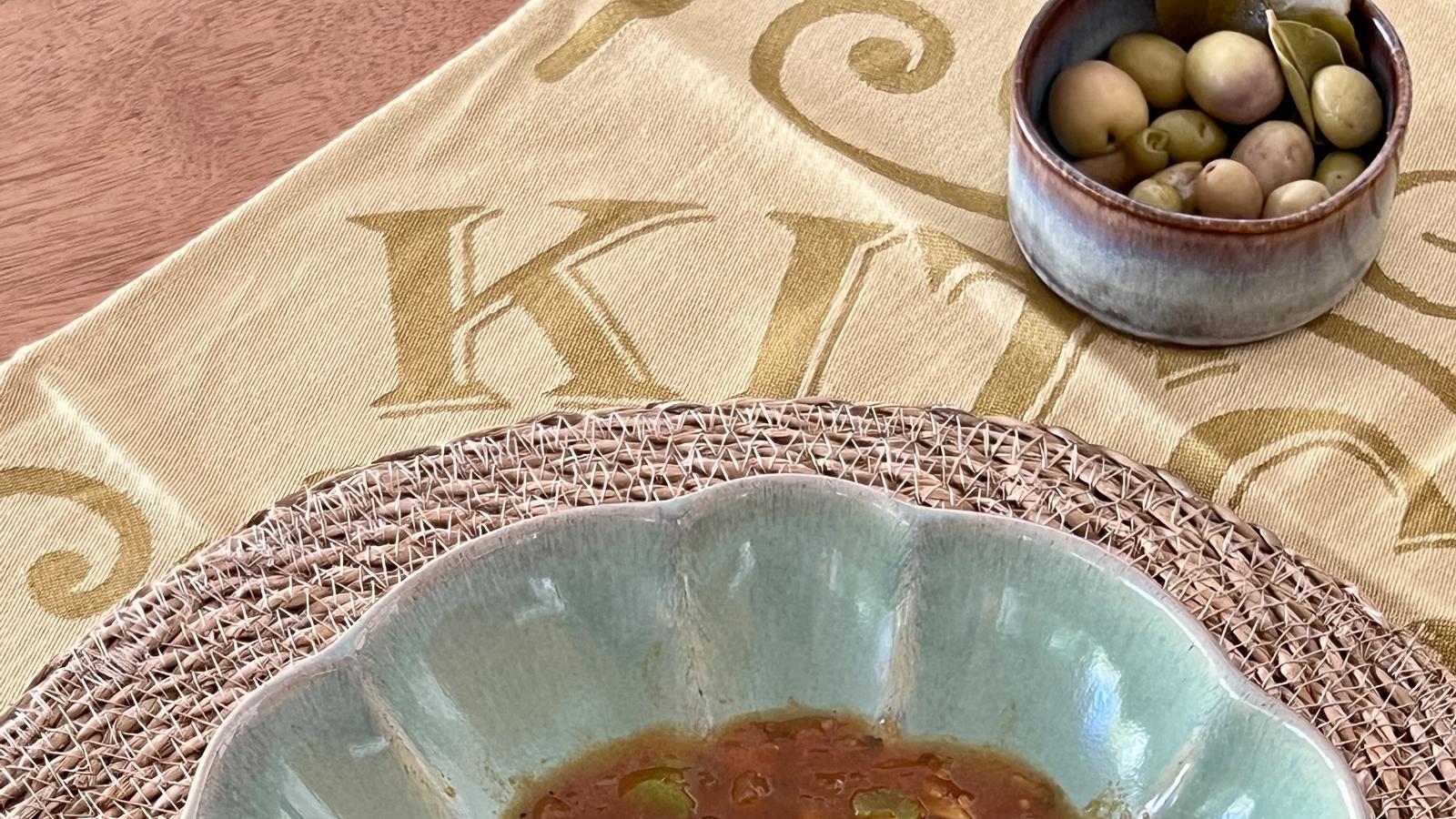
Today's recipe is an interpretation of a Sicilian dish described in La llampuga: un mite de la tardor.
Dolphin fish stew
First of all, we will boil the celery and reserve the broth.
We will sauté the onion cut into small squares. When it is golden brown, we will add the tomato and half a cup of celery broth, the chopped celery, salt, and black pepper. We will let the sauce reduce over low heat.
We will flour the fish and fry it. We will let it drain on absorbent paper.
We will add the olives and capers to the sauce. We will pour in the white wine, a splash of vinegar, and add the fish. We will let it cook for 5 minutes and serve it.
Ingredients
l 1 kg of mahi-mahi cut into slices
l 100 g of pitted green olives
l 1 stalk of celery
l 1 onion
l 50 g of capers
l 100 g of tomato sauce
l 1 splash of vinegar
l half a glass of white wine