The origin of the art market in Mallorca
The restaurateur José María Pardo publishes a detailed history of the Foment de la Pintura i Escultura society that promoted art on the island between 1876 and 1904
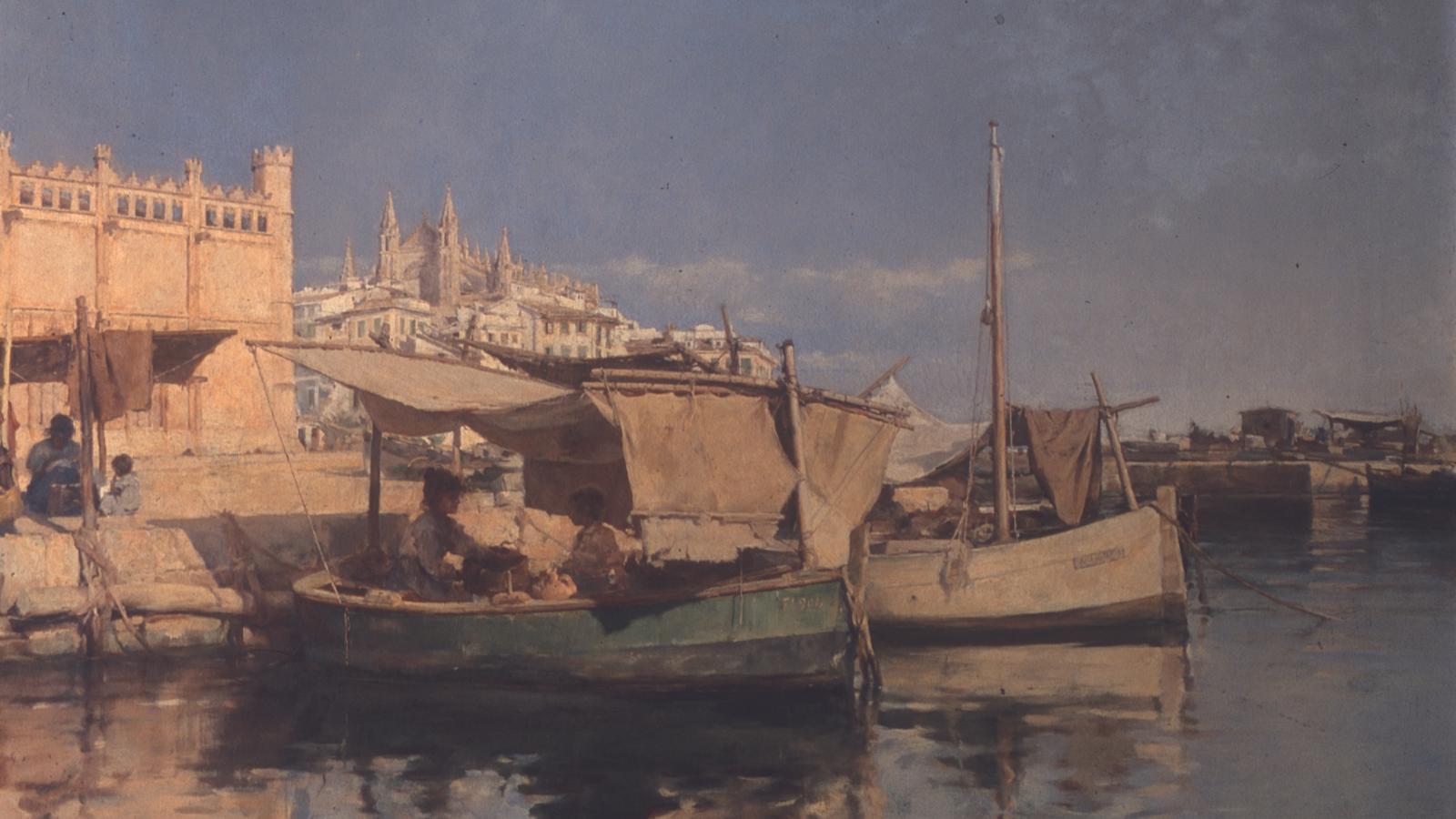

PalmaThe history of the art trade in Mallorca cannot be understood without the emergence, at the end of the 19th century, of a society that turned painting into an object of desire and a business capable of moving significant capital. We are talking about the Foment de la Pintura i Escultura, a social entity active in the city between 1876 and 1904, but about which little has been said until now. The restorer of works of art José María Pardo Falcón now reconstructs that collective adventure in the essay-book "La sociedad del Fomento de la Pintura y Escultura. Palma 1876-1904", edited by Ensiola and with a prologue by professor Catalina Cantarellas. The volume will be presented on May 7 at the Quars bookstore, in a conversation between the author and Cantarellas herself.
The book exhaustively documents how the Foment de la Pintura i Escultura became the seed of the first stable art market in Mallorca. For almost three decades, this entity, driven by painters, bourgeois, institutions, and patrons, created a circuit for buying, selling, exhibiting, and raffling works that until then did not exist on the island. "The great triumph of the Foment is that anyone who owned a share could participate in the raffle, buy, or, in the early days, even contribute a painting of their own," explains Pardo. Furthermore, he highlights that the extraordinary longevity of the Foment – 28 years – has practically no comparison with similar initiatives in the State. According to José M. Pardo, this long duration is explained by the transversal support it received from the beginning, with the involvement of the main political, social, and cultural strata of Mallorca at the time, to the point of granting it a certain quasi-institutional character.

The Foment was born in a context of social and economic change. The Restoration had consolidated a new urban bourgeoisie with purchasing power and a desire to distinguish itself culturally. Painting had become a fashion. The homes of well-off families demanded images and decoration, and artists needed channels to sell their works. "All the inhabitants of Palma with a certain position needed paintings at home," summarizes the author.
The trigger also had an international component. The death of the painter Marià Fortuny, in 1874, had sent the prices of Spanish painting soaring and had increased collector interest. Mallorcan artists, who until then had exhibited mainly in the artistic societies of Barcelona, found in the Foment their own alternative after the closure of some of those Catalan entities.
Among the main promoters were painters such as Ricard Anckermann, Emili Pou and Joan O’Neille, who had the support of the Palma City Council, the Provincial Deputation (predecessor of the Consell de Mallorca), the Bishopric, the civil government, the military government and entities such as the Círculo Mallorquín. Linked to the Academy of Fine Arts, the Foment de la Pintura i Escultura was mostly presided over by professors and painters from the same Academy, including Fausto Morell, O’Neille, Anckermann, Joan Mestre and Francesc Parietti. Great names from Mallorcan society of the time also participated. Archduke Lluís Salvador was one of the main shareholders and the first major subscriber was Sureda Villalonga.
An innovative formula
The Foment's operating formula was innovative and effective. The collective desire to make Palma a modern artistic center combined with the incentive of chance, as shareholders could obtain works through periodic lotteries of monetary amounts to purchase them. This mechanism would end up defining its own model that, according to Pardo, stimulated artistic creativity by remunerating it, centralized and commercialized the works of local artists, and kept interest in art and painting alive during the last third of the 19th century and afterwards. The Foment was financed through small monthly fees and managed to gather nearly 500 subscribers and over a thousand shares. In the early years, lotteries were held every three months and activity was intense. The dynamics of the lotteries and private sales ended up establishing artistic and economic benchmarks and generated a local market practically nonexistent until 1876. The exhibited works bore labels with the price, a mechanism that contributed to normalizing the purchase and sale of art and to giving transparency to the market.

Pardo also provides very precise data on the economic dimension of the phenomenon. Between 1876 and 1885, in the first 35 raffles, the Foment distributed 35,025 pesetas in 357 prizes. Between 1886 and 1904, despite the progressive decline of the entity, it still distributed nearly 37,000 more pesetas in 68 raffles and 435 lots. In total, more than a hundred raffles ended up awarding almost 800 works of art for a value exceeding 70,000 pesetas, not counting the private sales that were also channeled through the Foment. Artists, many of whom earned modest salaries as professors or civil servants – Anckermann, who presided over the Academy, had a monthly salary of 125 pesetas –, finally found a structure that allowed them to consolidate their work.
“The real phenomenon of the Foment is above all the first three or four years”, points out Pardo. Between 1876 and 1879, the society experienced its most prosperous period. Palma even had a permanent salon where artists and amateurs exhibited, and commercial activity was constant. Many of the works produced in Mallorca passed through the Foment or through the most refined shop windows in the center of the city.
The book also reconstructs the progressive decline of the society. From 1885 onwards, subscribers decreased, the entity lost stability, and even ended up without its own premises. A large part of its activity can only be followed through press notices that Pardo has patiently recovered in an extensive documentation effort. The author has reconstructed the history of the Foment from regulations, advertisements, newspaper chronicles, and scattered documentation, thus offering a very precise snapshot, not only of the entity, but also of the cultural life of Palma at the end of the 19th century.
The comeback arrived in 1897 thanks to a new board led by Alexandre Rosselló as president and Martínez Rosich as vice-president, considered by Pardo one of the great dynamizers of the society's last stage. However, the turn of the century definitively transformed the artistic landscape. The emergence of new aesthetics accelerated the decline of a society still very attached to academicist postulates. Pardo particularly emphasizes the struggle between Santiago Rusiñol and Antoni Gelabert, on the one hand, and Joan O'Neille, on the other, as one of the episodes that precipitated the definitive dissolution of the Foment in 1904. The emergence of modernism and figures like Santiago Rusiñol changed tastes and cultural dynamics. Rusiñol had arrived in Mallorca in 1901 to paint the canvases for the Gran Hotel and shortly after promoted the first major modernist exhibition on the island. In 1902, he promoted an exhibition of the painter Antoni Gelabert in Barcelona. The artistic world was entering a new era and the Foment's model was beginning to seem old-fashioned.
A deep footprint
However, Foment's impact was profound. The lottery system itself particularly benefited the main consistent shareholders: the Provincial Council obtained 38 prizes; Archduke Luis Salvador, 29; the Círculo Mallorquín, 22; and the Palma City Council, 11, which translated into the purchase of works. Despite this, the profits remained far from the financial contributions these institutions and personalities had made to sustain the project. However, many of the current institutional art collections originate from those lotteries and acquisitions. Some of the works that the Consell de Mallorca and also the Palma City Council preserve today come directly from Foment de la Pintura i Escultura, where they were purchased after the lotteries. The Parliament also preserves pieces linked to that 28-year history, heir, in part, as this institution is, to the heritage of the Círculo Mallorquín, which was located in the building that today houses the parliamentary chamber. And, on another level, later collections such as Sa Nostra's ended up acquiring works that had initially circulated in that market.
José María Pardo's book is not just the history of an artistic society. It is also a portrait of a city discovering art as a sign of modernity, of a bourgeoisie beginning to collect painting, and of artists who, for the first time, found a stable mechanism to professionalize themselves. In short, it is the story of the moment when Mallorca began to build its contemporary art market.
