A whole life searching for Daria and Mercè, murdered in Manacor in 1936
Carles and Ann Buxadé have dedicated decades to reconstructing the history of the two nurses, found in Son Coletes, to restore their memory
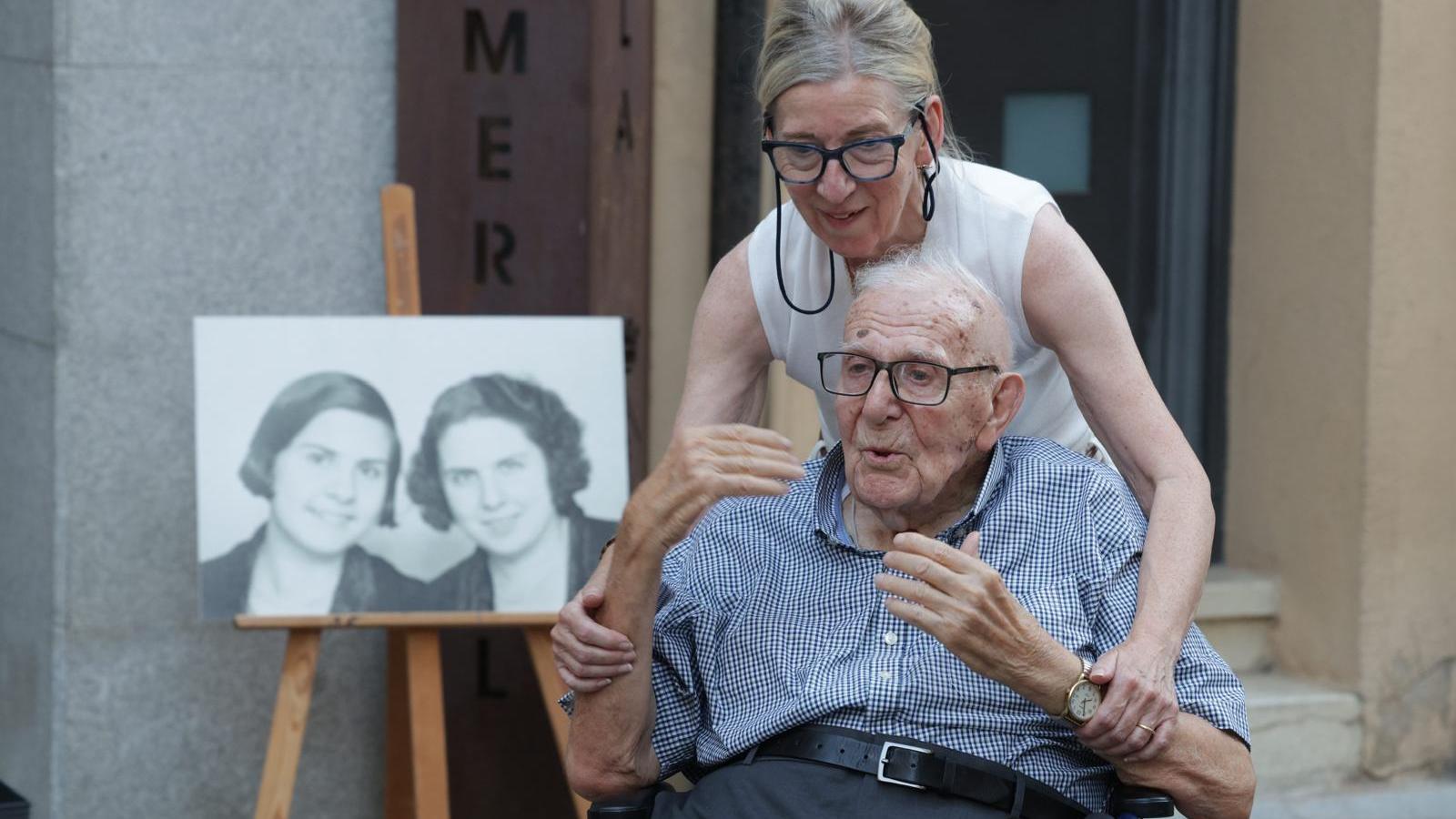
ManacorCarles Buxadé was two years old when his aunts, Daria and Mercè Buxadé, embarked at 22 and 18 years of age at the port of Barcelona with Captain Alberto Bayo's expedition. He keeps a vague memory of it, but enough to have dedicated decades of his life to searching for the truth about the cruel fate of those two women whom he never saw again. “Obviously, he was very small, but he remembers seeing them get onto an open truck with many other women, approximately ten of them,” relates his daughter, Ann.
Daria and Mercè had been born in Mexico, daughters of a married couple who had emigrated from Santa Coloma de Farners, where they returned while still very young. In the summer of 1936, they enlisted as Red Cross volunteers with the Republican army that intended to reclaim Mallorca, which had revolted against the current democracy. At a time when communications were precarious, they did not find out about the sudden withdrawal of Bayo's troops and were left to their fate in territory controlled by the fascists.
On September 5, 1936, they were raped, insulted, humiliated, and murdered in a public act. With all the cruelty one is capable of imagining, Daria and Mercè Buxadé were killed in Manacor by order of the bloodthirsty fascist Arconovaldo Bonaccorsi, the self-proclaimed “Count Rossi.” They were not alone; they were accompanied by three other women, also volunteer nurses: Maria Garcia Sanchís, Teresa Bellera Cemeli, and, according to the latest research, the most plausible hypothesis is that the fifth was Josefina Garcia Prats.
The only thing the family knew was that they had died, but not where, when, or under what circumstances. “After the war, it was not talked about much,” explains Ann Buxadé, Carles's daughter, and a veil of silence covered that story. Carles's father, brother of Daria and Mercè, “did not want to talk about it. My father, on the other hand, kept it in his heart,” she asserts.
The twists of fate meant that Carles did his military service in Mallorca, but even though he “carried Daria and Mercè in his heart,” the context made it impossible for him to investigate anything. In 1960, he settled in Northern Ireland. The distance acted in that case as a spur, and gave him the freedom he needed to look back. It was not until he retired that he dedicated himself to gathering letters, photographs, and memories scattered between Catalonia, Mallorca, and Mexico, and that work resulted in two books about the family. “No one had been able to verify or confirm anything until my father began to investigate it,” recounts Ann, who traveled when her father could not to help him gather the material.
The trip to Manacor
After the year 2000, he decided to go personally to Mallorca with his wife. The couple spent an entire day in Manacor searching for information, but no one knew or wanted to tell them anything. When they were about to give up, a chance encounter at the library with a young man who had heard them talking and asking opened an unexpected window for them.
Pulling on the thread, they reached Tomeu Ferrer and Antoni Tugores. From this meeting, a friendship emerged, as well as a decisive exchange of information so that Tugores could reconstruct the sisters' lives. A research that has also allowed recovering who they were before becoming victims: two women “very young, very talented and adventurous”. Daria played the piano and painted, and the family still keeps some original works. Decisive had also been the investigations by Josep Massot i Muntaner, Miquel Alenyà and Llorenç Capellà, regarding this story.

“Carles’ stubbornness in wanting to know and not stopping searching for what had happened to his aunts is admirable, and from there our friendship and collaboration were born,” expresses researcher and historian Antoni Tugores, who in 2017 published They Died Twice. Daria and Mercè Buxadé, Catalan nurses murdered in Mallorca in 1936.
Found at Son Coletes
On March 22, 2023, the Government of the Balearic Islands made the finding public: excavations at Son Coletes had located the remains of three women who could be militiawomen from the landing of the Republican captain Alberto Bayo. The bodies were found piled up, face down, and covered in lime, along with those of 17 other victims of the Francoists in the third phase of excavations at the Manacor cemetery, included in the IV Plan for mass graves.
Speculations did not take long to arrive, and it was immediately suggested that they could be the remains of the five nurse militiawomen. "Either it was them or it was the 'Roges del Molinar' [Red women of El Molinar], since there was no record of any other group of women murdered together," explains the historian from Manacor.
The son of another of the Buxadé sisters, Maruja, who returned to Mexico after the war fleeing from too many misfortunes, was the one who was able to provide the DNA, essential for the identification tasks.
Unresolved questions"During all these years, many doors and windows have been opened," states the researcher and playwright Jaume Miró, who more than twenty years ago came across the diary that one of the militiawomen wrote from the war front in Mallorca, which was published for the first time by the Falangist newspaper Arriba in 1938 and which Father Massot had already collected. The result of this desire to shed light on this story was the theatrical play Diari d’una miliciana [Diary of a Militiawoman] and the documentary Milicianes [Militiawomen], in addition to the research carried out with Julià Rodríguez, which points to the identity of the fifth militiawoman.
What is left for us to discover about these five women? “We still need 100% certainty that Josefina Garcia is the author of the diary; we still need to find the original diary and, most importantly: that this group of women found at Son Coletes can be identified. We know 100% that it is them, and if only one of them were identified, we would know who they are”, affirms Antoni Tugores.
Homage in Santa Coloma de Farners
Santa Coloma de Farners, the town where the parents and grandparents of the Buxadé sisters came from, paid them the first great tribute last September 5th since that fateful day, nine decades ago. It was at the initiative of La Bulla, an entity formed by young people who managed to involve the City Council and a good part of the municipality in a memory cycle developed over months. “Many of the people from Farners did not know this story, and however little sensitivity you may have, it reaches very deep,” explains Tugores.
Carles Buxadé and his daughter Ann traveled from Northern Ireland to attend. There, with emotions running high, they met with about twenty members of both branches of the Buxadé Adroher family. For Ann, the whole journey “led to this moment.” La Bulla, the youth entity promoting the cycle, and the response from Santa Coloma have turned a family search into collective memory.
La Bulla wanted to take advantage of the 90th anniversary to "reverse the unjust situation" that had condemned Daria and Mercè Buxadé to silence and oblivion. "We wanted to place them in the position they deserve to have in Santa Coloma and make their story known with the rigor of historians," explains Ernest Morell, a member of the entity. With this objective, La Bulla has organized screenings, conferences, presentations, recitals, and memorial acts around Daria and Mercè over the last few months.
The importance of reparation
Rising from the chair that helps him move and with the care of his daughter, Carles Buxadé unveiled, that Saturday, at the age of 92, two Stolpersteine stones with the names of his aunts installed in front of the house where they grew up and he was able to contemplate the mural by Roc Blackblock dedicated to them. It has not been until now that “they have returned home with their name cleared,” says Ann. Santa Coloma de Farners has closed a part of the circle. “In those two moments I saw his eyes fill with tears,” she recalls emotionally.
“Now everyone will be able to see their names and remember that they existed,” maintains the nephew of these two women whom, for decades, the Falangist propaganda wanted to dehumanize with slanders. Restoring their identity also undoes the Francoist defamation.
