Thus ends the 2025-2026 course: a year of wear and tear, delays, and tensions that do not explode
Teachers, families and management teams agree on the feeling of discomfort and the lack of resources to attend to diversity

-
CAT -
CAST -
GER
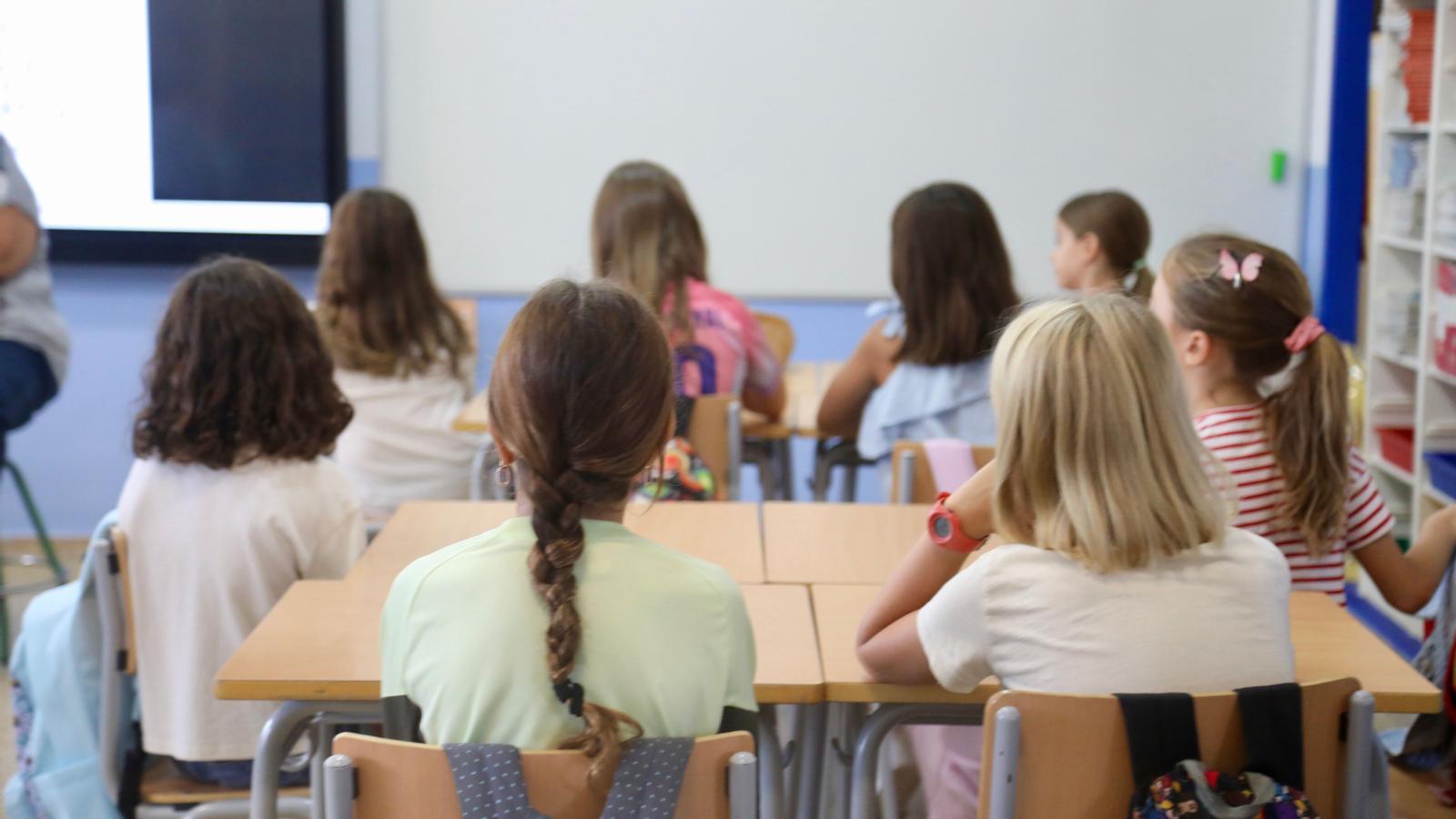
PalmaA classroom with heat, insufficient ventilation, and students trying to follow the class while the course enters its final stretch. The scene, repeated in many centers in the Balearic Islands, summarizes a year marked by wear and tear and the feeling that the distance between educational planning and classroom reality continues to grow. In this context, the Ministry of Education has announced several measures throughout the course: the Baccalaureate of Excellence, the incorporation of psychologists in Primary education, the reinforcement of emotional support for teachers, new coexistence measures, the consolidation of free 0-3 stage education, and the commitment to Vocational Training (FP), in addition to investments in centers, among others. All this comes to a system that, according to the centers, continues to be marked by a lack of foresight and the difficulty of turning announcements into real improvements.

The first focus of tension appears in the management of aid and conciliation. The father of CEIPIEEM Son Serra and member of FAPA Mallorca, David Edwardes, summarizes it as “a year of delays”, especially in the calls for meals and summer and Easter activities. Families, he explains, often receive aid when they can no longer use it, which turns public support into a delayed response to immediate needs.
This lack of planning also extends to educational participation spaces. Edwardes denounces that at the Consell Escolar de les Illes Balears “much has been processed urgently when it was not necessary”, which has reduced debate and made participation “symbolic”. As he explains, decisions arrive accelerated and with little room for analysis, in a context in which the educational community has less and less capacity to influence.
When this imbalance reaches the centers, the consequences become visible on several fronts. One of the most sensitive is attention to diversity. Edwardes warns that “there are not enough therapeutic educators or listening and language teachers to guarantee good integration within the classroom”. He also questions the commitment to UECO classrooms when they cease to be a specific tool: “It is a mechanism that segregates students with needs”. Added to this is the lack of adequate air conditioning in many centers, especially in old buildings, with still unequal interventions.
To the management teams, the diagnosis is repeated in other words: saturation and bureaucracy. The director of IES Portocristo, Xisca Crespí, expresses it forcefully: “Management and bureaucracy are a disaster. The promise of debureaucratization is a fallacy”. She explains that an increasing part of the teams' time is consumed in administrative tasks: “You can spend half your life doing paperwork”, she summarizes.
New management system
Added to this burden are continuous changes in digital management tools, such as the transition from Gest-IB to the Llull system, perceived in the centers as another source of uncertainty. And in parallel, a structural debate reappears that runs through the entire system: ratios. “In Secondary, there cannot be 30 students per classroom. There should be 24,” claims Crespí, who links this situation with the growing difficulty of attending to diversity.
From another center, the director of CEIP Es Puig de Lloseta, Miquel Bujosa, agrees with the general diagnosis, but adds a key idea: exhaustion. Despite the demographic decline, he explains that the complexity of classrooms does not decrease. “Big announcements are made, but nothing reaches the schools,” he laments. The demand, he says, is recurrent: fewer students per classroom and more support.
In Secondary education, the teacher from IES Politècnic, Magdalena Vázquez, introduces a more structural view of the conflict. “The worst part is that we are a center in extinction. It is a consequence of the attacks that public education suffers”. As she explains, the offer of Baccalaureate is being reduced in some centers while it grows in others, in a process that she considers unbalanced and that affects the natural functioning of the system.
Vázquez interprets these movements as a change of model: “Vocational training is being strengthened at the expense of reducing Secondary education, and I don't see any stopping it”. She also detects a difference in response between territories: “In Catalonia and the Valencian Community, they continue to fight for educational rights”, she says, while in the Balearic Islands she perceives a deactivated context, with less capacity for mobilization.
Feeling of alienation
This lack of collective response, he explains, translates into a feeling of isolation within the centers: “We have often commented that we should have gone on strike.” He also points out that the changes have been applied center by center, which makes a joint response difficult. The result, he states, is visible: “We see closed lines and high ratios.
Among the latest course announcements, Vázquez questions the proposal of a sabbatical year for teachers: “It's a very attractive headline, but when you read the fine print, you see that it's a rather populist measure, ideal for the end of the school year”. Nevertheless, from the course that is ending, he highlights two positive issues: the visibility of the 0-3 stage and the daily work of the teaching staff, who “constantly train and strive for the students”.
In private subsidized schools, the president of the Teaching sector of the Union of Associated Work Cooperatives, Kiko López, values the dialogue with Education: “The subsidized sector has benefited from it,” he says. Nevertheless, he acknowledges that bureaucracy continues to be a problem and claims cooperatives as part of the system with a public school vocation.
The course closes with a shared image among very different actors: an educational system that advances with reforms and announcements, but which continues to be crossed by structural tensions. Between institutional planning and tangible reality in the classrooms, the distance is still one of the constants of education in the Balearic Islands.
