Alfonso Díaz: "We want to be a very Mallorcan center"
Commercial Director of the Beato Luis Belda University Center
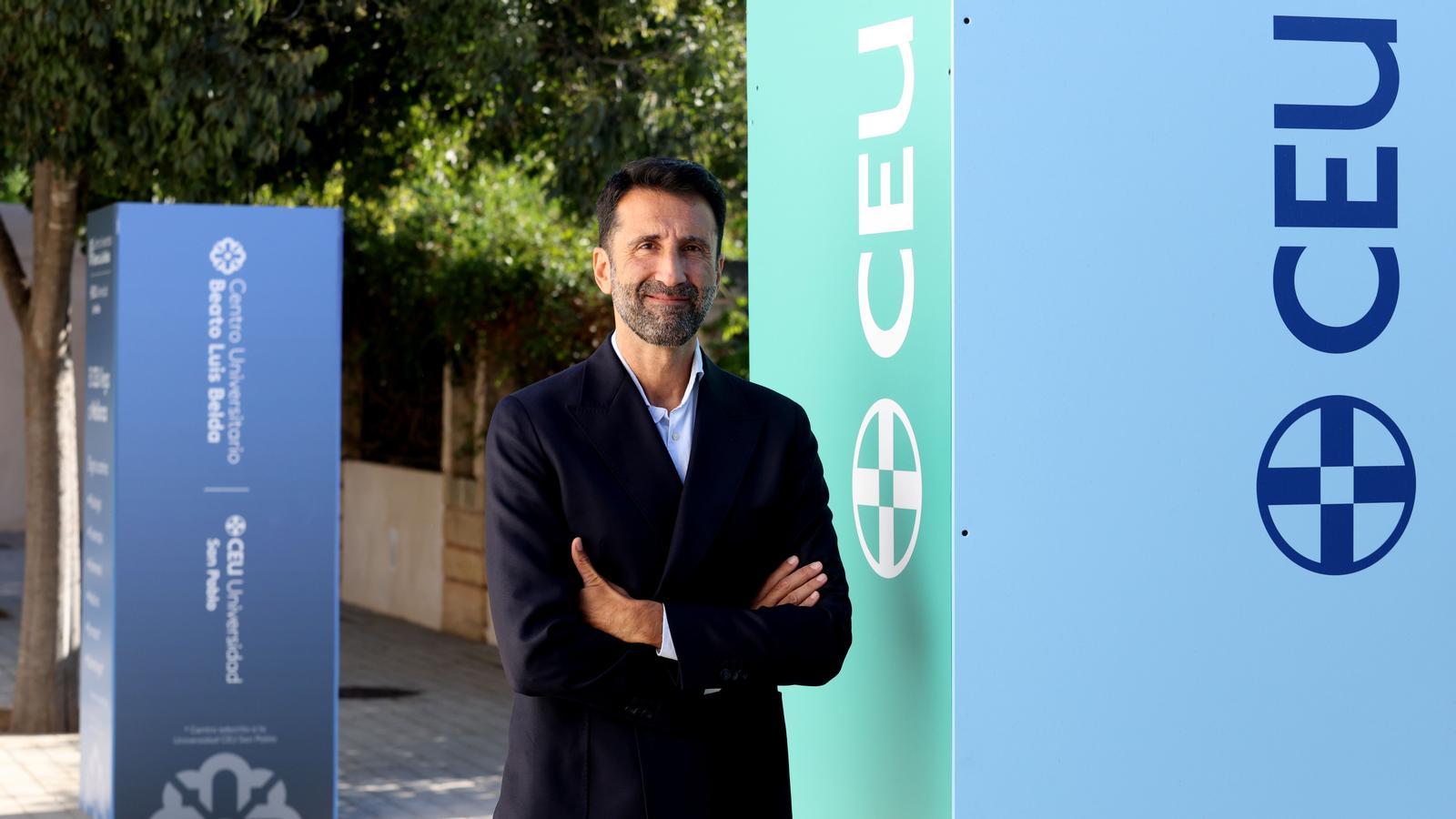
PalmaThe Beato Luis Belda University Centre, affiliated with CEU San Pablo, has begun its activity in Mallorca this academic year with the aim of becoming a benchmark for healthcare education in the Islands. The centre, which has started with the degrees of Medicine, Nursing, Physiotherapy, and Psychology, aspires to grow in the coming years with new studies and to retain some of the students who each year have to leave the Balearic Islands to pursue a degree. Its commercial director, Alfonso Díaz, explains in this interview the project's objectives, the profile of the first students, and the centre's growth prospects.
What were the initial objectives of the CEU Mallorca project and what expectations did you have for this first academic year?
— The objectives were basically three: to detect that there was a demand in the Balearic Islands for health qualifications that would provide a response to a structural need of the Islands' health system. We also wanted to retain and attract talent and train professionals who can carry out their activity in both the public and private health sectors, and thus contribute to the health development of the Balearic Islands.
— We wanted to build an ecosystem of relationships and activate all the groups with which we can work. The future expectations are greater than the initial ones, because we already have all these groups active. In terms of quality, we are very happy with it, because we have built an ecosystem of relationships with hospitals and other institutions. Medicine, Nursing and Physiotherapy are fully consolidated, and Psychology as well, although to a slightly lesser degree.

What is the profile of the students who have chosen CEU Mallorca for this first year? Where do they come from and what are they mainly looking for when choosing a university?
— The profile is not very different from that of the rest of the CEU universities: two-thirds of the students are women and two-thirds come from charter schools. 97% are from the Balearic Islands, and approximately half are residents of Palma. We also have students from Menorca and Ibiza. The remaining 3% come from other parts of the country. Our goal was for the students to be from here. Almost 50% of the students from the Balearic Islands go away to study, and we wanted to contribute to avoiding this brain drain and offer them the option to stay here.
Which factors do you believe have been decisive for students and their families to have chosen CEU Mallorca?
— Our value proposition is based on nearly one hundred years of experience. We are a non-profit organization and we have been providing Medicine degrees for fifty years. Our proposal is based on academic quality and a conception of health studies that is not limited to responding to market demand and needs, but also understands health and life as a way of approaching people. We defend life and the care of people. We want to approach health education in a comprehensive way and train people, not just professionals.
— We are also committed to employability. We have a network of contacts with professional associations and healthcare institutions so that students can have a good practical experience from the very first moment.
After this first year, what are the growth prospects for CEU Mallorca? Do you plan to expand the range of degrees, the number of places, or the facilities?
— In the short term, we want to expand the offer with Pharmacy and Dentistry, and also with a second line of Medicine in English. Furthermore, we want to incorporate degrees linked to the physical activity and sports sciences with RCE Mallorca, which complement the health degrees and also have a connection with this field. In the medium and long term, it will probably make sense to incorporate degrees from other areas, especially related to the humanities and other professional disciplines.
How do you imagine CEU Mallorca five years from now and what role do you aspire to have within the university map of the Balearic Islands?
— We would like it to be a reference center for studying health-related degrees. That a student who wants to pursue a health qualification has no doubts that we are a first choice. We want to be a recognized center, related to health institutions and health policies. That we are not considered someone who has arrived from outside, but that we are part of the social and educational fabric of the Islands. We want to be a very Mallorcan center.
Bet on a powerful scholarship system. Do you have students with this profile?
— We have many potential students who can benefit from scholarships. We have scholarships for academic merit and also an aid program. We believe that the scholarship should be correlated with merit and effort. And then we have an aid program linked to income and certain personal situations. We refer, for example, to students coming from Higher Degree Vocational Training, who may need study aid, we also refer to those who have accessed their first job and need financial support to be able to assume the cost of university studies. It may also be the case for single-parent families who need financial aid to be able to continue studying.
What residential alternatives do you have for students coming from out of town?
— We have worked with housing solutions near the Slaughterhouse, very close to the center and with a very good location. These are new apartments that are now coming onto the market, with between one and three bedrooms, with affordable prices for students.
