23 years stuck with the second beltway of Palma
The Council of Mallorca will begin in 2027 the works of a new 350 million road that does not guarantee putting an end to the circulatory collapse
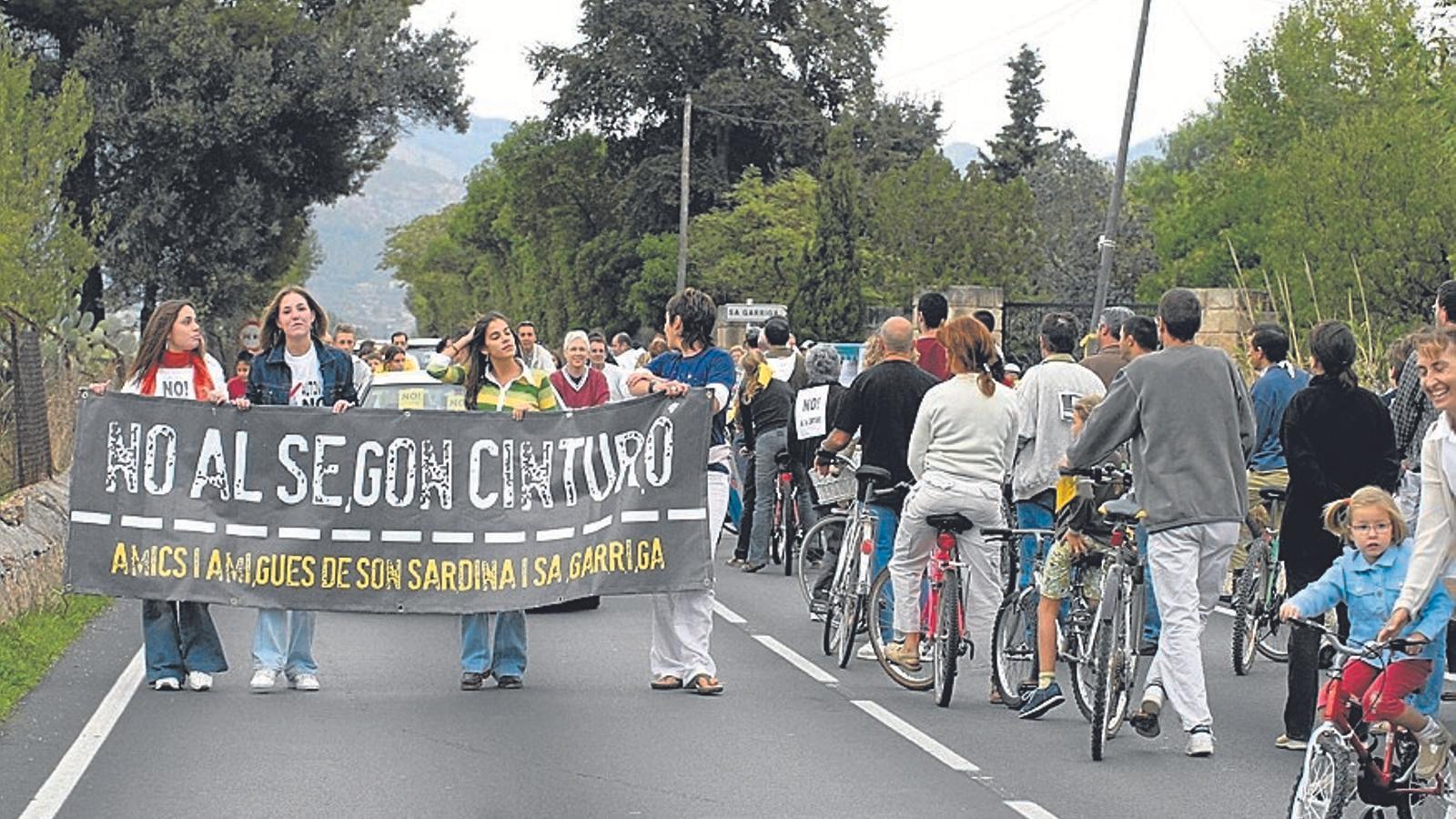
PalmaPlaça del Fossar in Sineu, November 2003. Thousands of people watch the satirical performance of the wedding between Maria Antònia Munar and Jaume Matas, a symbol of the political alliance that drives an unprecedented transformation of Mallorca's road network. Munar's Council road plan projects an island turned into a giant Scalextric and ignites one of the most intense periods of social mobilization in recent history. Sineu becomes the epicenter of the opposition to the Inca-Manacor motorway, an infrastructure that threatens to mutilate the Pla region. At the same time, another slogan begins to be heard: 'No to the second beltway'.

The second beltway was incorporated on December 1, 2003, into the second amendment of the 1998 Road Plan, approved by the Council after rejecting more than 21,000 allegations. The proposal was conceived as a large outer ring road to Palma's beltway to distribute traffic between the highways and roads that lead into the City.

The route, a large arc that crossed rustic and peri-urban land in Palma, started from the Llucmajor motorway, passing through the surroundings of Son Ferriol to connect with the Manacor road, continued towards Pla de Na Tesa and the Inca motorway, advanced towards the Bunyola and Sóller roads, crossed the rural environment between Son Sardina and La Garriga, and reached the Valldemossa road and the surroundings of Son Espases.
The project, approved together with the Inca-Manacor motorway, inflamed spirits and provoked strong opposition. The route devastated fertile soil, farms, and paths, as well as one of the last rural spaces preserved in the north of Palma. Opposing groups warned that the road would act as a new urban frontier, facilitating new developments.
A project that mutates and changes its name
The second ring road of Palma is an infrastructure that, for more than twenty years, has changed its name, route, and dimensions. With the political change of 2007, the second Pacte de Progrés led by Antich and Armengol did not eliminate the Road Plan project, but rather renamed it and started calling it a 'connecting road'. In 2009, a new proposal was approved that widens a succession of existing road sections between the Manacor road and Son Espases. The narrative changed, but "the solution remains the same," the GOB warned at the time.
The PP returns to the institutions and in 2012 construction begins on the central section or Ma-30, which is the only one executed to this day, and which connects the Inca motorway with the Manacor road. “The ‘Via connectora, així no’ platform arose from the need to defend ourselves,” recalls one of its members, Antoni Reynés, who is very critical of a section that the PSIB renamed and the PP ended up executing. “How can they talk about circularity and be so hypocritical as to build infrastructure without having a long-term vision?” he asks.
In 2015, with Miquel Ensenyat (MÉS) as president of the Council and Francina Armengol as head of the Executive, the inability of the progressive governments to make a change in the mobility model effective is evidenced with the approval of the project for section I between Son Ferriol and the Llucmajor motorway and the Campos motorway. The left wing was re-elected in 2019 and it was not until 2021 that it decided to exclude the most problematic sections of the second ring road from the road agreement with the State. The extension from the old Inca road towards the roads of Bunyola, Sóller, Son Sardina, Valldemossa and Son Espases is abandoned, at least financially. Since then, although the route remains in the Road Plan, all the government officials of the Council have said that they will not build it. “There is no forecast regarding this matter,” assures the current Department of Roads.
A 350 million road
Overlooking the airport motorway and from one of the halls of the Congress Palace, the president of the Council of Mallorca, Llorenç Galmés, has announced the details of the new section I of the second ring road. Amidst reproaches to the previous Executive for “having left it in a drawer”, the popular [party member] has positioned himself as the president who “solves people's real problems”.
350 million euros, 240 more than what Galmés himself said it would cost, is what it is expected to cost, over a period that could reach 2033, 30 years after Munar approved a project dogged by controversy. The president insisted during the presentation on the “great social consensus” of this section, he did so before the residents of Coll d’en Rabassa, grateful because the new road will move away from their homes.

The works are to begin in 2027 and are divided into two phases. The first, budgeted at 90 million, will act for two years and ten months on the roundabouts located in front of FAN Mallorca, the Camí Fondo and Coll d’en Rabassa, in addition to expanding the Ma-19 with one more lane in each direction between kilometers 4 and 7. The second, of 260 million and 40 months of execution, will build the new underground layout of the Ma-30, with two lanes in each direction and nearly a kilometer of tunnel, and will convert the surface into a boulevard with spaces for pedestrians.
A mobility technician consulted by ARA Balears who requests anonymity considers that the first phase “does not change much of what is already there”, because it basically expands the existing roundabouts, moves the one at Coll d’en Rabassa away from the houses and replaces a bridge. The problem, he points out, is that the second phase will build the tunnels under the recently reformed roundabouts: “As a construction process, it seems surprising to do the top part first and then bury it in the same place: it is doing and undoing”. For the expert, dividing the action in this way is “illogical” and amounts to “procrastinating”.
The technician admits that, once the tunnel is finished, the intervention may improve traffic flow at this specific point. It is another matter whether it will serve to decongest the beltway, the main argument the Council has used to justify the investment. "I don't see that making the second beltway more fluid will have a direct impact on the beltway if the section from Alcampo to the Son Castelló industrial estate is not built, at the very least," he states. Traffic between the airport and the Inca highway will have a more comfortable route, but, he points out, most of these vehicles already use the Ma-30 today.
The Council's figures confirm the weight that this route already carries. Sections 2 and 3 of the Ma-30, built between 2011 and 2021, absorb a daily average of 34,900 vehicles. With the construction of section I, the institution's simulation models predict that traffic there will increase by 27%, to exceed 44,000 vehicles per day. The Highways Department argues that completing the dual carriageway between the Inca and Llucmajor highways will create a route with an "optimal" level of service and will reduce the number of drivers using the beltway. However, it does not specify how many of the 185,000 vehicles that pass through this ring road daily will stop doing so, nor at which points the reduction will be noticed.
Promotion of induced traffic
The professor of Human Geography at the UIB and mobility expert Joana M. Seguí warns that increasing the capacity of a road usually provides only temporary relief. “At first, it becomes decongested, but then more cars go there because it is easier to drive, and in the end, it becomes congested again,” she explains. It is the phenomenon known as induced traffic: a new infrastructure or the widening of lanes makes the use of private vehicles more attractive and ends up absorbing new trips. Seguí points out that the beltway has already been recently expanded by Galmés and continues to suffer from traffic jams, just like the Inca motorway, which is saturated during peak hours up to the surroundings of Marratxí.
The Council maintains that the latest interventions on the beltway have improved fluidity by 20% compared to the previous year. Seguí notes, however, that the issue cannot be separated from demographic growth, the increase in the associated car fleet, and public transport that has not grown at the same pace. “Traffic is a reflection of what happens with land use,” she summarizes. Peripheral industrial estates, shopping centers, and residential developments generate more and more trips and saturate a radial network concentrated in Palma.
Therefore, she considers the recipe of responding to congestion by constantly increasing road supply to be outdated, describing it as “typical of the road engineering of the seventies.” In an island and limited territory, she argues that the priority should be a public transport network with more frequencies and connections, combined with measures regarding demand, such as staggering start times for schools and workplaces, implementing school buses, and promoting shuttles for workers in industrial estates.
The underlying reflection is whether Mallorca continues to adapt a limited territory to a car fleet and an urban model that do not stop growing, or acts on the causes that force thousands of people to take the car every day. “We are talking about a model, not about fixing a little piece,” concludes Seguí. 23 years after that ‘No to the second beltway’, the question remains open: will the road solve the collapse or will it move it a few kilometers further?
