Politics enters a loop: perhaps it would be fun if it didn't affect people
Between obstacles to regularization and restricted aid, national priority is making headway in institutions governed by the PP

-
CAT -
CAST -
GER
PalmaRegularization, migration, the people from here, siren effect, registry, residence, rights, collapse, obstacles, boycott... These words –and a few more– have been monopolizing the political debate for weeks, in a loop that no longer hides where it is heading and that drags us towards increasingly dark ideological zones. Meanwhile, an idea as simple as it is uncomfortable is consolidating: skin color, place of birth, and the religion practiced determine a person's rights in the Balearic Islands. What is the excuse? That to be a full citizen, one must accumulate years of residence.

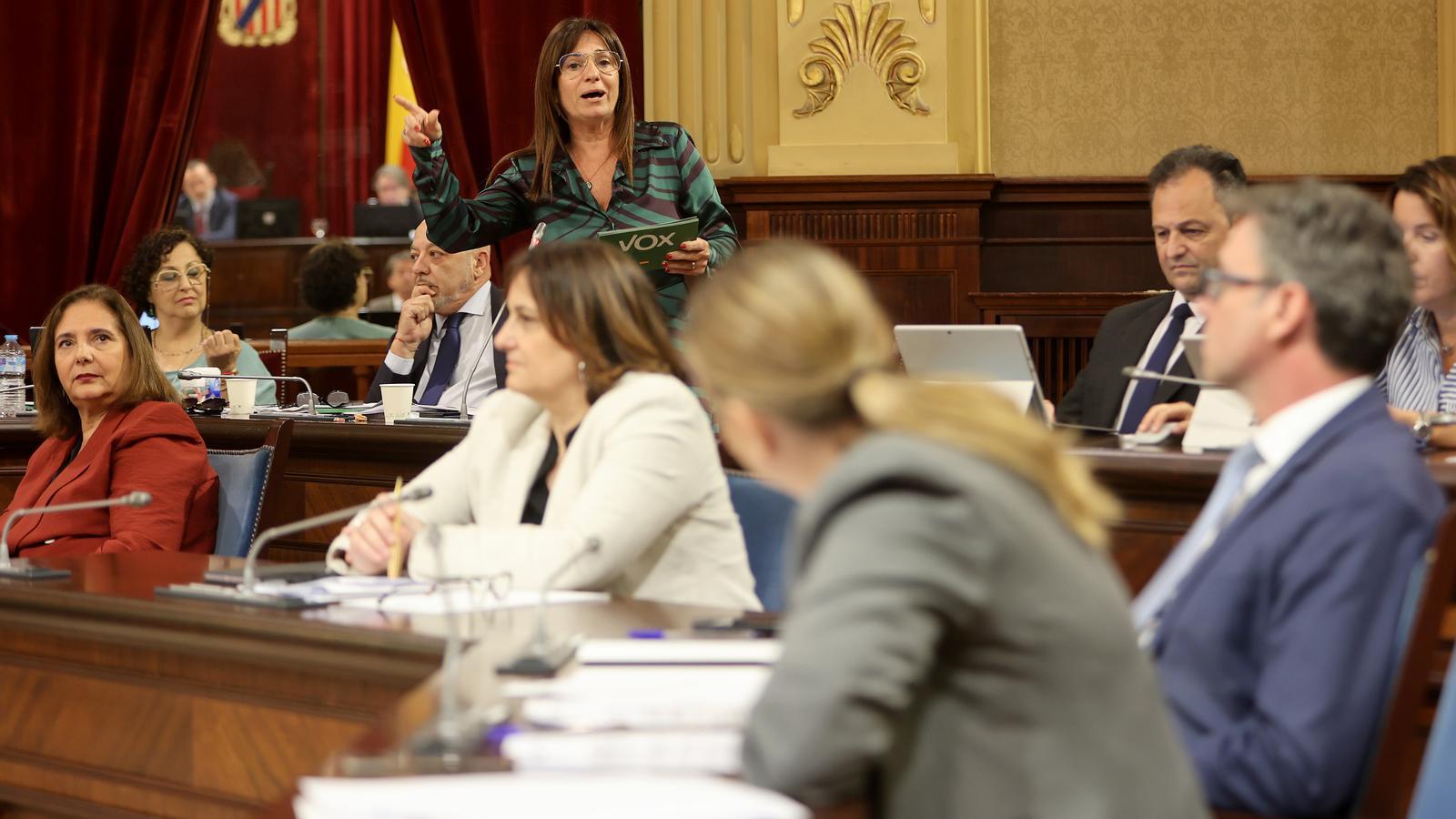
The President of the Government, Marga Prohens, reproached the spokesperson for Vox, Manuela Cañadas, for the far-right's use of the concept of 'national priority' in Tuesday's plenary session of Parliament. But Cañadas herself pointed out that the Executive requires years of residence to access social aid, when a large part of those who need it most are precisely migrants. “Rooting and legal residence must be taken into account for aid, to avoid encouraging the pull effect and population growth,” Prohens boasted, as if this were not the same as applying national priority.
The Council discriminates nationals
Aid to alleviate the effects of the Iran war, launched by the Consell de Mallorca, chaired by Llorenç Galmés, is proof of the situation. The requirement of having to prove five years of continuous residence has caused Vox's objective of excluding migrants to lead to a paradox: Mallorcans, Ibizans, and Formenterans, and the rest of Spaniards – so important to the far-right – who have lived in Mallorca for less than five years, are not entitled to receive aid from the island institution; on the other hand, immigrants who have exceeded five years of residence can receive it. Horses will also receive aid, because the package includes 500,000 euros for the Institut de l'Esport Hípic de Mallorca, a body that depends on the vice-president of Vox in the Consell, Pedro Bestard.
Vox expressed satisfaction at having "conditioned" the aid in this way. Bestard defended that the requirement of years of residence responds to the principle of "national priority", which benefits "Spaniards". Perhaps someone should explain to him that it is not quite like that. Rumors point to the weariness of the PP in the Consell de Mallorca for having to deal with the far-right and with politicians who, beyond the official car and good lunches, have neither vision nor the necessary political training for the position. However, the suffering must not be so great if everyone holds on tight to their chairs and maintains the alliance.
Cort's institutional racism
The Palma City Council also serves as an example of what institutional racism can cause. The OAC (Citizen Service Office) Social has collapsed because the municipal government team decided not to reinforce it to cope with the extraordinary regularization of migrants decreed by the Spanish government. This, despite the fact that technicians had prepared reinforcement measures to provide adequate attention to applicants for the vulnerability certificate, one of the required documents. "Political instructions have been received not to reinforce the service," denounced the officials.
In this way, the big question in Thursday's Cort plenary session was: who gave this political instruction to hinder the process and endanger the regularization of people who live and work in Palma?
The mayor, Jaime Martínez, did not disappoint and put on a display of laughter, jokes, and silences. The tone of the plenary session escalated, and the spokesperson for Podem, Lucía Muñoz, repeatedly asked who had given orders to obstruct the municipal service to migrants. During the interventions of citizen entities, the Majorcan activist of Senegalese origin Mahécor Mbengue recalled the most basic thing, which is precisely what the right and the far-right have forgotten: “Palma is its people. Among these people are thousands who work, care, clean, sustain, and contribute to the city. They are not a threat, they are residents of Palma. A democratic city cannot treat as invisible those people who are part of its daily life.” However, Martínez could not hear it, as he absented himself from the plenary hall during the citizens' interventions. “Red Code” was his response amidst laughter when the opposition demanded to know what was more important for him to do than listen to the citizens. In case anyone doesn't understand the joke, a red code is an emergency protocol in the face of an imminent threat to life or safety that requires immediate action. Therefore, actions like having a snack or going for a walk would not fall under this protocol.
From this arises the conclusion that voting every four years is no guarantee of democratic quality and that the level of demand will have to be raised to avoid drifts that violate human rights, even if in a subtle way. The opposition as a bloc requested the resignation of the Councilor for Social Services, Lourdes Roca, who received the explicit support of the government team from the mouth of the Councilor for Finance, Mercedes Celeste.
A separate chapter should be dedicated to the Councilor for Culture, Javier Bonet, who refuses to create a municipal award that bears the name of the last republican mayor of Palma, Emili Darder, murdered by the Francoists. His elaborate argument was that “institutions should not divide society” and that Darder’s mandate was “brief, in an unstable context”. For this reason, “[Darder’s] government action is not assessable in its full dimension”. “We do not vote against it out of confrontation, but out of the conviction that institutions must represent all citizens”. So there.
