They warn of the dangers of tourist saturation on emotional well-being
The Mental Health Federation claims to incorporate mental health into the debate on tourist saturation
-
CAT -
CAST -
GER
PalmaThe Federation of Mental Health of Mallorca has claimed this Friday the need to incorporate the mental health perspective into the existing debate on the tourist and territorial saturation that the Balearic Islands are experiencing. In this regard, the Federation warns of the dangers posed by high tourist pressure on the emotional well-being of citizens and, to a greater extent, of workers in the sector.
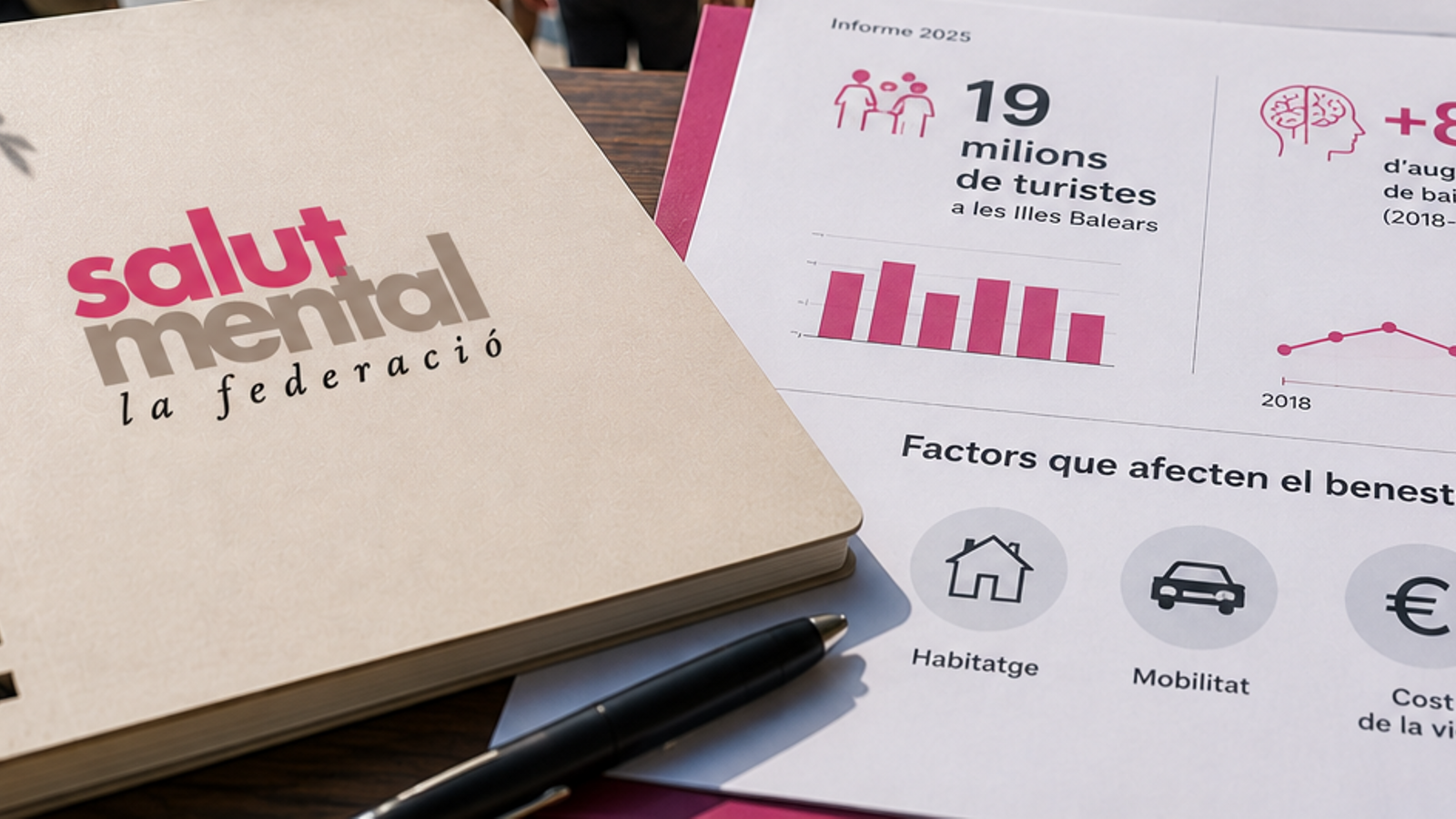
The entity recalls that the Balearic Islands received more than 19 million tourists in 2025, a figure equivalent to 16 visitors per resident in a territory of only 1.25 million inhabitants, while pointing out that mental health depends not only on health services, but also on the territory, living and working conditions, and the possibility of developing a dignified life project. Furthermore, this sustained increase in tourist pressure coincides with a context of growing difficulties in accessing housing, road congestion, rising cost of living, and saturation of public spaces and services. The impact is especially relevant in a territory where tourism is the main economic driver and where workers in the sector are exposed to psychosocial risk factors such as seasonality, irregular working hours, work intensity, or job insecurity. In this regard, and according to various published studies, the Federation points out that between 2018 and 2023, sick days related to mental health increased by 88% among salaried workers, and by 75% among self-employed workers in Spain. Temporary incapacity processes for mental health problems grew by more than 110%, reaching nearly 600,000 annual cases.Currently, mental health is the second leading cause of work absence in Spain, and anxiety disorders are the most frequent diagnosis. Furthermore, published data indicate that this upward trend has continued during 2024 and 2025. Regarding housing pressure, this is especially relevant in the Balearic Islands, one of the communities with the highest prices in Spain. Scientific literature identifies housing as one of the main social determinants of mental health, and evidence shows that residential insecurity is associated with higher levels of stress, anxiety, and worse psychological well-being. For its part, the WHO points out that mental health is influenced by social, economic, and environmental factors, such as housing, working conditions, social cohesion, or the physical environment. Given this context, the president of the Federation of Mental Health of Mallorca, Guillem Febrer, pointed out that “the scientific community agrees and all studies published on overtourism indicate that the perception of overcrowding is associated with a lower quality of life, a greater sense of stress and a loss of control over the daily environment, as well as that quality of life is a central element for emotional well-being”. According to Febrer, “the people who sustain the main economic engine of the Balearic Islands often work in conditions of high intensity, temporality, and seasonality. Taking care of their mental health is also taking care of the social and economic sustainability of the main economic sector of the Balearic Islands”.
“We cannot talk about a healthy island if the people who live or work there experience a permanent sense of saturation. Sustainability must also be measured in terms of mental health and quality of life. Tourist saturation is not just an environmental or economic issue, it is also a matter of community mental health,” concluded the president of the Federation.
