"All students should go through the Legal Clinic": the most humanitarian face of Law in the Balearic Islands
The UIB students combine practical learning with social services and attend to real cases of people in situations of vulnerability

-
CAT -
CAST -
DE
Palma“All students should go through the Legal Clinic if they want to practice law”, assures the lawyer and project coordinator, Sebastià Arbós. The students who intern there agree and know that this "taste" of the real lawyer's profession is not found in law textbooks.
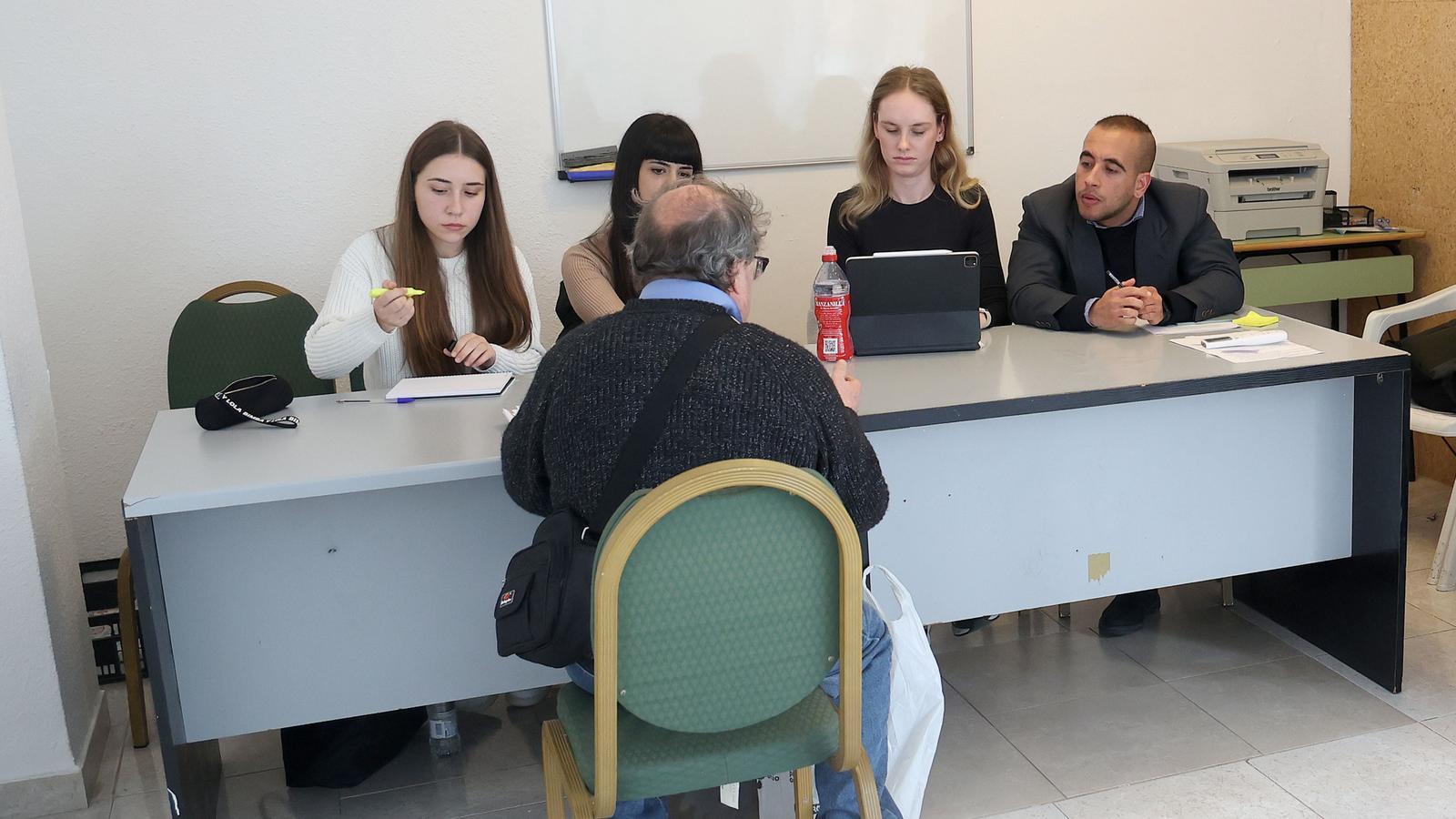
“If you do it here for free, it’s because you really like it”, explains one of the students doing her law internship at the Legal Clinic, at the Monti-Sion Foundation, where it is common to see the president and magistrate of the TSJIB, Carlos Gómez, founding partner of the entity, and the president and magistrate of the Provincial Court, Gabriel Oliver, both volunteers of the foundation – not of the Legal Clinic, due to their condition as judges, wearing the volunteer vest.
The students (mostly women) who do their internships agree that going through the Clinic helps them define their professional vocation and, moreover, allows them to experience social realities firsthand that are often not perceived in the faculty. “It is a space where they confront social reality and the human dimension of the profession, while also allowing them to develop skills such as active listening, communication, and analytical capacity in real situations”, points out the current coordinator of the clinic and lawyer, Sebastià Arbós.
An essential part of the work involves guiding, helping people understand their case, gathering documentation, and completing the initial procedures. “Many times they arrive without knowing exactly what the problem is or what they need to solve it. Therefore, the most important thing is that they leave with a clear idea of the situation and know what steps they need to follow,” explain the students. “Although we don't solve the person's problem, it's incredible to see how they leave here with a different look. You can tell we've given them hope,” explains one of the interns.
User experiences highlight the service's impact. One woman explains that she learned about the Clinic through the foundation's social programs and that she turned to it for debts she had been carrying for years and which prevented her from moving forward. "I had a debt for an apartment for years. I had an accident at work and couldn't work or pay. They helped me here and I managed to go to court with a lawyer I couldn't have afforded," she recounts. According to her, the case was resolved a year ago, even though the origin of the conflict dated back two decades: "I've been able to solve a problem from 20 years ago." With a pension of about 800 euros and high rent, she assures that the situation was very complicated and that the support she has received has been key. "It's an excellent tool for people who are in a vulnerable situation, it has changed my life," she emphasizes. She also advocates for the service to grow: "It should be made more known and have more space, because more and more people need it.

Another user emphasizes the human support of the service. “It’s not just about completing a procedure: there’s a lot of emotional support. When I came, I even cried with gratitude,” she explains. In her case, she came to the Clinic for an administrative matter at a difficult personal time, marked by the loss of her mother. “Feeling that someone supports you in these moments is very important,” she assures. She also values the Clinic’s training role for students: “It’s very positive that graduates can gain experience with real cases.” Likewise, she agrees in pointing out the lack of resources to meet the growing demand: “The service helps a lot, but it needs more space, because there is too much demand.”
The cases that reach the Clinic reflect complex realities, such as the elderly without family support, families without resources, eviction situations, abuses related to the housing crisis, women with family burdens in contexts of precariousness, etc. Each year, between twenty and thirty students do their internships there, an average of 400 cases are attended, and about thirty pro bono justice lawyers from the Bar participate. pro bono from the Bar.
Delicate cases are also dealt with, such as sexual assaults and abuses, where the service offers legal guidance and refers psychological care to specialized services. “This is something I repeat a lot to students: we are not psychologists, we are jurists”, says Sebastià Arbós, and points out that one of the most important challenges students have is to have the necessary “cool head” to empathize without being emotionally affected. “They must have a clear head to offer the person in front of them the best legal solution to their problem, and this implies taking a certain distance. It is what a good professional must do”, he continues. “Later, when you are at home, in bed, it is another matter, because you cannot avoid many cases coming to mind. We are also human”, he acknowledges.
The beginnings
The Legal Clinic of the University of the Balearic Islands (UIB) has consolidated, fifteen years after its creation, as an essential legal guidance service for people in a situation of vulnerability. It was a joint initiative of the deans of the Faculty of Law and the Bar Association, who were aware of legal clinics at other universities, especially those in the United States, which have an "extremely important" social function, according to the project director and professor of Public International Law at the UIB, Margalida Capellà. "Internships at the Legal Clinic are an optional external practice where students learn about the more social side of law, which is difficult to explain during their degree and which, due to each person's personal context, they probably do not know about," she comments.
"I always say that it is a program that could be marketed as a win-win-win. All three win: NGOs, which can offer their users a highly qualified service; the University, which gives back to society a part of the knowledge it generates, while providing its students with vital learning impossible to find within the walls of academia; and the Bar Association, which can materialize its corporate social responsibility through the pro bono practice of the profession," she explains.
“Furthermore, with the Legal Clinic we guarantee what we call the “right to Law”, because there are many people who do not know their rights, nor even that they are entitled to free legal assistance if they meet certain requirements, which most usually do”, argues Capellà. In this sense, he points out that, as the project becomes known, demand increases, and the subject matter of cases tends to be conditioned by the moment. “Now there are many consultations on immigration law due to the announcement of the extraordinary regularization, but the housing crisis also leads many people to consult about rentals and mortgages”, he comments.
The director explains that the UIB clinic is part of the network of State Legal Clinics, made up of about fifty clinics, which annually organizes a meeting to share joint projects, such as a legal guide they made for the victims of the DANA or another for Ukrainian refugees. However, the Legal Clinic of the Balearic Islands is the only one that has the support of the Bar Association of its territory (ICAIB). Furthermore, it is the only one that offers legal guidance directly and in situ, while the rest of the clinics in the State do so through entities or foundations, and it is the claimants who go to the University.
“It is stimulating to see that students who have passed through the clinic are today lawyers, judges, prosecutors, and officials of the CAIB. Also how they participate in conferences that we periodically organize to evaluate the situation of the Legal Clinic and how they recognize the important role it has played not only in their professional training and guidance, but also in their formation as people and citizens”, acknowledges Margalida Capellà.
