CCOO attacks the new hotel agreement and qualifies it as "the worst in history" for the sector
The union assures that the new regulation generates more legal uncertainty among fixed-discontinuous workers
-
CAT -
CAST -
GER
PalmaCCOO Balears has attacked this Wednesday against the new hotel convention of the Balearic Islands and has warned that it generates greater job insecurity, especially among fixed-term discontinuous workers, because it expands the possibilities of temporary hiring. The union considers that the agreement represents “a clear setback in employment stability” and has thus justified its refusal to sign it.
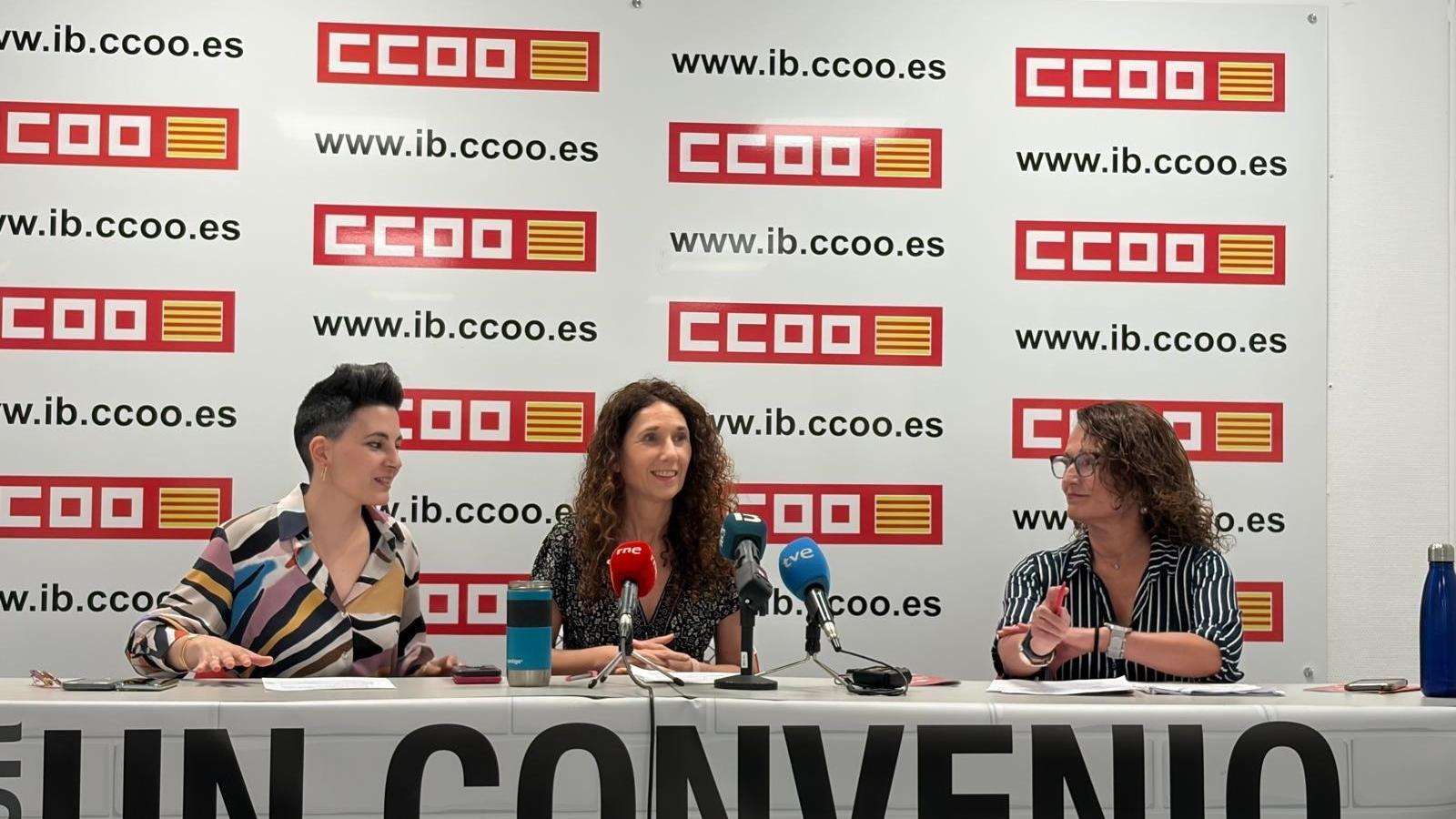
The general secretary of the Services Federation of CCOO Balears, Carmen Carmona, stated at a press conference that the agreement is “the worst in the history” of the sector and presented a guide in which the union analyzes 26 articles of the agreement to explain the reasons for its rejection. According to Carmona, article 7 of the agreement expands the causes, duration, and margins of use of temporary hiring, which, in her opinion, particularly harms fixed-term discontinuous workers.
CCOO has also reported that the agreement harms chambermaids because it postpones until December 2028 the obligation for companies to carry out workload studies. “They will not know how many rooms they have to clean for two more years,” lamented the unionist, who considers that this situation directly affects occupational health and increases the workload. Regarding medical leave, the union has criticized that the coverage of the first three days can only be claimed once every 12 months and not every calendar year, as established by the previous agreement. This means, according to CCOO, that a worker who would have been on leave in September 2025 could not claim these days if they took leave again at the beginning of the 2026 season.
The union also rejects that the new agreement allows sanctioning workers on medical leave if they do not comply with the Mutual's requirements and that the temporary disability supplement can be withdrawn from those who do not accept company controls over their leave. Furthermore, Carmona has criticized the creation of a “commission against labor absenteeism” within companies in the sector, which she has described as the result of “a right-wing discourse” and “a setback” in labor rights.
Another of the aspects that the union considers most serious is the change in weekly rest. According to CCOO, it ceases to be “collective, consecutive and guaranteed” and can now be negotiated individually with each worker, a situation that, according to Carmona, opens the door to employer pressure and harms work-life balance, health, and job quality. “They don’t care if a person can work six days a week in August,” he stated.
During the appearance, the union also referred to a ruling by the Superior Court of Justice of the Balearic Islands (TSJIB) in favor of recognizing the retirement bonus, taking into account actual seniority in the company, including periods of inactivity.
Housing and precariousness
CCOO has also related the agreement to the housing crisis that the Balearic Islands are suffering. The union denounces that some companies use workers' accommodation as a tool of labor pressure and has warned of overcrowding situations, with employees sharing hotel rooms.
In this regard, Carmona has criticized that access to a place to live is presented as a counterclaim for accepting more working hours or split shifts. The union also considers the 13.5% salary increase agreed for the next three years insufficient. According to CCOO, the increase, equivalent to approximately 4.5% annually, does not compensate for the increased cost of living in the Islands, especially regarding housing.
Furthermore, the central union has lamented that the agreement does not include any review clause linked to the CPI, which could lead to a loss of purchasing power if inflation exceeds the agreed salary increases. Finally, CCOO has warned that some workers might not even notice real increases in their payslips due to the salary compensation and absorption system provided for in the agreement.
