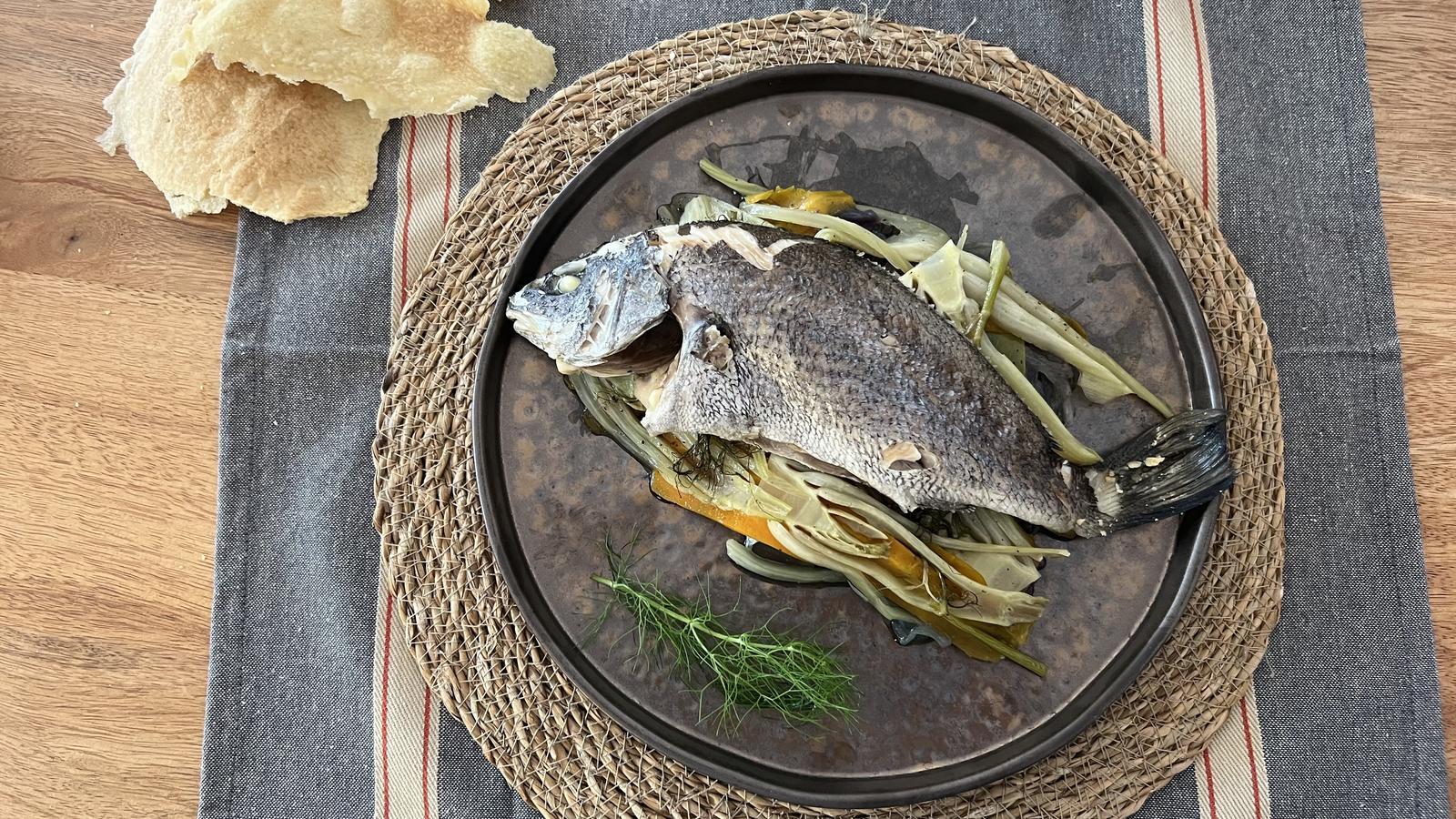
First of all, we will make the dough for the pie. We will mix the oil, water, and salt, then add the flour and knead it until it doesn't stick to our hands. We will let it rest.We will cut the onion into julienne strips, the carrot into thin strips, and do the same with the fennel bulb. We will sauté the vegetables separately. In a baking dish large enough for the fish, we will layer the vegetables, finishing with the chopped olives, and on top, we will place the sea bream. We will flatten the dough and cover the baking dish, ensuring the dough spills slightly over the sides, so it is well sealed. We will prick it all over with a fork and bake the fish at 180 ºC until the dough is cooked (in my case, it took 25 minutes). We will serve the fish accompanied by pieces of the cooked dough, as if it were bread.
A life tied to the sea
Today's recipe is a version of baked sole with olives and a crust
At home we are from dry land, from inland, from the Plain. The wind near us shakes the branches of trees instead of the sails of boats and the sea is far away, even further away for my ancestors despite having the same distance. Inside the dining room of my maternal grandparents there was a huge black and white photograph of the Old Pier of Palma. Some moored llaüts could be seen, the still waters of the port and also the Cathedral, immense and silent dominating the scene, as if it were watching over the city, the sea and us, seated at the table, at the same time. A large window by the water, an ordinary day, in a house in the interior of the island.
I often return to that image while reading La mar quotidiana. Cartes d’un pescador, by David Oliver Ramón and Bartomeu Vera Mas, published by Miquel Font in 2010. The volume starts from the letters, conversations and memories of Bartomeu Vera, a fisherman born in the Jonquet neighborhood in 1926 who evokes a seafaring and popular city that has almost disappeared today. Within its pages, a task that Bartomeu loves, knows and suffers from is reflected. He talks about the hard work of fishermen, the Jonquet and Santa Catalina neighborhoods, precariousness, the routines of the port and other trades that orbited around fishing. Through his voice, a city very different from the current one emerges. El Jonquet, Santa Catalina, Can Barbarà and the pier appear as humble spaces, inhabited by fishermen, fishmongers, sailors and working-class families who lived very connected to the sea.
Artisanal fishing
, published by the Association of Mediterranean Sailors in 2023. It is a surprising and very versatile recipe that I have cooked with escorball, a seasonal fish mentioned by Tomeu Vera in his story.
It is particularly interesting to approach the daily life of this group. The hours spent on the boat, the coexistence among the crew, the knowledge passed down from generation to generation, and the small rituals associated with seafaring work are part of a heritage of great value. The lives of fishermen were marked by the annual cycle, by the species caught, and by the customs and practices for catching them. They often slept on the boat, sheltered in coves, and meals were communal in a mud basin. In one they ate fish, in the other they cooked rice that simmered while they finished the first. For someone from inland, as is my case, these pages allow us to approach an often unknown reality, a personal testimony of great value, but which is also part of our collective history.
Today's recipe is a version of "anfós amb olives tapat de pasta de coca" from the book Recetas marineras mediterraneas para cocinar a bordo, published by the Asociación de navegantes del Mediterráneo in 2023. It is a surprising and very versatile recipe that I have cooked with escorball, a seasonal fish that Tomeu Vera mentions in his account.
