Palma will draw 10 million more liters of water from aquifers each day to grow
The Emaya Management Plan does not propose concrete savings measures, but rather opts for extraction from the subsoil and a new desalination plant

-
CAT -
CAST -
GER
PalmPalma wants to continue growing in population and Jaime Martínez's team does not intend to give up on this despite the lack of water that the Water Resources technicians already detected and confirmed in the year 2023. This is one of the conclusions of the Sustainable Water Management Plan promoted by Emaya, which has just completed the public exhibition period. The document advocates for increasing desalination and extracting more water from underground: up to 10 million more liters per day than are currently obtained, despite the delicate situation of the aquifers.
The plan assumes that Palma will have a population of 572,178 inhabitants in 2040 and calculates that the city will need to capture at least 37.59 cubic hectometers of water annually to sustain this scenario. But the document does not question whether this growth is compatible with the island's water limits, but rather starts from the fact that the city's population will continue to increase and proposes how to guarantee supply with new water sources.
The context is especially delicate. The same plan admits that, by putting the desalination plant and new intakes into full operation, the real availability of water resources will be 40.32 hm³ in 2040 due to the reduction in rainfall caused by climate change. A figure very similar to the demand that population growth will generate (37.59 hm³). Therefore, despite the increase in water production, a very dry year would push the system to its limit.
The document arrives at a time of special political pressure due to the housing shortage and with the commitment of the mayor and the president of the Govern, Marga Prohens, to solve the problem with new developments. In fact, the need to facilitate the construction of 5,000 new apartments has led to measures such as intensifying land use for developers, among others, which have drawn criticism from the opposition.
Emaya's response to this need foresees rather vague measures regarding the improvement of water demand management and, instead, bets on a new desalination plant and three new underground intakes.
Desalination, structural
Until now it was a complementary resource and now a new station is incorporated
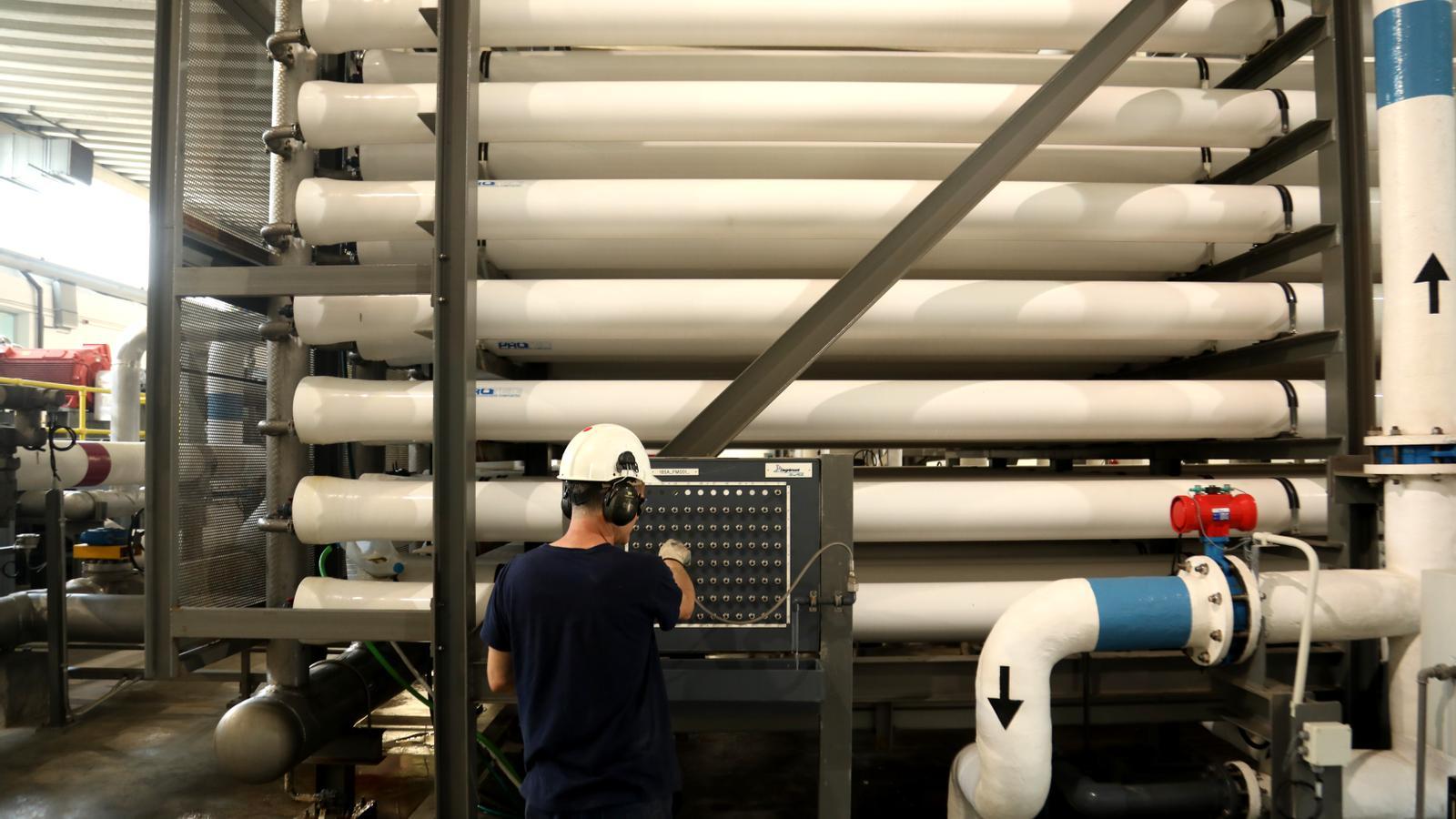
The document goes a step further and opts for desalination as the central resource of Palma's future water model. The Sustainable Water Management Plan defines the future municipal desalination plant –a project that Martínez's team wants to promote to avoid control by the Govern's Water Resources department– as a “structural pillar” of the system and foresees a new facility of up to 36 hm³ per year.
The decision clashes head-on with the message the European Commission is sending these days. Brussels has warned that “the water crisis is not solved only with desalination plants” and argues that these infrastructures should only be used after demand has been reduced, efficiency improved, and reuse enhanced. The EU, as environmental groups and experts have tired of repeating, also warns of the energy and environmental costs associated with this model and insists that the priority should be to adapt consumption to available resources rather than multiplying water production.
Two years ago, technicians from the Govern's Water Resources already warned during the processing of Palma's General Plan that there was not enough water for all the planned growth, and that was even before Martínez and Prohens announced plans to build thousands of apartments in Palma.
The short term strains
The new desalination plant will not arrive for another five or six years
The construction of a new desalination plant will not be immediate, but will require five or six years. This situation has motivated the promotion of new underground abstractions, when experts and the Government's Water Resources department insist on the need to reduce subsurface extraction. "It hasn't even been put out to tender," explain sources from the municipal administration.
That Palma currently needs more water than it has available “causes overexploitation of aquifers”, says the spokesperson for the Alianza por el Agua entity, Juan Antonio Calvo. “Since they do not want to give up urban growth, new extractions will be opened, because they know that the incorporation of the desalination plant will be in the medium term”, he criticizes.
According to Emaya sources consulted by ARA Balears, the plan “does incorporate a wide range of measures to reduce consumption and improve water use efficiency while the new desalination plant is not operational”. The company lists actions such as network renovation to reduce leaks, remote reading, saving campaigns, reuse of regenerated water, and the use of rainwater and greywater. “The objective is to guarantee the resilience of the system and minimize pressure on natural resources, and to move towards a more sustainable model adapted to future conditions”, assures the municipal company.
But the document, according to a technician consulted by ARA Balears who requests anonymity, “does not propose at any time to reduce the global forecast demand or to limit urban growth while the new infrastructures do not exist”. Saving measures appear as complementary mechanisms, but the plan also concludes that it will be necessary “to increase collection availability”.
¿What are the new wells?
Xorrigo, la Fita del Ram and l’Ullal de Son Mir will be the new extractions
In addition to desalination, the other major bet of the plan is the increase in underground abstractions, as they will be more immediate. The document incorporates up to 3.86 cubic hectometers annually of new extractions or underground contributions: 2.29 hm³ in Xorrigo, 0.07 hm³ in Fita del Ram, and 1.5 hm³ in Ullal de Son Mir. In total, this represents 10.6 million new liters per day from the subsoil.
The figure is equivalent to approximately 10% of all the water availability planned for Palma in 2040. All this in a context where Mallorca's aquifers have accumulated decades of pressure, salinization, and deterioration due to overexploitation. Emaya defends that any new abstraction “is always planned with the objective of guaranteeing the system's resilience without compromising the good condition of the water masses” and assures that the model “bets on the diversification of sources and the progressive reduction of underground water extraction”.
Juan Antonio Calvo, who in addition to being the head of the Water Alliance is also a drafter of the Water Plan linked to urban planning in Ibiza, considers that Palma uses much more lenient criteria than those applied on the island of Ibiza to justify water sufficiency. “The first thing that caught my attention is that they do not sufficiently justify water sufficiency because they make an annual scale balance,” he explains. Calvo recalls that, in the case of Ibiza, Water Resources required justification of availability for specific moments of maximum demand. “It is not the same to say that you have desalinated water for a specific year as what you really have on August 18th,” he warns.
The expert points out that the document also does not set timelines nor links urban development to verifiable water objectives, as was done in Ibiza. “I don't see any timeline here, so it's a declaration of good intentions, like a blank check,” he adds.
The opposition criticizes the plan
MÁS por Palma demands conditioning growth on available water
MÉS per Palma and the PSIB have criticized and filed allegations against what they consider an excessive project obsessed with urban growth. According to the spokesperson for MÉS per Palma, Neus Truyol, the new extractions from the subsoil demonstrate “the destructive model that the PP and Vox are promoting”, and she demands that “urban growth be conditioned on real water availability, limiting large consumptions and luxury uses”.
The opposition reminds the municipal government that it cannot ignore “the impact of the urban policies it has approved in the last three years”, referring to the projects for large apartment buildings that are being promoted to combat the housing shortage. “If we continue down this path, what is a right today, like water, will be a privilege tomorrow”, remarks Truyol.
We will have to see what the position of the Govern is, ultimately responsible for water, especially for groundwater, considering that Palma's aquifers are already overexploited.
