Produce more or consume better: the debate behind the new 135 million euro desalination plant in Palma
The infrastructure, planned for 2035, will produce up to 36 hectometers cubed annually. It is conceived by the City Council as a "structural pillar" to guarantee the supply

-
CAT -
CAST -
DE
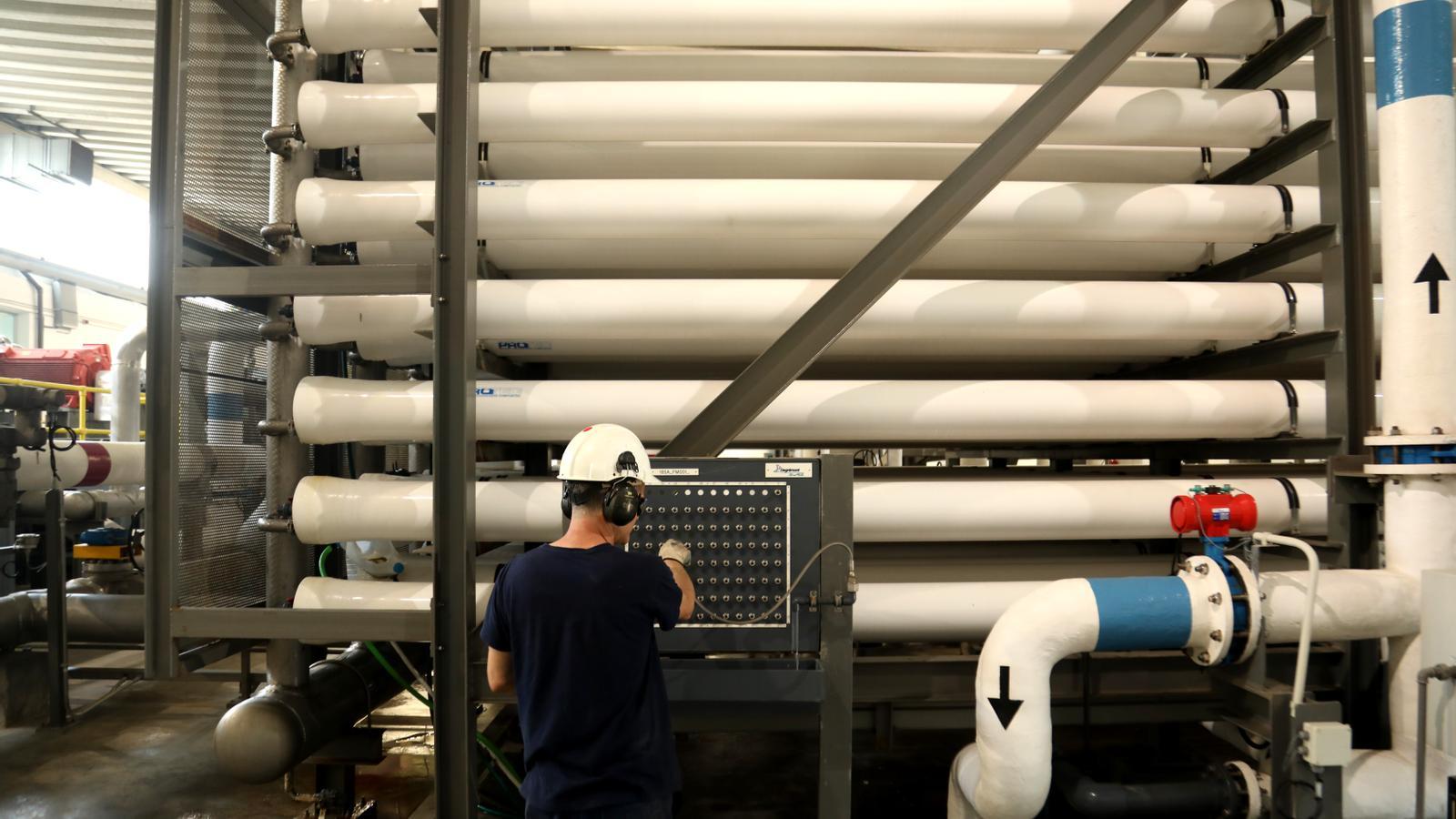
PalmaPalma City Council will have its own desalination plant. Driven by Emaya, the installation will cost around 135 million euros, according to the sustainable water management plan project. This facility, which is planned for the year 2035 and will have a maximum capacity of up to 36 cubic hectometers (hm3) per year, is proposed as an "structural pillar" to guarantee supply. The action aims to respond to the water shortage that water resource technicians of the Government anticipated in their reports on the General Plan of Palma in 2023.
This critical situation had caused several clashes between the mayor's team, Jaime Martínez, and the Ministry of the Sea and Water Cycle. Martínez wants to increase the supply of housing in Palma at all costs, above the projections of the General Plan; this would be the main reason for promoting the new desalination plant. With the horizon of climate change increasingly present, the question that arises among technicians and experts is direct: do we really need to produce more water or should we use less?
The main objective of the project is to ensure water supply through "non-conventional" resources, especially in contexts of prolonged drought, which are increasingly frequent. Complementarily, the desalination plant will also allow strengthening Mallorca's overall water system, as it will reduce pressure on aquifers, as explained in the document to which this newspaper has had access.
The project report considers that Palma and the island as a whole suffer from a "structural deficit" of water resources that cannot be resolved solely with savings measures or efficiency improvements. Projections indicate that this water shortage could be between 16 and 24 hm3 annually by 2040 (one hm3 is equivalent to one billion liters), a situation exacerbated by climate change and the decrease in underground resources, as indicated by the analyses of the Hydrological Plan of the Balearic Islands (PHIB 2022-2027), along with the technical studies of Cort's future Sustainable Water Management Plan.
A key pillar of the "future" model
In this context, for Cort, desalination is consolidated as a key pillar of the "future" water management model. However, sources from the technical field insist on having another order of priorities. Juan Calvo, director of the Water Alliance and former secretary of the Balearic Water Agency, recalls that the European framework is clear: first reduce demand, then reuse it, and only as a last resort, increase supply. "Before building a new desalination plant, we should make the most of the ones we have," he argues. As he explains, the current plants in Palma and Alcudia do not operate at full capacity, especially in winter, which prevents the recovery of aquifers as a strategic reserve. In Ibiza, desalination plants are used in winter —the majority of the water consumed on this island is desalinated—, but this is not the case in Mallorca. "Why do we want another desalination plant if the ones we already have are not used at full capacity?" he asks.
As explained by Dr. in Geography Cels García, the EU's Water Framework Directive seeks the principles of efficiency, demand reduction, and water reuse, and only if there is no other possibility, increasing supply, although it is not recommended. On this matter, Calvo warns that increasing supply is "a step forward" that can cause a "rebound effect".
The City Council's plan also highlights that this facility will reduce dependence on external supplies of desalinated water, a trend that has been increasing in recent years and which increases the system's vulnerability during drought episodes. The intention is for the desalination plant to contribute to the recovery of aquifers and to meet the environmental objectives set by hydrological planning, while improving supply security in the face of the projected population growth, which could exceed 570,000 inhabitants by 2040, further straining the system.
This idea opens another fundamental question: the growth model. Calvo warns that desalination plants often arrive too late for urban development, causing "even more water stress". "If construction was planned with a new desalination plant in mind, by the time it's finished, another one will be needed," he states. Therefore, he argues that any urban expansion should be conditioned on the real availability of water.
Remodeling of the desalination plant
In parallel, the Government has already approved the renovation of the desalination plant in the Bay of Palma for a maximum amount of 58 million euros. The planned actions will allow for a thorough update of the plant, which has a nominal production capacity of 63,000 cubic meters per day and shows a high degree of obsolescence in some of its main systems. This action precisely reinforces the argument of those who demand to first optimize what already exists.
There are also institutional questions. Dr. Cels García, a Doctor of Geography from the UIB, recalls that water resource competencies correspond to the Government, which is who should authorize this type of infrastructure. The Executive, for its part, has explained to this newspaper that the project is municipal and that the City Council has the power to develop it.
As García explains, desalination poses concrete impacts. Only approximately 45% of the treated water is suitable for consumption; the rest is brine that is returned to the sea, which can cause possible effects on sensitive ecosystems, such as posidonia meadows. Added to this is the energy consumption: between 2 and 2.5 kWh per cubic meter in current plants, but much higher in older ones, where it reaches 50 kWh, figures that increase the final cost of water compared to traditional sources.
