Recovering Can Morató to understand the work that was done there
The rehabilitation of the old mat factory in Pollença will preserve elements of the production process and will reconstruct the industrial buildings to explain the industrial past of the site

-
CAT -
CAST -
DE
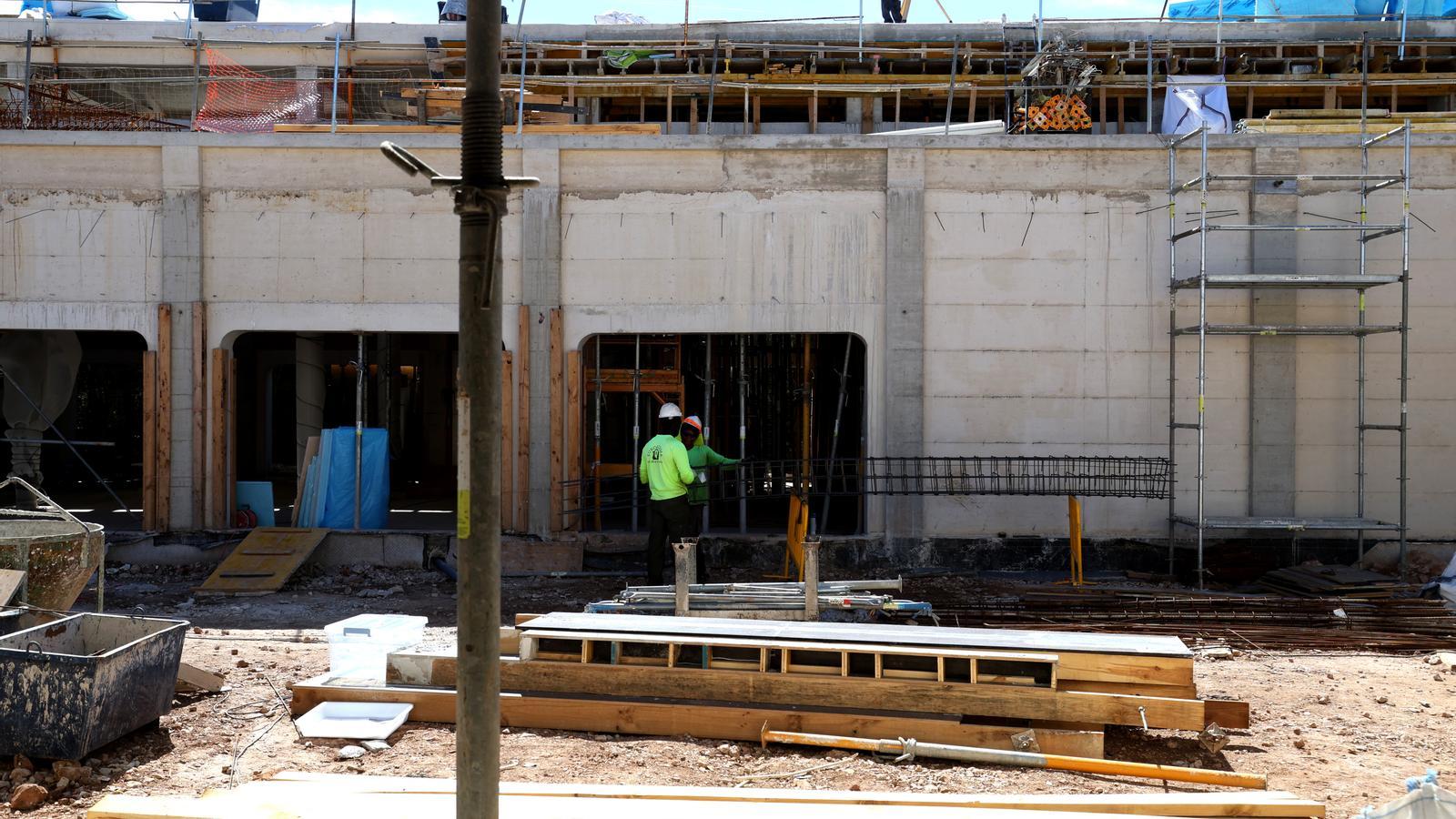
PollençaCan Morató, the old mat factory located in Pollença, is being transformed after decades of abandonment. Colonya Caixa Pollença will move its central services there and set up cultural spaces. The work must also resolve how to preserve a factory that had reached a state of ruin. The façade will recover its original configuration and, inside, the warehouses and the remains of the facilities will allow for explaining how wool was converted into carpets and how the people who made them worked there.
Biel Bauzà, general director of the savings bank, describes this process in an interview on Ràdio Pollença. Can Morató operated from the 20s to the 60s of the last century and sold part of its production outside of Mallorca. As he recalls, at some points more than a hundred people worked there, mostly women.
The doctor of History Pere Salas, a good connoisseur of the trajectory of Can Morató and the rehabilitation process, considers it especially important that the intervention is not limited to recovering a building to give it a new use, but that the elements that allow us to understand what it represented are preserved. Salas highlights the heritage and economic value of the factory, but also its relationship with the social, cultural, and artistic context that Pollença experienced during the years it was in operation.
For this reason, he values that the decision was made to preserve and recover the historical part instead of proposing a complete transformation of the complex. The factory, he points out, “is part of the contemporary history of the municipality and allows for explaining a stage in which industrial activity also had weight in the economic and social life of Pollença”.
Before reaching the loom
The work began when the carts entered loaded with wool. They were weighed on a scale and, after unloading, they passed through again: the difference indicated the amount of material they had left behind. Later on, trucks followed that same route. Almost nothing remains of the weighing machinery, explains Bauzà, but the pit is preserved.
The wool had to be treated to remove parasites, washed, and dyed before being woven. The rooms and containers used for these operations will be restored within the visitable route, as will the large washbasin that collected rainwater and water from the torrent.
Then came the work of the looms. In the warehouse where the mats were woven, mostly women worked. Bauzà explains that that space had more elaborate columns than those of the other warehouse, which have been reproduced with molds to recover their shape. The carpentry workshop, where the machines were repaired, and a small vegetable garden completed the activity of the site.
Conserving the factory has forced a good part of it to be redone. The state of the structures and the demands of current regulations made it impossible to keep them all, notes Bauzà. Even between the acquisition and the start of the works, there were new collapses. Before introducing machinery, it was necessary to shore up and check the wells and cisterns to ensure the safety of the workers.
One of the elements to which Pere Salas attaches the most value is, precisely, the facade. During the work prior to the rehabilitation, he explains that he and several architects verified that the facade that had reached our days did not correspond exactly to the original one of the factory, but that it had been modified at some point in its history. It has not been possible to determine with certainty the reason for that alteration, although Salas points out as a possibility the fact that a part of it fell due to external causes and was subsequently rebuilt.
This discovery influenced the criteria for the rehabilitation. Instead of reproducing the facade after that modification, the choice was made to recover the original configuration, the first one that Can Morató had. For Salas, this decision allows bringing the building closer to its historical appearance and reinforces the heritage value of the complex.
The project also maintains the volume of the two warehouses. Some elements will be original: the stone floor of the entrance was dismantled and the pieces were marked to be able to put them back in place. The washbasin and the washing and dyeing containers will also be recovered. Together with the scale pit and the rebuilt columns, they will allow each space to be related to the work that was done there.

A museum spread throughout the factory
Initially, it had been thought to concentrate the museum in one room. Of the looms, however, mostly iron pieces remained, because the wood had rotted. According to Bauzà, it made more sense to explain the production while walking through the factory. “The building itself will be a museum,” he summarizes. Panels, old images, and testimonies will help to follow the path of the wool to the finished carpet.
It is precisely this conservation of the complex that Salas believes will allow going beyond showing industrial remains. Recovering Can Morató, he defends, “means preserving a piece that helps to understand the Pollença of that era, its economy, and the society that was formed around the factory, but also the cultural and artistic context that characterized the municipality.” The value of the rehabilitation, therefore, is not found only in the building, but in everything that can be explained about it.
Bauzà recounted that the nave closest to the torrent was already rebuilt and the other was advancing with formwork. The works began in October 2025, with two years of execution planned, after a long processing period. Bauzà admits possible delays and acknowledges that building a headquarters at the industrial estate would have been easier and cheaper.
The new activity that the space will host will include an auditorium, one for training, and a courtyard where concerts and cinema are being considered. Some former workers, however, had a more immediate request. When they returned to Can Morató to record their memories, they asked for them to hurry: they were getting old and wanted to see the factory recovered. Their testimonies will be part of the visit and will allow giving a voice to the work that the structures, all alone, cannot explain.
