“We are a rural 'queer' with goats”
The former president of Ben Amics, Jan Gómez, combines activism for LGTBIQ+ rights with a circular livestock project in Montuïri
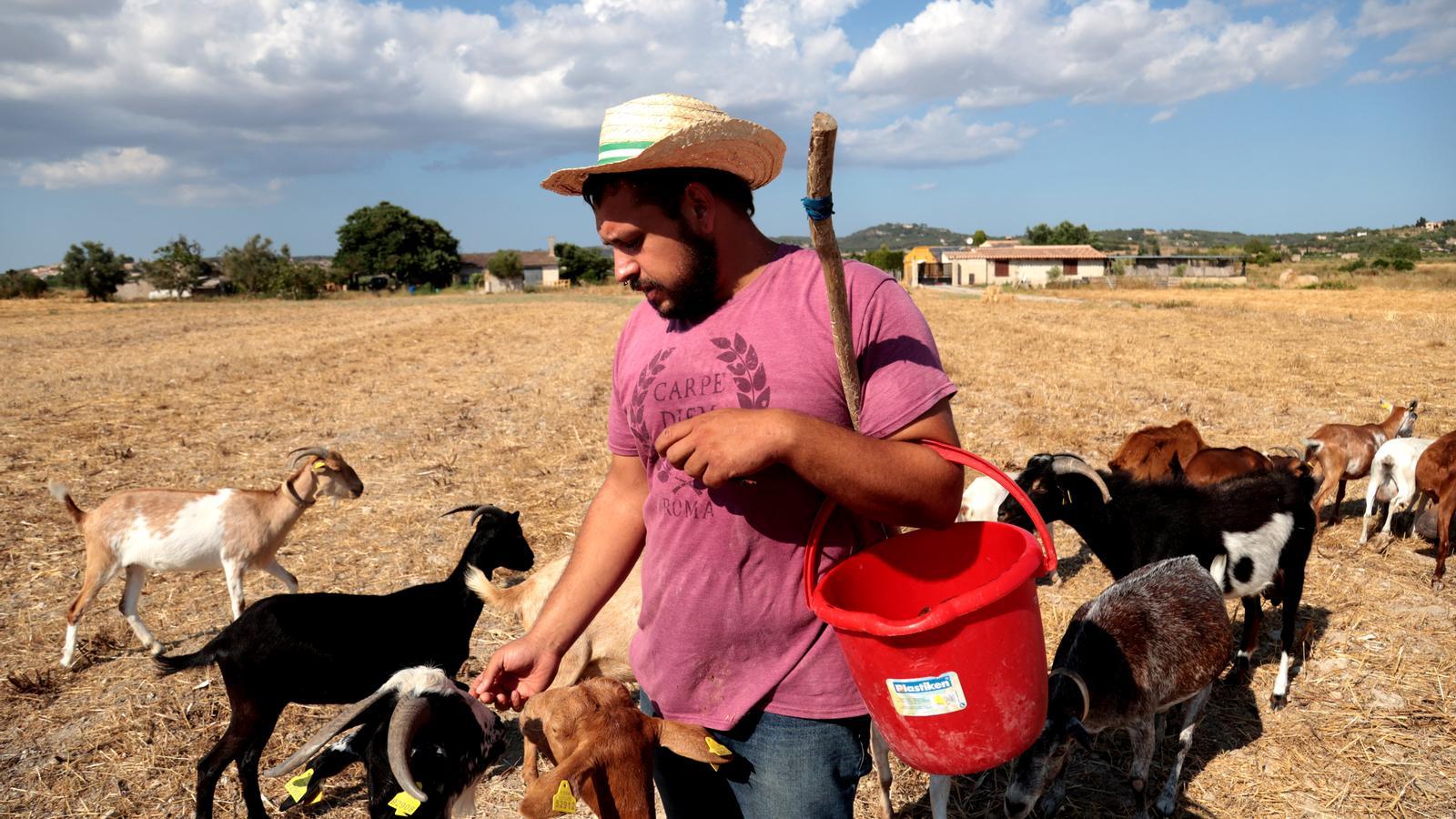
PalmaThe immense shade of a mulberry tree protects Jan Gómez from a late June sun that tastes like August. He gets up from his chair, takes off his straw hat with a green and white ribbon –"the first one I found at the bazaar," he says–, stretches his T-shirt that says Carpe Diem, and grabs a stick that had belonged to his grandfather. To the left of the mulberry tree, the onions in the vegetable garden have their stems bent so they can finish fattening up, the tomatoes peek out from between the reeds, and the sunflowers are already bowing their heads, loaded with seeds. To the right, the corral. About twenty goats come out in a rush and cross the sown field as soon as Jan opens the bolt. They search with their muzzles for the grain that remained scattered on the dry earth after the harvest.
Jan is only 30 years old, but he has been in the public eye for half his life. When he was 16, he joined Ben Amics, the main organization for the defense of LGTBIQ+ rights in the Islands. He had just turned 18 when he assumed the presidency and today –after voluntarily taking a step back– he is the technical coordinator. The goats surround the bucket full of carob beans that Jan is chopping. How does someone who has spent half his life trying to change the world end up on a lost farm in the Pla de Mallorca?
“I have always wanted to live in the countryside,” he confesses. As a child, when he spent his summers with his grandmother in Granada, he would slip away at five in the morning with the goatherd to accompany him. "When we reached the first hill, he would tell me: 'Go back, your grandmother will worry,'" he recalls, surrounded by animals. "What I like about goats is that they are quite crazy. They are mischievous by nature. I didn't want to raise sheep. They are very boring," he adds.

The opportunity to live in the countryside came to him after the pandemic. He bought a modest little house that had ended up in the hands of a vulture fund after a foreign businessman dedicated to car rentals went bankrupt. "Divine justice," he laughs, still with carob beans in his hands. He found wrecked cars there and had to clear the scrubland to be able to enter. "I didn't want to take out a mortgage, but in the end, I'm left with a monthly payment that today would be equivalent to the price of a room in Palma.
A cheese shop
Furthermore, Jan rents the mulberry farm to develop a long-term project that aspires, first, to self-sufficiency and, later, to opening a cheese factory. With his partner and the help of his godfather, he sells kids and black pig piglets. He does not yet make a living from the countryside, but he would like to. “I am a very strange person, a rural queer with goats. It is hard to find,” he says before laughing again. “I have always liked worlds that collide.”
At first, he ran into the reservations of the farmers, who often view city dwellers as people who imagine the countryside with a pool and lawn. "I know that in the village there were bets to see when the city 'queers' would get tired of this life," he reveals.
But the worlds that collide, in reality, have always coexisted within Jan. From that child who would run away with the goatherd to the young man who survived school bullying for being different and who today still fights it through activism. "I liked games that weren't football. I was a lonely child and I didn't fit into the traditional model of masculinity. Besides, I was a bit chubby. It wasn't easy," he recalls.
At high school, he was already involved in student social causes. Everything pointed to him becoming a veterinarian, but a head of studies changed his life. Convinced of his potential, one day she asked him if he would really be happy locked up in a clinic or a laboratory. He ended up studying Labor Relations and, just after starting his presidency of Ben Amics, a photograph of him with a rainbow-colored fan during the reception that King Felipe and Queen Letizia were offering to civil society at the Almudaina Palace became a symbol. The gesture grabbed the headlines of a reception that, until then, Juan Carlos I had reserved almost exclusively for politicians, military personnel, and business people. "I wish that moment would disappear from the annals of history," he says, laughing. "There are still many people who remember me for that. I was very young, a republican and, surely, much more radical than now. We understood that it was important to attend. Not for the Royal Household, but because, for the first time, the Head of State was publicly recognizing our collective. Did the gesture have historical and symbolic value? Yes. But I did not want to be its representative."
They went there for three years. Afterwards they decided not to return. "At that moment, a faggot was very useful for their photographs, but the trade-off had to be publicly defending diversity, also on an international scale, in a world where there are still countries that persecute it or punish it with the death penalty."
Rosa stands out among the rest of the goats. While the others chew on pieces of carob, she insists on seeking a caress from Jan. "She is the most affectionate. She acts as a wet nurse." When there is not enough milk for the kids, Rosa feeds them. "This is an animal welfare project, about knowing where what you eat comes from. There are children convinced that milk comes directly from a carton. Here, no animal eats feed. The whole environment is natural," he explains.
The goat's birth
The countryside requires constant attention and, if his hands are in Palma organizing Pride or fighting because the City Council has suspended it, others must take care of the animals. There have been Christmas lunches where both he and his partner have left their chairs empty, because a goat had gone into labor. Meanwhile, Jan learns by trial and error and asks for advice from local farmers, too tired to believe that their knowledge still has a future. There is no other school than books and YouTube videos.
Jan's more social side has ended up connecting with his rural project. His eyes, of a deep blue, no longer project the indomitable wildness of his 18 years. They have calmed down. Or perhaps they have been domesticated.
When he was bullied at school, the Law on Equal Marriage and Adoption already existed. Since then, LGTBIQ+ rights have continued to advance, but Jan's eyes do not speak the language of optimism. "For my generation it was easier than for the current one," he says in reference to the "ideological shift" driven by the far right. "We have found swastikas drawn on high school blackboards. It was unthinkable in a society that had emerged from a dictatorship and that knew the value of human rights. Now the idea is spreading that human rights are a woke thing, a leftist ideology. We are living in a moment of change. Of regression."
How is it reversed? "If I have to be honest, I have given up. Or perhaps the word I should say is hopelessness. And I think that explains why I have become more and more involved in this rural project." Jan entered activism convinced that he could change the world. Over the years he has discovered that "the world goes where it wants to." "It is very hard for someone who has been fighting for so many years. You face enormous structures and there comes a moment when you need to rest. It has been 14 years on the front line."
Permanent discomfort
Activism has also changed, pushed by “a more individualistic society,” in which social networks “have replaced collective structures.” “We are a small island. There are many queers, but few committed to their rights.”
After putting the goats away, he sits back down under the mulberry tree with his stick between his legs and his mud-caked espadrilles. "There are fewer and fewer physical meeting spaces left. Most relationships happen through applications and social networks. This makes this sense of community disappear. Before, you could walk into a bar, meet people, make friends, fall in love, or simply talk. Now, many relationships begin and end in front of a screen. Comfort dominates our lives. And activism is exactly the opposite: a permanent discomfort. It is exposing yourself, arguing, trying to change mentalities. It goes in the opposite direction to a society that only seeks Netflix, sofa, and air conditioning."
According to Jan, there is no replacement. And identities –despite the proliferation of concepts– are increasingly understood from the self. "I grew up thinking that there were irreversible consensuses. Now I see that they break with enormous ease, based on increasingly simplistic and aggressive discourses," he says while wiping sweat from his forehead.
Rural activism
He had no choice but to open an Instagram account. “If you want to mobilize, you have to be where the people are”. He will use it to talk about rural activism. He will be able to explain how he braids garlic to have it all year round, how in winter he opens jars of tomato sauce from local varieties made in the summer, and how the whey from future cheeses will feed the pigs. Everything is part of the same cycle.
Perhaps hopelessness is also recycled, just as animal manure nourishes the vegetable garden. “An activist never gives up completely. They take a step back, regain strength, and wait for the moment to return to it. But every time I am clearer that returning to the land, farming, and raising animals is the place where I want to be. Returning to the land is also a form of struggle”, he says, surrounded by straw bales. Under the shade of the giant mulberry tree.
