The drought pushes the Islands to a landscape similar to that of Morocco
Experts have confirmed a severe impact with high mortality in 500 forest hectares and state that the transformation has already begun

-
CAT -
CAST -
DE
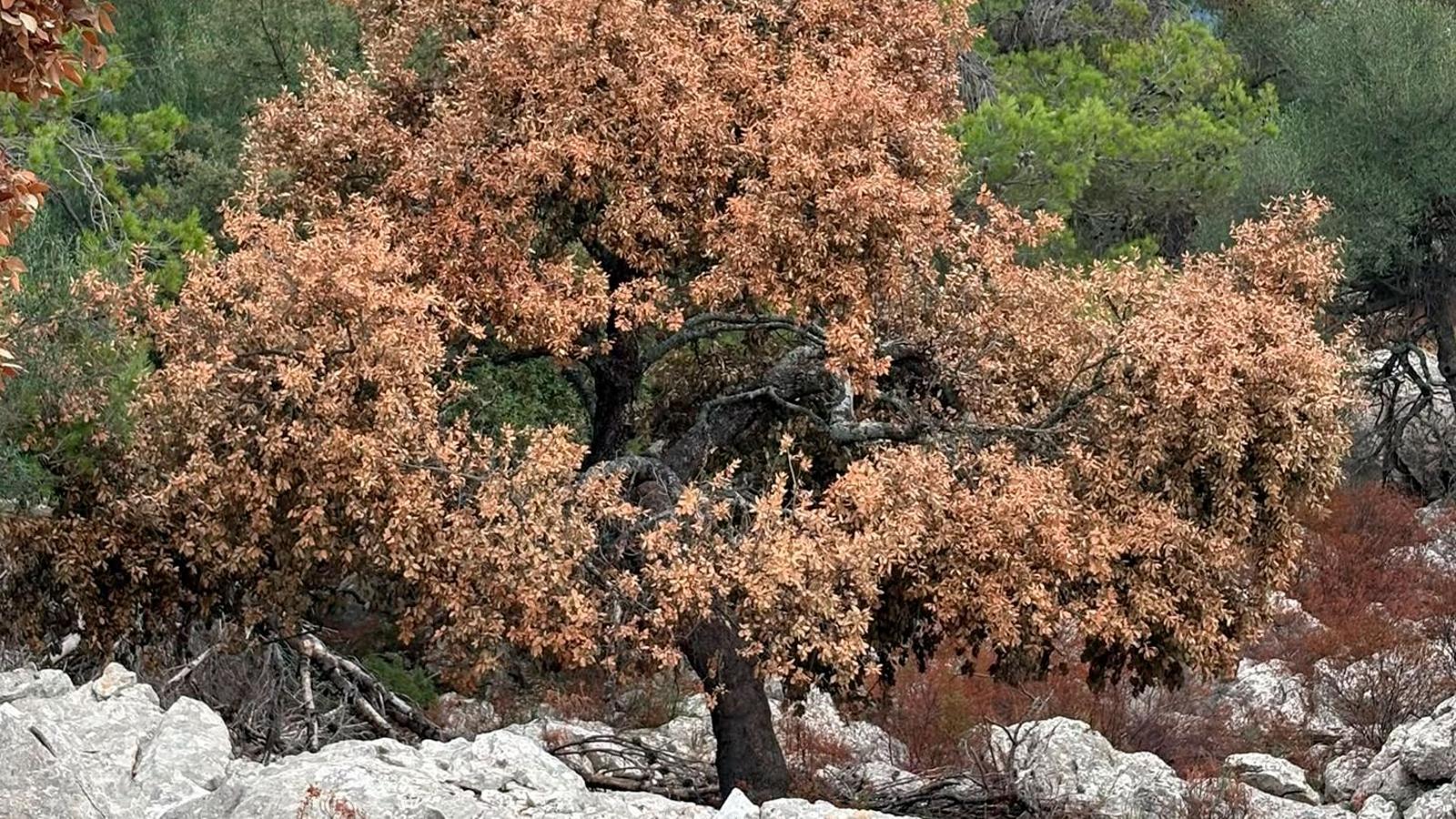
PalmaThe forests of the Balearic Islands have begun a transformation that will turn them, according to experts, into spaces increasingly similar to Morocco. The comparison, which is part of the Forest Network's analysis, is one of the warnings issued by forestry technicians after a summer that has particularly punished pine trees, holm oaks, and other Mediterranean species. The succession of extreme droughts and heatwaves threatens to transform the vegetation we know today. The first effects are already visible. “The change in landscape, without a doubt, has begun,” warns Carolina Rodríguez, territorial dean of the Official College of Forestry Engineers, to ARA Balears.
The summer of 2026 has been the hottest since records began in the Balearic Islands, according to monitoring by the Government's Forest Management and Soil Protection Service. 96% of the days recorded temperatures above average, with heat that began in mid-May and continued practically without respite. Rainfall was scarce in many areas, especially in Menorca, where the index that combines the lack of rainfall and the atmosphere's water demand reached the lowest value in the entire historical series.
The consequences can be observed on the territory. Technicians estimate a severe impact of up to 500 hectares of forested land, mainly in Mallorca and Menorca, according to data from the Forest Network. There are dead pine trees in the Pla and Migjorn regions, dried-out holm oaks on the sunny slopes of the Serra de Tramuntana, and areas of scrubland that have lost much of their vigor. But the figure only reflects the most serious damage. Much vegetation has suffered water stress that is not always visible and that could condition its ability to withstand coming summers.

Forest engineer Oriol Domènech explains that an isolated mortality episode does not necessarily have to cause a permanent transformation of ecosystems. “The problem arises when these episodes repeat. If they occur this year, last year, next year, three years from now...”, he comments. This accumulation can end up causing a significant substitution of plant species and a progressive aridification of the Islands.
Domènech sketches a very graphic scenario: Mallorca, Menorca, Ibiza and Formentera could end up with vegetation “similar to that which we find today in certain areas of Morocco”.
Alicante, Murcia and Almeria
The professor of the Department of Biology and Geology at the University of the Balearic Islands (UIB) Javier Gulías shares this perspective, but reminds us that there is no need to go so far to find examples. "We have Alicante, Murcia, and even Almería, territories that are experiencing desertification processes, a list we have now joined," he explains. According to Gulías, climate evolution may favor landscapes with "less dense vegetation and a reduced presence of trees and shrubs."
This specialist in water stress explains that Mediterranean plants adapt very well to changes. "The landscape we have now is precisely the result of 10,000 years of adaptation," he reminds us. But this capacity for resistance is not unlimited. Plants face a particularly harsh combination of climatic factors: "High temperatures, long drought, and high irradiation. This is a cocktail that is very difficult for these plants and trees to endure."
The key is not so much an extraordinarily hot summer as the frequency with which these episodes repeat. “Hard summers, like this year's, if one happens every fifteen years, is one thing. Plants and trees can recover. But if this happens year after year, or in alternate years, we are facing a situation that will cause a very important change. And we are already witnessing it,” he remarks.
Wild olive groves of the Pla and pine forests of Ibiza
The wild olive groves of the Pla de Mallorca and certain pine forests on the island of Ibiza are of particular concern to experts because they grow in territories with scarce rainfall and very hot summers, and this year has been no exception. In contrast, the wetter areas of the Serra de Tramuntana generally have more water resources, although this does not make them immune to extreme droughts. In fact, one of the novelties of recent years can be easily observed on the Forest Network maps, where patches of severe damage can be seen in areas of the Serra.
The extreme drought of 2026 did not strike forests starting from scratch. In 2023, significant rainfall deficits were already recorded. In 2024, forestry technicians detected a notable deterioration of vegetation in the Pla and Migjorn areas of Mallorca, with wild olive trees, shrubs, and other species showing leaf loss and symptoms of water stress.
In 2025, annual precipitation was mostly within normal values, but temperatures remained extraordinarily high. According to Aemet, it was an extremely warm year, with an average temperature 1.1 degrees above the climatic average for the 1991-2020 period. This summer, the heat and lack of water have once again put the vegetation against the ropes.
To the combination of heat, drought, and high solar radiation, Javier Gulías adds another factor: the increase in nighttime temperatures. The researcher explains that, during the driest part of the summer, approximately between June 15 and September 15, “many plants have to survive mainly thanks to accumulated water reserves. The night played a fundamental role, because since it was not as hot, or even a bit cool, they stopped consuming reserves. They rested, literally. Now that is not the case,” he explains.
When nighttime temperatures are high, this expenditure can increase, especially after days in which drought has reduced the capacity for photosynthesis. “The nights of these summers are very harsh and the plant doubles its effort, day and night. This is also a factor that ends up taking its toll,” points out Gulías.
Drought is not the only obstacle to forest recovery. The dean of engineers warns that the pressure from wild goats “prevents natural regeneration” in numerous areas of Mallorca, especially in the holm oak forests.
