Puente accuses the Balearic Islands of "unbearable hypocrisy" for criticizing the expansion of airports and not limiting the places
The Minister of Transport attacks the Prohens Government amid social rejection of the expansion of Ibiza airport, promoted by Aena, 51% controlled by the State
-
CAT -
CAST -
DE
PalmaThe Minister of Transport, Óscar Puente, accused Marga Prohens' Government this Monday of an "unbearable hypocrisy" for demanding limits on the growth of the Balearic Islands' airports while, as he denounces, it does not reduce the supply of tourist accommodation. The statements come amidst the strong social opposition that has been provoked by the expansion project of Ibiza airport, promoted by Aena, a company 51% controlled by the State through ENAIRE, a public entity that depends precisely on the ministry directed by Puente.
The controversy has a clear epicenter: the Codolar airport. Aena's investment plan for the 2027-2031 period provides for allocating some 230 million euros to the reform of the Ibizan facilities, with the expansion of the terminal and an increase in boarding gates, which would go from the current 17 to 32. The project has sparked rejection from environmental organizations, youth and neighborhood groups, as well as institutional representatives and economic sectors of the island, who take it for granted that the new facilities will facilitate an increase in air traffic and will aggravate tourist saturation.
The opposition has gone beyond political statements. The Ibiza Youth Association promoted a mobilization against the project, while GEN-GOB, Friends of the Earth and other entities have warned of the consequences it could have on the territory, water resources and real estate pressure. More than a hundred people also signed a collective letter to express their rejection of the expansion. Even the president of the Consell d'Eivissa, the Popular Party's Vicent Marí, has positioned himself against an expansion that he considers excessive.
Aena, on the other hand, defends that the works represent a necessary modernization to adapt the airport to the new security requirements and European border controls. The manager denies that the increase in boarding gates necessarily implies an increase in passengers. The groups opposed to the project question this explanation and warn that larger facilities may facilitate future growth in airport activity.
Puente blames the accommodation supply
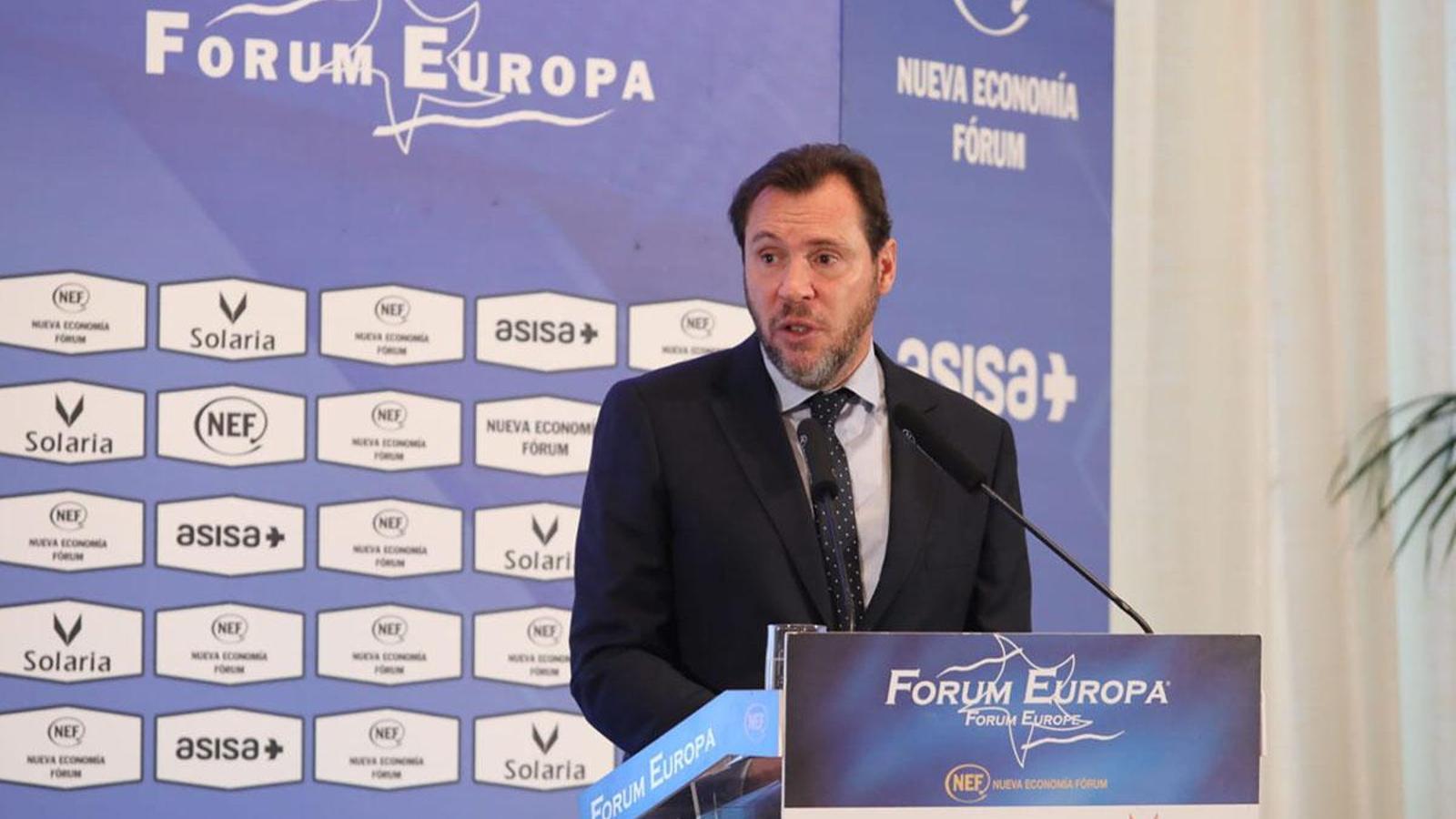
In this context, Puente defended during an informative breakfast of Nueva Economía Fórum, in Madrid, that the control of tourist flows should not be done by limiting the capacity of airports, but by regulating the supply of accommodation at the destinations.
The minister has qualified as "unbearable hypocrisy" the position of administrations such as the Government, which he reproaches for not stopping tourist housing licenses while demanding to "strangle" the airports. According to Puente, airports are only an infrastructure that allows reaching the destination, but they do not determine tourist demand by themselves. "People don't go to airports, they go to an apartment, to the coast or to a hotel," he stated. For this reason, he argued that, if the number of visitors is to be reduced, it is on the accommodation supply that action should be taken.
"Aena does not establish who goes to the airports, but it can dimension them according to the travelers they will foreseeably receive," argued the head of Transport. Puente also appealed to the European regulatory framework, which establishes the conditions for airlines' access to airports and the allocation of time slots. According to the minister, the airport manager cannot arbitrarily prevent operations if available capacity exists.
Another of his arguments is that the same amount of tourist beds can generate more passengers if stays are shortened. Puente gave as an example an apartment in Alcúdia that previously accommodated two visitors for 15 days each and that can now receive four tourists with weekly stays. The accommodation capacity remains the same, but the number of people passing through the airport increases.
With this explanation, the minister maintains that keeping the tourist supply intact, especially in a context of higher visitor turnover, makes it difficult to contain the growth of air traffic.
Bauzà: "He can say whatever he wants"
The Government's response was not long in coming. The Minister of Tourism, Culture and Sports, Jaume Bauzà, replied that Puente "can say mass," because the Balearic Islands' tourist spots "are limited." Bauzà thus defended the containment measures adopted by the Executive and demanded that the minister allow Balearic institutions to have "a voice and a vote" within Aena in order to participate in the decisions that affect the islands' airports. The minister's response once again puts on the table one of the Government's main institutional demands: that the Balearic Islands be able to intervene in the planning of infrastructure that directly conditions the arrival of visitors, but over which they do not have decision-making capacity equivalent to that of the State.
However, limiting the creation of new tourist spots does not necessarily mean reducing those that already exist. This is one of the underlying issues of the confrontation: while Puente demands action on accommodation capacity, the Government defends curbing its growth without opting for a generalized reduction of the legal offer.
Aena, a company under state control
Puente's criticisms contrast with the role the Spanish government itself plays in airport planning. Aena is not a company alien to the State: 51% of its capital belongs to ENAIRE, a public entity that depends on the Ministry of Transport, while the remaining 49% is private capital traded on the stock market.
Furthermore, the Council of Ministers approved in September the third Airport Regulation Document (DORA III), which establishes the investments planned for the 2027-2031 period. It is within this framework that the reform of Ibiza airport is inscribed, rejected by a significant part of the island's society. Therefore, even though Puente argues that Aena must respond to existing demand and respect European rules, the planning of infrastructure and the investments that can condition its future capacity are also part of the public decisions in which the central government participates.
The discrepancy had already caused a confrontation between the two administrations. The Government published a letter sent to Aena in which it assured that its investment requests referred to improvements in mobility, accessibility, technology, sustainability, and user comfort, but not to increases in passengers. The regional executive rejected that its demands be linked to airport expansion plans.
