Unfavorable reports: Manacor stops the feet of the Son Brau macro-farm
The municipal services report unfavorably on the 80,000-chicken project and question the urban, environmental, and road viability of the project
-
CAT -
CAST -
DE
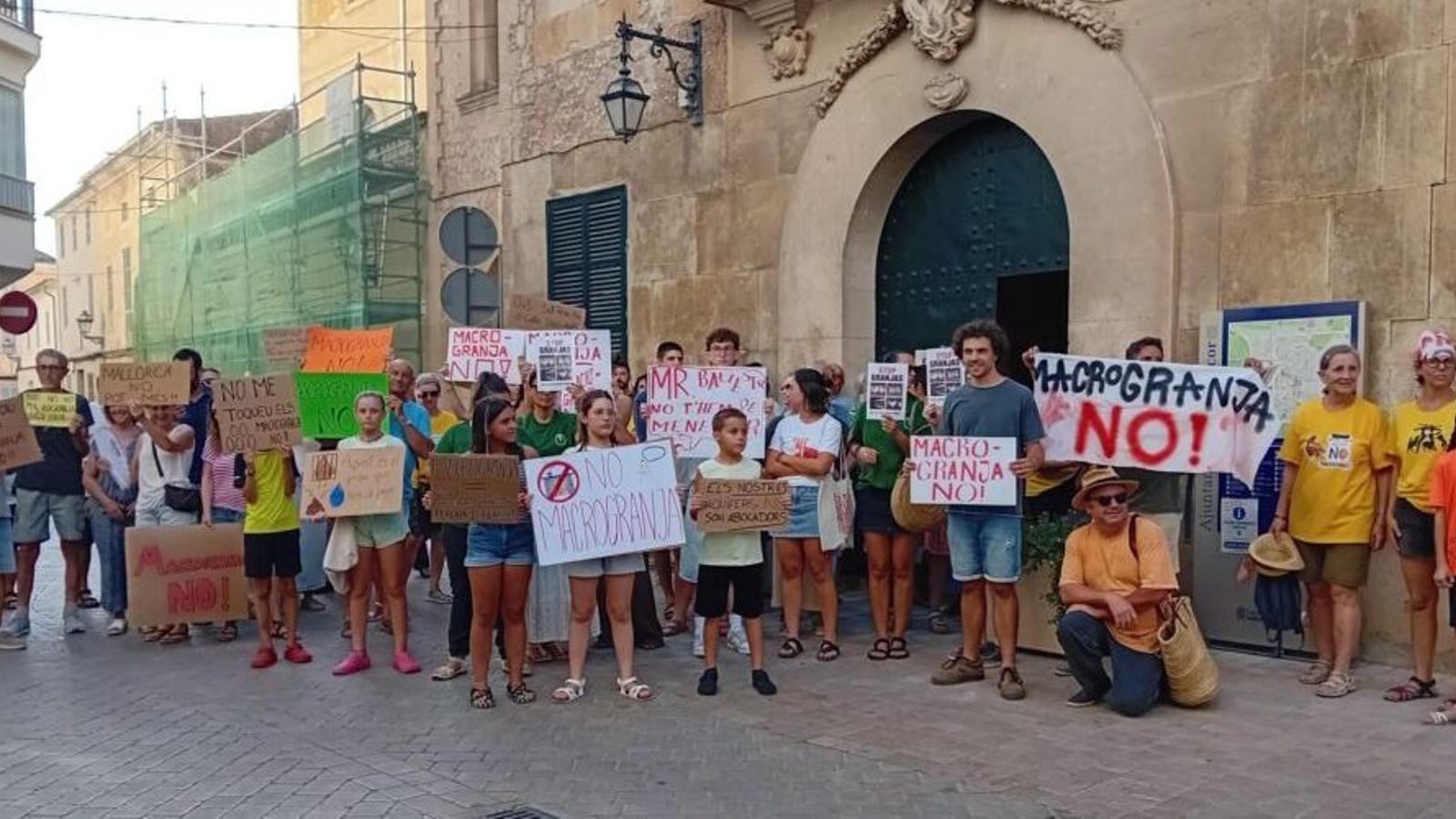
ManacorThe Avícola Son Perot project to build a farm for 80,000 laying hens at the Son Brau estate, in Manacor, has received all unfavorable reports from the Manacor City Council. Technicians question aspects regarding urban planning, environment, and mobility. The resolution for the integrated environmental authorization now lies with the Government.
The proposal provides for two sheds with 40,000 hens each, a shed to receive and package the eggs, a covered manure storage, and various auxiliary facilities. The new buildings would occupy about 10,108 square meters and the project calculates an annual production of 25.6 million eggs, a consumption of 3,212 tons of feed, and 9,600 m3 of water. The environmental report, however, warns that this figure does not include or sufficiently justify the water needed to cool the sheds and clean the facilities.
Urban planning: volumes exceeding the limit and works that could not be authorized
The urban planning report admits that intensive agricultural activity is a permitted use in this category of general rustic land, but considers that the documentation does not certify compliance with various parameters of the urban planning regulations.
The municipal architect points out that there are buildings on the plot executed without an accredited building permit and that, therefore, they are in a situation of non-conformity. The report considers that this circumstance prevents the authorization of the projected new construction works.
According to the project, the warehouses and the manure pit exceed the maximum volume of 1,500 m3 established per building, and in order to exempt this limit, a favorable report from the agricultural administration would be required. Likewise, a mandatory agricultural report that would have to support the action would also be required, in addition to the necessary pronouncement on the typology and aesthetic conditions of the constructions.
The documentation also would not have allowed verifying in the first instance whether the minimum separations of ten meters from the boundaries and five meters between buildings are respected. The validation of the occupancy and buildability calculations regarding tanks, septic tanks, silos, exterior slabs, and auxiliary constructions, among other elements, is another pending matter pointed out by the Department of Urban Planning in its first report.
Environment: an overexploited aquifer and an incomplete impact study
The Son Brau estate is located within the Son Talent groundwater body, which has been declared vulnerable to nitrate pollution. The municipal Environment report states that this body is “in poor quantitative and chemical status,” with an exploitation index of 115% and an average nitrate concentration of 93 milligrams per litre.
Although the document does not claim that the farm would contaminate the aquifer, it considers the assessment of the potential impact of the operation to be insufficient. Likewise, it criticizes the project for not sufficiently quantifying the water required for cooling and cleaning, and for the environmental impact study failing to adequately analyze the effects that manure and leachates would have on groundwater.
Regarding the analysis of alternatives, the report also considers it deficient, as it points out that the Avícola Son Perot study does not propose concrete alternative locations nor compare the environmental effects of each option. And, in this sense, it also fails to justify why locations outside the areas vulnerable to nitrates were not considered.
The planned operation would, moreover, be located about 300 meters from the Na Borges Special Area of Conservation, a protected space of high environmental value.
Another of the arguments concerns the management of poultry manure, another controversial issue for this company, which accumulates accusations of causing bad odors in several municipalities, such as Manacor and Llucmajor. The project plans to remove 1,067 tons every four months. The report calculates that about 43 trucks of 25 tons would be needed to empty the manure pit, but points out that the farms where the manure would be distributed or the distance to urban centers are not specified. Neither is the volume of leachates that would be generated calculated, nor are the characteristics of the planned deposit sufficiently described, nor is it explained how these liquids would be managed.
The odor assessment is also considered incomplete. The report identifies dwellings 400 and 600 meters from the future farm and requests an analysis of emissions from the sheds, the poultry manure transport belts, the manure pit, and the loading operations. The environmental monitoring plan, municipal technicians point out, should include an odor management plan with parameters and measurement thresholds, control points, and concrete corrective measures.
The document also questions the lack of a budget for environmental surveillance and monitoring, as well as for preventive, corrective, and compensatory measures. It also considers the proposed vegetation barrier insufficient, as the species, length, irrigation system, and maintenance are not specified, and the effectiveness of the measure and the visual impact before and after the construction of the warehouses are not assessed.
The study calculates annual emissions of 4,312 kilograms of ammonia, 162 kilograms of nitrous oxide, 9,692 kilograms of nitrogen, and 13,670 kilograms of nitrogen oxides. However, the municipal report states that the measures proposed to reduce noise, chemical, and atmospheric pollution are general and do not sufficiently detail the magnitude of the impacts or the specific actions to limit them.
The access road is not considered suitable for trucks
The access and location of this poultry farm and its effects on mobility is another obstacle. The Local Police and the municipal road engineer alert about the limitations of the access route to the farm. The Police describe a rural path about 2.5 meters wide, without sufficient space for two vehicles to pass each other safely, and considers it inadequate for a significant increase in freight traffic or heavy tonnage vehicles. Therefore, it recommends enabling passing places and requesting a safety assessment of the intersection with the Ma-3322 road.
The municipal engineer inspected the 785 meters between the Ma-3322 and the plot. Of the first 570 meters, which are paved, they highlight the advanced deterioration; the remaining 215 have an irregular granular surface and drainage problems. They also point out an old animal underpass whose load capacity is unknown and a double narrow curve that hinders the simultaneous passage of vehicles.
Due to these conditions, the engineer says they cannot determine a safe tonnage limit and reports unfavorably on the use of the road for heavy vehicles linked to both the construction and the operation of the farm. They consider it suitable only for low-intensity traffic: light vehicles of residents, non-special agricultural vehicles, and maintenance and service vehicles.
Overall, the reports do not resolve the environmental authorization for the Son Brau chicken farm, which now depends on the Government of the Balearic Islands, but they conclude unfavorably on the project as it has been presented. They point out that compliance with urban planning regulations is not proven and that the environmental assessment does not allow for a sufficient evaluation of the effects on water, waste management, odors, landscape, and mobility.
