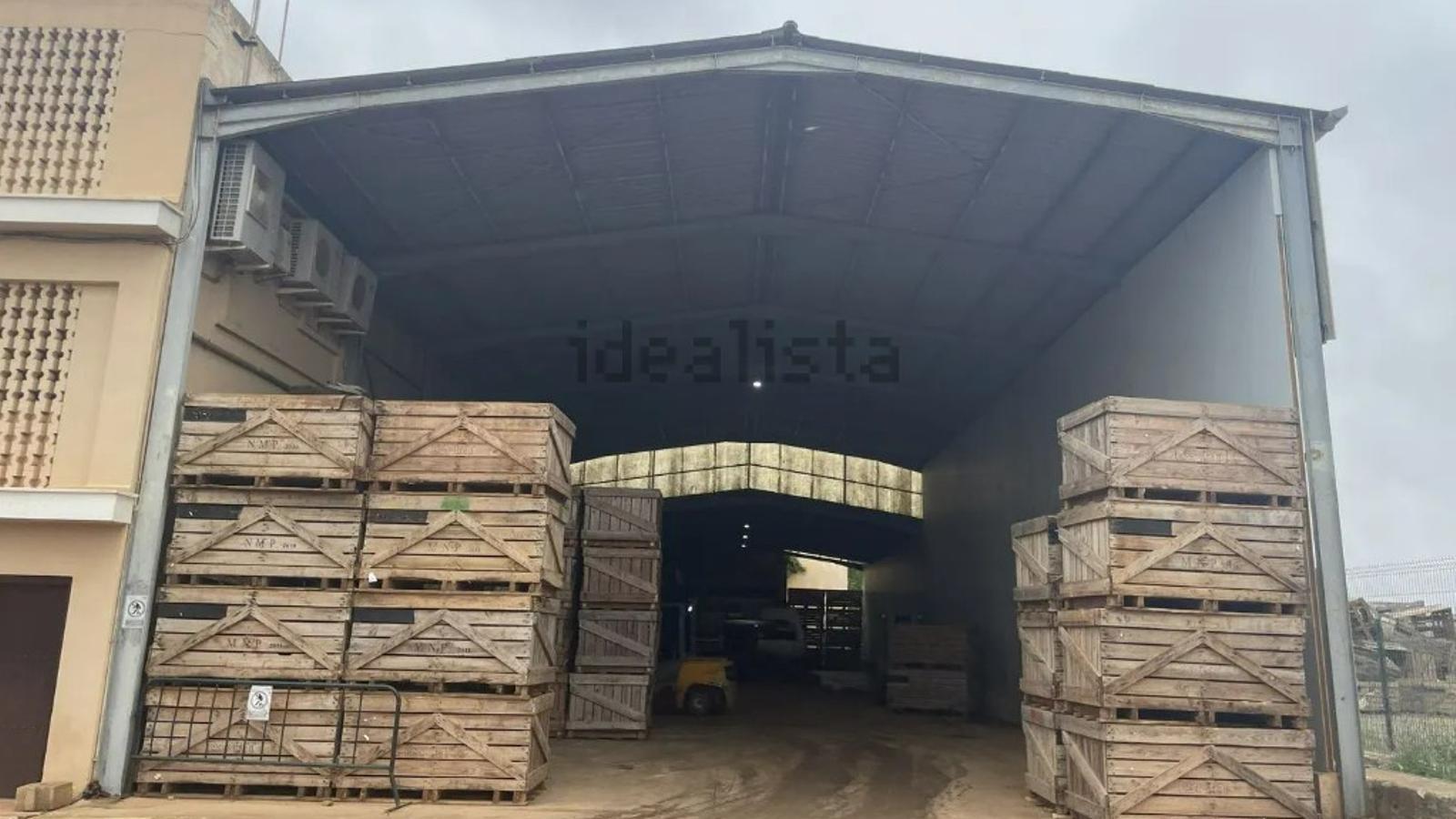
The ship of l'Esplet, for sale for five million euros
MÉS per Mallorca accuses the Director General of Agriculture of favoring speculation with the company from sa Pobla

-
CAT -
CAST -
DE
PalmThe sale of the warehouse and the rustic land exploited by the founding company l'Esplet is now the last chapter in the disappearance of a benchmark in the Balearic countryside. At the beginning of the month, the company's closure and the dismissal of its 19 workers due to economic problems were made public. Now, two weeks later, the company is selling the warehouse and land for five million euros.
The advertisement, published on the real estate portal Idealista, explains that the space has two properties (one industrial and one rustic). Specifically, the owners detail that the industrial property has 5,385 m² of land and 3,991 m² built and assure that it is "ideal for logistics, commercial, or productive projects". On the other hand, they explain that the rustic property, with a current declaration of general interest, has 13,085 m² of surface area and 3,107 m² built, and that, therefore, it is "perfect for complementary developments". Additionally, they offer the option to buy only the industrial part for more than three million euros.
It is worth remembering that this same March, the agricultural cooperative l'Esplet de sa Pobla closed definitively due to the loss of partners, internal disagreements, and the impossibility of formalizing the sale of its facilities. The SAT, which had reduced its members to only seven people, laid off its 19 workers and has stopped producing and exporting potatoes. This closure represents a new blow to the agri-food sector of Mallorca, after just over a month ago the closure of the Agama factory and the farewell of the brand Laccao as a Mallorcan product.
Attacks and accusations between political parties
MÉS per Mallorca has accused the Director General of Agriculture, Fernando Fernández —who already held the position in the previous legislature with Podem— of favoring speculation with l’Esplet, the old potato export portal of sa Pobla, whose warehouse has been sold for five million euros. The spokesperson for MÉS in Parliament, Lluís Apesteguia, recalled in Tuesday's plenary session that Fernández decided to divest himself of the Government's shares just before the 2023 elections, an operation that benefited the rest of the shareholders, including "a businessman linked to the PP" and Asaja, "the employers' association where the current minister Joan Simonet used to work".
The President of the Government, Marga Prohens, has defended the actions of her executive and has assured that everything possible has been done to maintain the agri-food industry, and has criticized MÉS per Mallorca for questioning decisions from previous legislatures, in addition to recalling that the final responsibility falls on the consellers and the presidency, not just the director general. Thus, a cross-accusation is drawn: MÉS denounces arbitrary and detrimental management for the public interest, while Prohens defends the transparency and responsibility of the current Government, and highlights the continuity of agri-food policy.
L'Esplet, a benchmark in the sector, disappears
L'Esplet was born in 1993 as the third attempt to keep potato production alive in sa Pobla, after the bankruptcy of previous cooperatives that had not been able to consolidate the sector. For years, the cooperative received public subsidies and government participation that allowed its agricultural activity, but over time it lost members and productive capacity. Furthermore, it generated controversy due to internal management and the influence of the leadership on the cooperative's decisions, a fact that weakened its structure and limited the succession of new players in the sector.

Throughout its trajectory, Esplet became a benchmark for the export of Majorcan potatoes to demanding European markets, combining industrial and rustic land and investing in its own machinery and logistics to guarantee the quality and distribution of the product. Despite these investments, internal conflicts, retirements, and the withdrawal of institutional support generated a situation of vulnerability that has culminated in its closure. The planned sale process to preserve the activity and jobs did not materialize, leaving a void in the local agri-food sector and highlighting the difficulties of traditional cooperatives in Mallorca to survive in a globalized market.
