Terraferida warns of the dangers of stone piles in the mountains
Terraferida denounces the trend of altering the environment; the Talaia de Albercutx concentrates more and more visitors and improvised piles
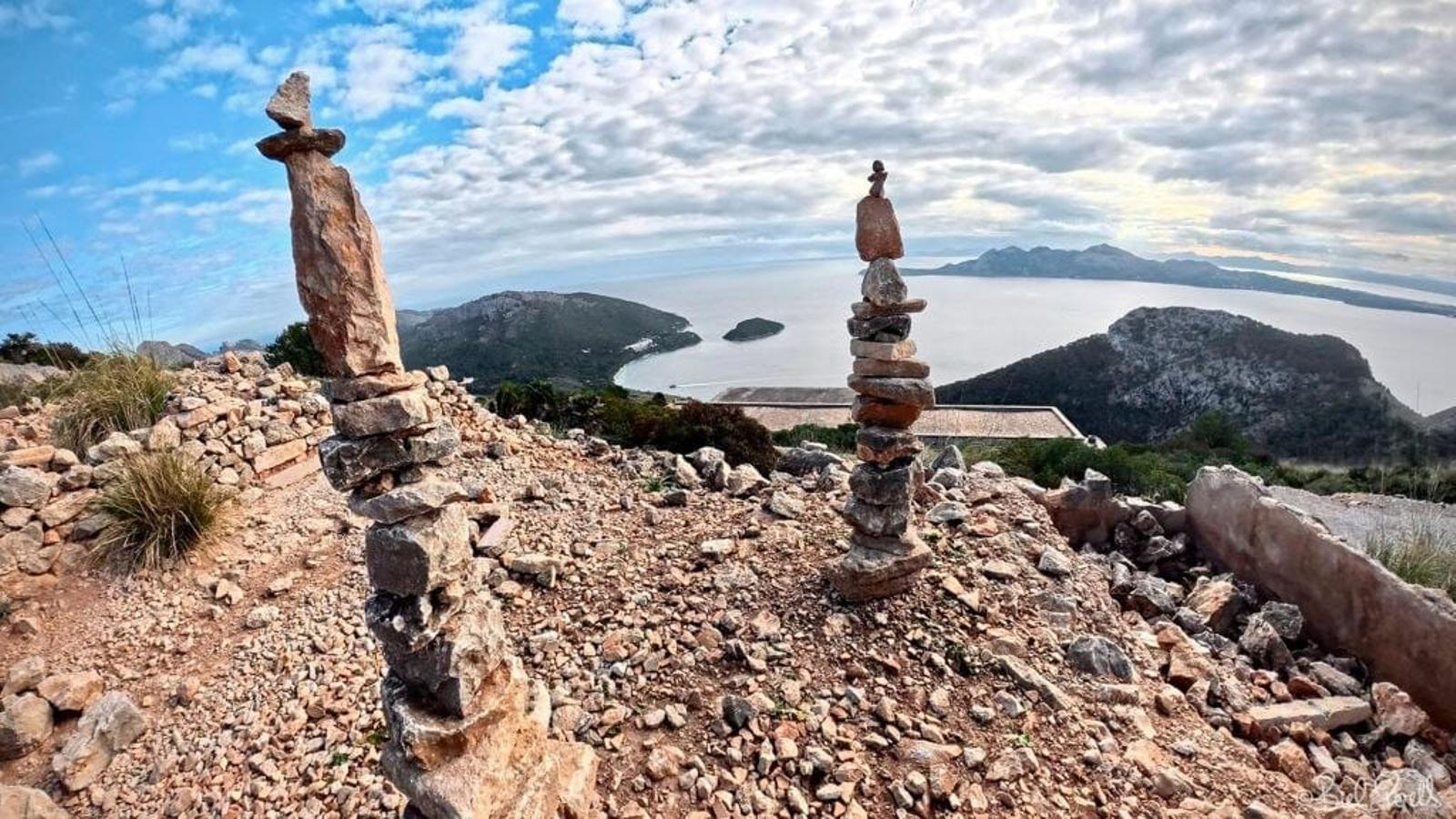
PollençaOn June 22, 2015, the Terraferida association published a cry of alarm that today, in 2026, is more necessary than ever: “Mounds that kill, enemies in balance”. That article denounced a trend that was just beginning. Ten years later, what was a warning has become a desolate reality: nature has been transformed into a mere backdrop for trivial activities.
The landmarks of a lifetime are not simple piles of stones. When we walk in the mountains, we often come across a detail that, although discreet, accompanies us every step of the way: stone cairns. These small mounds that someone, before us, has placed to mark the right path are much more than a simple sign. They are part of hiking culture and have a deep meaning of mutual aid, trust, and community. Each stone placed is a silent message to those who will come after: “Don't worry, you're on the right track.” But this reality contrasts with the current proliferation of improvised mounds that have nothing to do with this tradition.
A trend that causes havoc
The piles of stones, improvised landmarks, mounds, or "Instagrammized" mounds, have gone from being an anecdote to becoming a symbol of the cultural and ecological degradation of some natural spaces. It is not just a current environmental problem, but a phenomenon that has been around for a while and reflects a society that increasingly understands nature less as a living system and more as a decorative, consumable, and manipulable stage. A decade after the first warnings, the problem not only persists but has spread everywhere, both in the mountains and on the coast. The trend of making piles of stones has become a symbol of disconnection with nature. Furthermore, this phenomenon has a multiplier effect: one mound generates ten, ten generate a hundred, and in a short time, an entire landscape can end up transformed by this practice.
The life hidden beneath the stones
Scientific literature is clear: the manipulation of stones destroys microhabitats and directly affects biodiversity. In fact, it is already considered an emerging threat associated with tourism. The big mistake is to think that a stone on the ground has no function. Stones are not there by chance. On the coast, they protect against erosion and the force of the sea. In the mountains, they stabilize the soil and regulate natural processes.
Under each stone live reptiles, insects, snails, or spiders that need the moisture and coolness that these elements provide. Without this protection, many of these animals die from sun exposure or become easy prey for predators. Furthermore, stones are the support for lichens and mosses, organisms that can take years to grow only a few millimeters and that fulfill an essential function in soil protection. When a stone is moved, this living layer that helps maintain the balance of the terrain is also destroyed.
Likewise, stones help prevent rain and wind from carrying away fertile soil. When they are piled up, the soil is exposed, dries out, and progressively degrades until it becomes a space where it is difficult for vegetation to grow again.
The Talaia de Albercutx circus
One of the points where the problem has become most evident is the Talaia d'Albercutx, located within the natural park of the Serra de Tramuntana, declared a World Heritage Site. In this space, the influence of social networks has generated an increasingly crowded scenario. Many people no longer go to enjoy nature, but to "consume" it, especially during the summer and at sunset, when numerous visitors and vehicles are concentrated.
This phenomenon has led to the proliferation of empty rituals, such as people carrying speakers, dancing, or simulating meditations with the sole purpose of sharing them on social networks. The call effect has also intensified, as seeing one crowd incites another, generating a chain reaction that ends up transforming the landscape. All this reflects a progressive loss of respect for nature, which goes from being a living space to becoming a mere backdrop for superficial experiences.
The result is the absolute trivialization of natural spaces. The connection with nature is replaced by a superficial collective experience, where the need to leave a personal mark takes precedence over the conservation of the landscape.
Where is the administration?
This degradation occurs within areas that, on paper, have protection figures. But protection that is not actively monitored or managed is not very useful. In an area with international recognition, allowing this degradation so evidently is simply unacceptable. Although the problem has been known for years, the administration does not act with the necessary forcefulness and, when clear measures are not taken, the message that reaches visitors is that anything goes.
One of the main shortcomings is the lack of surveillance, especially at peak times like sunsets, when more visitors concentrate in the area. This absence of control facilitates the continued proliferation of stone piles without any limitation. Added to this is the lack of clear signage and forceful informative campaigns, which leads many people to consider this practice a harmless action, without being aware of the environmental damage it causes.
The need for a rigorous and systematic dismantling of existing stone piles is also raised. When these are left in place, the call effect is reinforced and the idea is transmitted that the practice is acceptable. This lack of action shows that there is no active management of the problem and contributes to the progressive increase in the degradation of these protected natural spaces.
Conclusion: THE best trace is no trace
Cairns are not just stones. Making a cairn is not art, nor is it spirituality; it is ignorance. It is the reflection of a society disconnected from nature, obsessed with superficial experience and incapable of understanding boundaries. And cairns are also the reflection of an administration that is not up to the challenge.
We must relearn to be within nature without having to touch or transform it. The greatest gesture of respect for our landscape is to leave the stones where they are.
Ten years after the first complaint, excuses are no longer valid. Either the administration starts to monitor and sanction, or we will have to accept that we have turned our heritage into a backdrop for social media, into a lifeless theme park. The mountain, the coast, should not be this, they deserve respect.
We still have time. But only if we stop looking at cairns as an anecdote and understand them for what they are: a clear indicator of ecological and cultural degradation, transforming entire landscapes into artificial settings.
