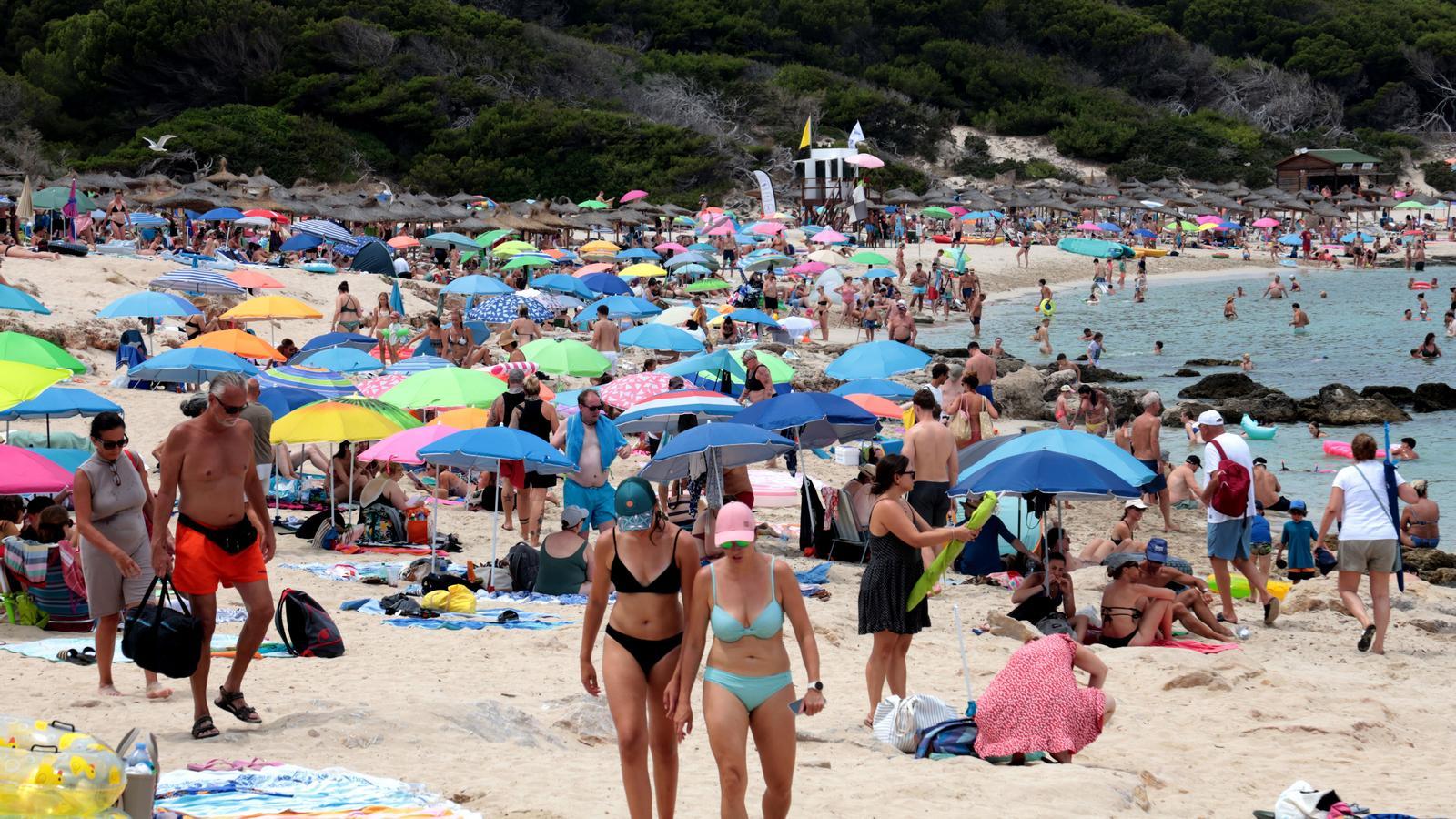
The islanders have had to give up going to the most emblematic beaches
Residents in the Balearic Islands often seek inopportune schedules, off-season dates, and inaccessible spaces to combat the expulsion they suffer due to overcrowding

-
CAT -
CAST -
DE
Palma“I remember we used to come with the little motorbike from Sóller, with friends. We would go down to Cala Deià on the motorbike almost to the beach and our little boats were on the sand all summer. There were people from Deià, from Sóller, and a few tourists. What times…”. Tomeu Ferragut, a man from Sóller, remembers it, and today he doesn't even consider going to what is one of his favorite spots on the Mallorcan coast: “Every year Narcís Serra, from Felipe González's government, used to show up. We knew his bodyguards. And we used to joke. Everything was very familiar”.
Today, Cala Deià is something else. At 11 a.m., all access roads and parking lots to the cove are full. This causes the road leading down to be closed, which generates traffic chaos because tourists do not give up visiting the landscape that Instagram has shown them. They turn their car back to the main road, the general road of the Tramuntana mountain range, and create a monumental traffic jam. “They stop in the middle of the road, it's the same every day. You can't work on the roads of Mallorca,” exclaims José from the steering wheel, one of the many delivery drivers who despair in the middle of the traffic.
Residents can go down, because the Town Hall had to organize a specific parking area for them. Antònia Mas says she goes early in the morning because “even though there is parking for residents, it also fills up.” Furthermore, “some rental cars don't look closely and go in,” explains Toñi, another resident of Deià. “I reprimanded a foreigner in a 4x4 for his attitude and he laughed at me. It's very sad,” she laments. “And it's not just going down, the adventure. It's that afterwards, when you want to go up, you find rental cars everywhere, stopped, badly parked, traffic jams, people in the car who don't want to move because they've seen a photo and are determined to go to the Cala. It's normal for locals to give up on our coast,” assures Toñi.

Everything transforms
Both one and the other agree on the dizzying transformation of the last 20 years, which has “blown everything up”. “It’s no longer the Cove, it’s the whole village,” says Toñi. “I’m not against tourism, I work for a foreigner who has a large estate. He is very respectful, he has restored the houses, he loves the island very much. But he is the first one who wouldn’t buy a property here right now, because it’s unbearable,” he states: “I’ve taken 40 minutes to travel about 300 meters of road at the height of the village. I think I don’t need to say anything else,” he laments.
Antònia Mas adds that “in Deià the clothing stores are prohibitive, for the rich. The food, the bars, everything has been transformed. It’s an artificial shop window and we locals have been excluded and logically, in part, we are to blame. We have sold the island,” she concludes.
The case of Cala Deià is unfortunately not an exception. The islanders have had to adapt to the avalanche of millions of tourists who want to visit the places that the instagramers have dedicated it as a must-see. And they will not stop until they achieve it, even if they have to collapse an access or spend hours in the sun queuing.
The islanders had already experienced the transformation of the landscape, massive constructions on the coast, and the disfigurement of the territory in the name of tourism revenue. But in recent years, they have realized that, in addition to all this, they do not even have the comfort of being able to minimally enjoy the paradise they are supposed to live in. “We go to the beach as if in hiding, late in the afternoon, during the week, it’s ridiculous. I go by motorbike to a hard-to-reach little spot, you have to wear trainers to get there and wetsuits to get into the water. A obstacle course because we have agreed to hand over all our treasures to the tourism business,” explains Miguel Garcia, a mainland Spaniard who arrived in Mallorca 25 years ago and fell in love with Caló del Moro (Santanyí). “Now I wouldn't go there even crazy before October. I would never have imagined it,” he laments.
Therefore, tourist overcrowding no longer transforms only the land, but also the customs of those who live there. This is one of the main conclusions of Sergio Gómez's final degree project in Geography, supervised by Professor Miquel Àngel Coll, which analyzes how the saturation of coastal areas affects residents' habits.
The study, based on a survey of 404 residents of Mallorca, reveals that 85% state that they have stopped going to some beaches during the summer months due to overcrowding. The research suggests that this situation has led to an adaptation of residents' behaviors, who modify both the times and the days and months they enjoy the beaches to avoid crowds. “I decided to do the study because everyone around me was talking about the issue. And, in reality, the results are devastating. Everyone has had to give up enjoying their surroundings. It is a logical consequence of bringing 19 million people to a small area where one million inhabitants live,” explains the author, Sergio Gómez.
This is one of the main conclusions of the work: residents can no longer go to the beach when it is most convenient for them and adapt their schedules to seek out less crowded times. The research also notes a temporal shift in beach usage. 35% claim to directly avoid going during August, while 24% also try not to go in July, the two periods of maximum tourist influx. 71% state that they look for a less crowded cove, even if it is more difficult to reach, and 12% end up giving up on the beach and opt for another activity. For the author, this data shows that saturation is no longer just a fleeting perception, but a factor that conditions residents' leisure decisions.
The survey also identifies which spaces Majorcans associate most with summer overcrowding. Among the beaches and areas that residents claim to avoid are, in the first place, Caló del Moro, es Trenc, sa Calobra, and Formentor. Then, Cala Deià, Port de Sóller, and Magaluf, among others. They are very diverse beaches, but they have one thing in common: the islanders no longer go there because they are completely saturated. Magaluf also had its audience: “Many people from Palma used to go there, even by bus, because it was close. But now it's also a disaster and, if there's been a night party, on top of that it's full of dirt," says Teresa Planas. “During the pandemic I used to come here and I was amazed. And, naive as I was, I was sure that Majorcans would never let so much tourism come again," she explains, laughing.
La Calobra is a paradigmatic case. “I have set foot there once in the last 20 years”, says Jaume Oliver from Palma. “We used to go once a year, it was a treat for the family. Now, you arrive after an hour and look for parking and there is a collapse of people and vehicles, and if you can't park, you have to turn back, and tell me where you're going. Three years ago, we went in June because I felt sorry that my son couldn't enjoy it, and I said: look, never again. We have to assume that we have lost it. And do you know what makes me angriest? That those who have made a fortune from tourism are not the ones queuing at the cove”, he states.
Menorca, also
“In Menorca, we looked at the other islands with a mixture of pride for having managed to preserve the territory and also with a certain fear that we would not be able to avoid it in the future. Unfortunately, we can no longer boast about it,” explains Maria Triay from Maó to ARA Balears. “Now we have also been forced to avoid the most famous coves. Either they are full of cars and people and you can't even put your towel down, or they are full of boats,” she laments.
The beach that registers the most saturation is Macarelleta, according to data from the Consell de Menorca. In 2025, Macarelleta reached 431% of its load capacity. This means it has hosted more than four times the users that studies consider adequate. It is followed by Cala en Turqueta, with 328%, and Cala Mitjana, with 303%, both well above triple the planned capacity.

The list continues with Pregonda (244%), el Talaier (232%), Macarella (220%), Binimel·là (208%), Son Xoriguer (206%), Viola de Ponent (186%), Binidalí (181%), Son Saura (159%), Biniparratx (140%), la Caleta (133%), el Grau (133%) and Binissafúller (131%). That is, the fifteen beaches analyzed exceed the threshold of 100% and, in ten cases, the pressure practically doubles or more than doubles the capacity considered sustainable.
From Ibiza, Miquel Costa says it forcefully: “I don't even consider” going to the best-known coves and beaches. I used to spend half the summer at Las Salinas, or at the Comte beaches. Then I started going by motorbike because, otherwise, it was impossible. Now, honestly, I spend Sundays at home. This option has an advantage: since everything is so absolutely expensive and exorbitant, if you don't even go out, then all that you save. This is the magnificent plan that this supposed tourist wealth has brought many of us to,” he summarizes.
