Five unfulfilled promises of Prohens in the general policy debates
The opposition and also Vox pointed out pending homework in the balance of the legislature

-
CAT -
CAST -
DE
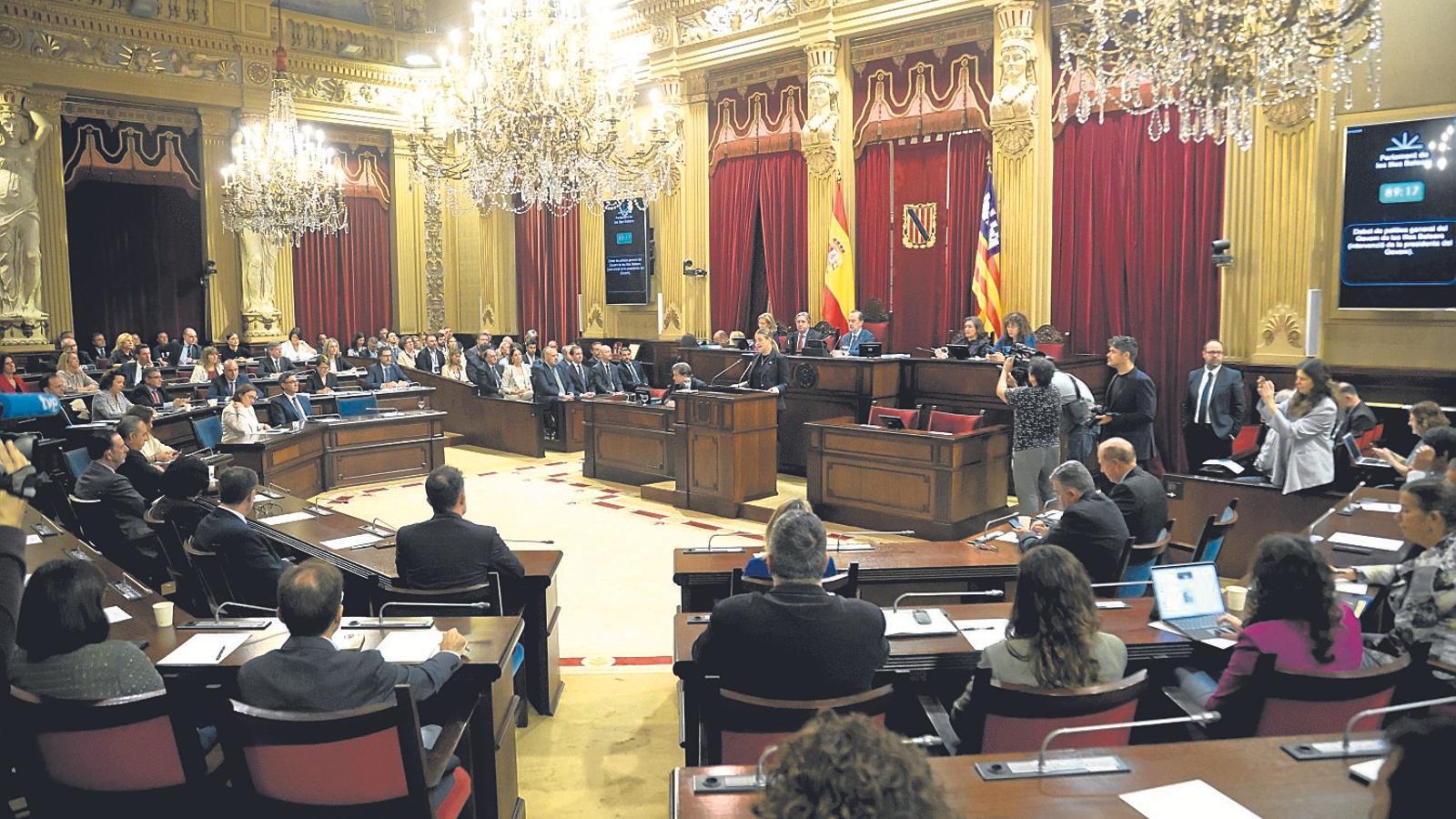
PalmaPresident Marga Prohens claimed to have fulfilled “more than 97%” of her electoral program in the general policy debate just held. But during the plenary session, the opposition also reproached her for promises made both in this and in previous extraordinary plenary sessions. These were the five most prominent reproaches to the head of the Executive.
Tourism containment
The increase in the ITS, the water tax and the tax on rental vehicles
The PP made a sudden turn in its discourse on tourism in 2024. In the context of growing social discontent over the touristification of the Islands and with internal polls in hand, President Marga Prohens admitted for the first time the saturation of the territory and promised “bold” containment measures. In the 2024 general policy debate, she announced an increase in the Sustainable Tourism Tax (ITS), surcharges on water fees for large consumers, and a tax on rental vehicles.
“With those announcements, she won that debate, the media headlined ‘Prohens, the brave one’,” the PSIB spokesperson, Iago Negueruela, told her last Wednesday. But precisely these same announcements with which the PP disarmed the opposition have been the main failures that the left points out relentlessly, since, two years later, they have not been implemented. “She has lost credibility,” insisted the socialist. Also, the spokesperson for MÉS per Mallorca, Lluís Apesteguia, criticized her for not having brought the proposal to increase the ITS to Parliament, despite having the “guarantee” that the left would vote in favor of it.
Prohens avoided referring to these issues in her reply. “There is still a way to go, it is true,” she asserted: “But no Government had ever gone so far in setting limits on tourism management in our Islands.” She also defended other measures, such as the prohibition of new tourist apartments in multi-family dwellings across all the Islands, and the imposition of fines of up to 500,000 euros for illegal tourist rentals.
Affordable rent
The Safe Rental program has failed and prices continue to skyrocket
The president announced the launch of the Safe Rent program during the general policy debate in October 2024. The initial objective was to mobilize more than 2,000 vacant homes into the rental market at affordable prices, offering owners guarantees such as insured rent collection and, in some cases, advance payments. This was one of the main measures that the Government defended against criticism from the left for refusing to limit rental prices, as permitted by state law.
Two years later, the program has had to be reformulated and is far from the projections made by the Popular Party member. In the last plenary session, Apesteguia described the program as a “failure,” pointing out that only 74 rental apartments have been successfully captured through this program. Prohens assured that she has engaged in “self-criticism” regarding this program, and argued that in the Basque Country it began to work after ten years of operation: “It is necessary to make the success stories known so that people are encouraged to join.”
2,000 protected homes?
There are only 91 under construction, according to Housing
In the latest general policy debate, Prohens explained that the Law on strategic residential projects had allowed for the speeding up of a plan with nearly 300 million euros for the promotion of 2,000 official protection homes. She also remarked that these 2,000 homes “started this legislature are already in the processing stage and many of them, under construction”. But Castells questioned this figure, contrasting it with the data from the Ministry of Housing that she obtained in a parliamentary response, according to which there are only 91 official protection homes actually under construction. The president defended that the 2,000 homes are in the processing and tendering phase, and attributed the lack of finished apartments to the inaction of previous governments.
Economic diversification
The industrial master plan has been expired since 2025
The president has promised to work on the diversification of the economy in two general policy debates: the first and the last. The PSIB reproached her that this has translated solely into the transformation and projection of housing at the Parc Bit and that the Master Plan for industry has been “expired since 2025”. “Every day we see the closure of an industry and the opening of a nightclub in its industrial estates,” she continued. For his part, Jesús García (Unides Podem) reproached her for a lack of transparency regarding projects of strategic interest. Prohens replied by defending the 70 million company and talent attraction plan destined for the Parc Bit, the launch of the Posidonia satellite, the new tax regime for innovation in the REIB, and the creation of the Board for industry, which must draft a new plan. She also claimed the agrarian law, still in process, as a tool for diversification.
Reduction of waiting lists
The time patients spend waiting to receive care increases
Prohens spoke about waiting lists in both healthcare and dependency in all three general policy debates of the legislature: 2024, 2025, and 2026. In the last plenary session, it was the Vox group that put the IB-Salut figures on the table. “On September 30, more than 17,000 people were waiting for surgery, 15% more than a year ago,” said the group’s spokesperson Manuela Cañadas: “We recognize the budgetary effort, but the underlying problems remain there.” Prohens argued that in the last three years the health system has had to absorb 78,000 new health cards (6% more users). Furthermore, she recalled the impact of the national doctors' strike, which forced the rescheduling of almost 90,000 appointments.
