The neighborhoods of Palma with less income are also those with fewer trees
Near 285,000 citizens do not have a green area of more than one hectare within 300 meters of their home

-
CAT -
CAST -
DE
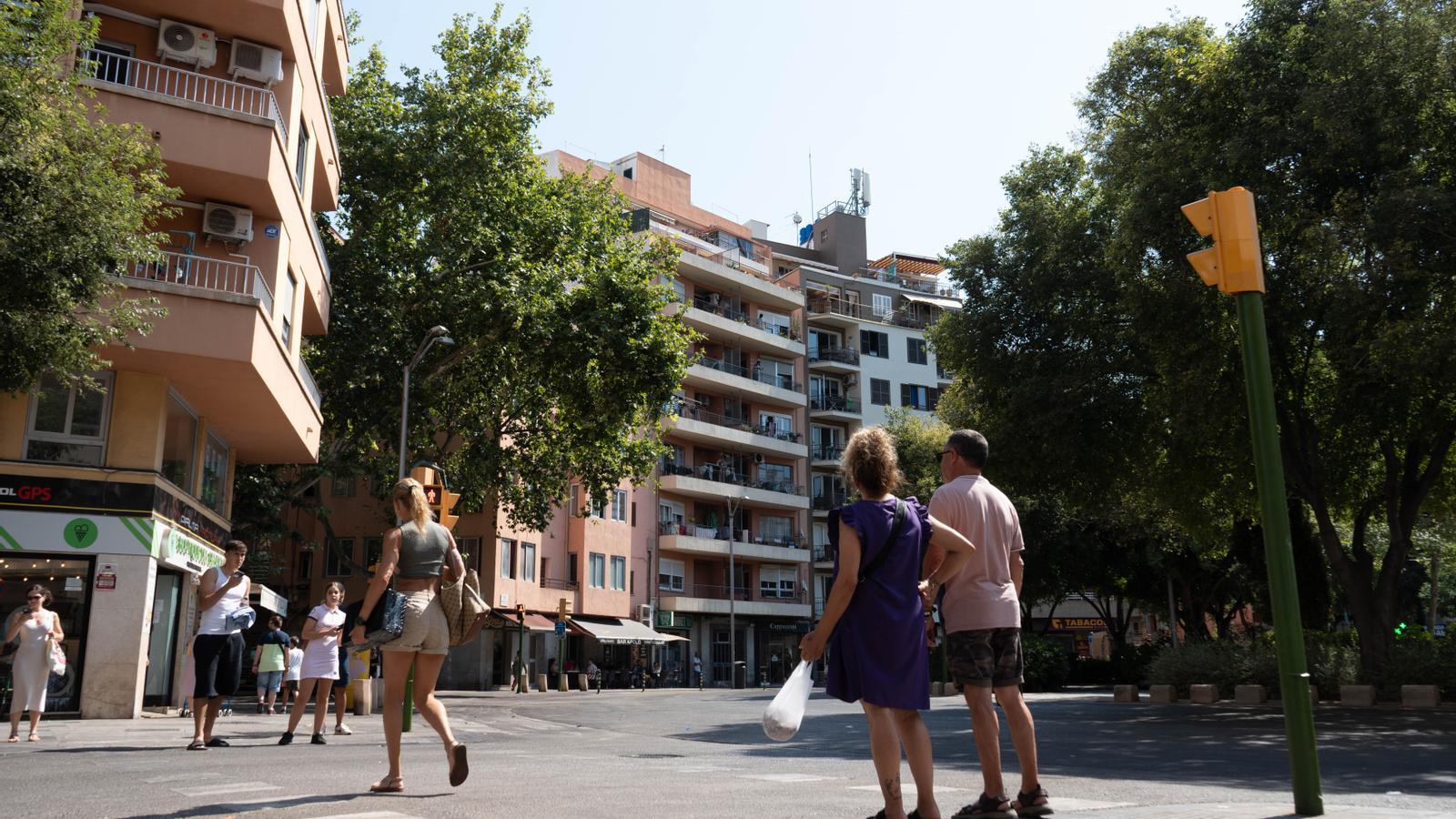
PalmaA woman with two bags in each hand, a man with a fanny pack and a cap, another woman dragging a cart; they are all sweating profusely. A daily scene. They advance clinging to the facade of the buildings, like a line of ants, as if an invisible force were pulling them. In reality, just the opposite is happening: it is the heat that pushes them to seek the little shade cast by the street blocks. They are all heading towards Miquel Dolç square from Josep Darder street with different purposes, but with a shared secondary objective: to be touched as little as possible by the relentless sun of a July morning.
Miquel Dolç square, formerly known as Lieutenant Colonel Franco square, is a huge roundabout that serves as a crossroads between the neighborhoods of Pere Garau, Son Gotleu, and La Soledat, in the east of Palma. According to the report by Friends of the Earth How to guarantee the right to nature?, which analyzes the relationship between income and access to urban green spaces, these neighborhoods are part of the areas where the provision of green spaces of more than one hectare needs to be increased.
The study identifies areas suffering from a double inequality: lower income and less availability of local parks. In Palma, almost half of the population with higher incomes – the highest income quintile – has a green area of more than one hectare within 300 meters of their homes. In contrast, the remaining income quintiles are in a clearly worse situation. "In lower-income neighborhoods, the green area per inhabitant is lower than in higher-income areas, due to higher population density," the report concludes.
While cleaning the entrance to the building where she lives, on Josep Darder street, Pilar Trujillo observes how pedestrians walk clinging to the scarce shade of the buildings and laughs. "We are all the same," she summarizes. She is in favor of increasing green areas, but warns: "The problem is that they are not looked after afterwards. The neighborhood squares are a mess".

A similar discourse is shared by Sofia Villanueva. She is on maternity leave and is leaving the gym when she explains that she moved to the neighborhood a couple of years ago, after living on La Rambla. "The difference is abysmal," she assures. "This neighborhood seems forgotten, so any shade is welcome." She also recalls the recent felling of trees that neighborhood associations like Flipau amb Pere Garau have repeatedly denounced as "ecocide".
Villanueva explains that, to find a green area with conditions, they have to go to the Parc de les Estacions or Kristian Krekóvitx Park, because Wifi Park offers very little shade. Furthermore, she takes the opportunity to criticize the urban development plans foreseen in the surroundings of the Gesa building: "I have discussed it with many neighbors and we all agree on the same thing: it's all cement".
"There is no garden culture"
In statements to ARA Balears, the historic conservationist Pere Llofriu, a key figure in the defense of Mallorca's natural heritage, considers that the lack of trees in Palma is due to an absence of garden culture, of professionalization, and to the fact that, historically, green areas have been treated as a "burden". "Politicians think about the next elections and trees need more than four years, which is how long a legislature lasts. They have their own rhythm, and this long-term vision does not exist in Mallorca", he laments.

Llofriu is also critical of some of the main green spaces in the City. "In Palma, the large parks, like La Riera or Parc de la Mar, have more to do with Abu Simbel – the archaeological complex in southern Egypt – than with a real park," he assures. As he explains, spaces based on "hard surfaces" continue to be preferred because they are more comfortable for architects, builders, and also for city councils, who save on the costs and maintenance difficulties that landscaped areas entail.
Son Canals
The report by Amigues de la Terra considers it a priority to guarantee Son Canals – a neighborhood adjacent to Pere Garau – minimum urban green spaces, with more street trees, landscaped medians, and continuous tree pits, in addition to the use of developable land as future community climate shelters.
Also in eastern Palma, the study points to Rafal Vell, Son Cladera, la Indioteria, and Son Fortesa Nord as priority action areas. In the west, it identifies Son Cotoner and Camp d'en Serralta, while in the North District it focuses on Camp Redó.
Without access to a green area
The data is compelling. According to the report, nearly 285,000 residents of Palma – two out of every three inhabitants if we take the 2023 population as a reference – do not have access to a green area of more than one hectare within 300 meters of their homes. The analysis is based on the World Health Organization's recommendation known as the 3-30-300 rule: being able to see at least three trees from the window, living in neighborhoods with 30% vegetation cover, and having a park of at least one hectare within 300 meters.
The study also highlights that Palma only has 8.33 square meters of green space per inhabitant, far below the average of 13.4 square meters in cities analyzed by Friends of the Earth. The comparison, in addition to Palma, includes Madrid, Valencia, Zaragoza, Seville, Valladolid, Badajoz, Ourense, Santiago de Compostela, and Ibiza.
Regarding the city of Ibiza, the study points out that "there are no recognizable green corridors or an articulated network connecting the different spaces". With the exception of the Dalt Vila gardens, the Parc de la Pau and the Maria Vilangómez park, the green areas have limited environmental quality and cement squares abound. In higher-income areas, green space is predominantly private. Outside the densest core, agricultural and Mediterranean scrubland patches are joined by the Feixes wetlands, which together form a fragmented landscape that, despite its potential richness, lacks a continuous and accessible structure.
In Ibiza, only 28% of people lack access to green spaces
In Ibiza, the analysis shows that only 14,000 people, 28% of the population, would lack access to sufficient green spaces, the lowest value among the cities analyzed. The areas with the greatest deficit of access are concentrated in the west of the city. Added to these areas is Puig dels Molins, whose proximity to a large open space does not translate into real accessibility, given that it is an archaeological park with paid access.
Amigues de la Terra points out that the major pending task is the conservation, restoration, and protection of Ses Feixes. Furthermore, as a high-impact and strategic measure, the opening of Puig dels Molins would immediately incorporate a large green space for the daily enjoyment of the resident population. However, it highlights that the main intervention area is located over Ca n'Escandell and Cas Serres, between Corona street, the EI-20, and Sant Josep de sa Talaia avenue, with part of the area south of this avenue.
