For Holy Week, empanadas for everyone
For whom are all these empanadas? Would you write it like this or would you pause for a second before sending the message? If you doubt it, you are not alone: the distinction between ‘per’ and ‘per a’ is one of the points where spontaneous use and the norm do not always coincide. Now, there are quite clear criteria that can help us to orient ourselves
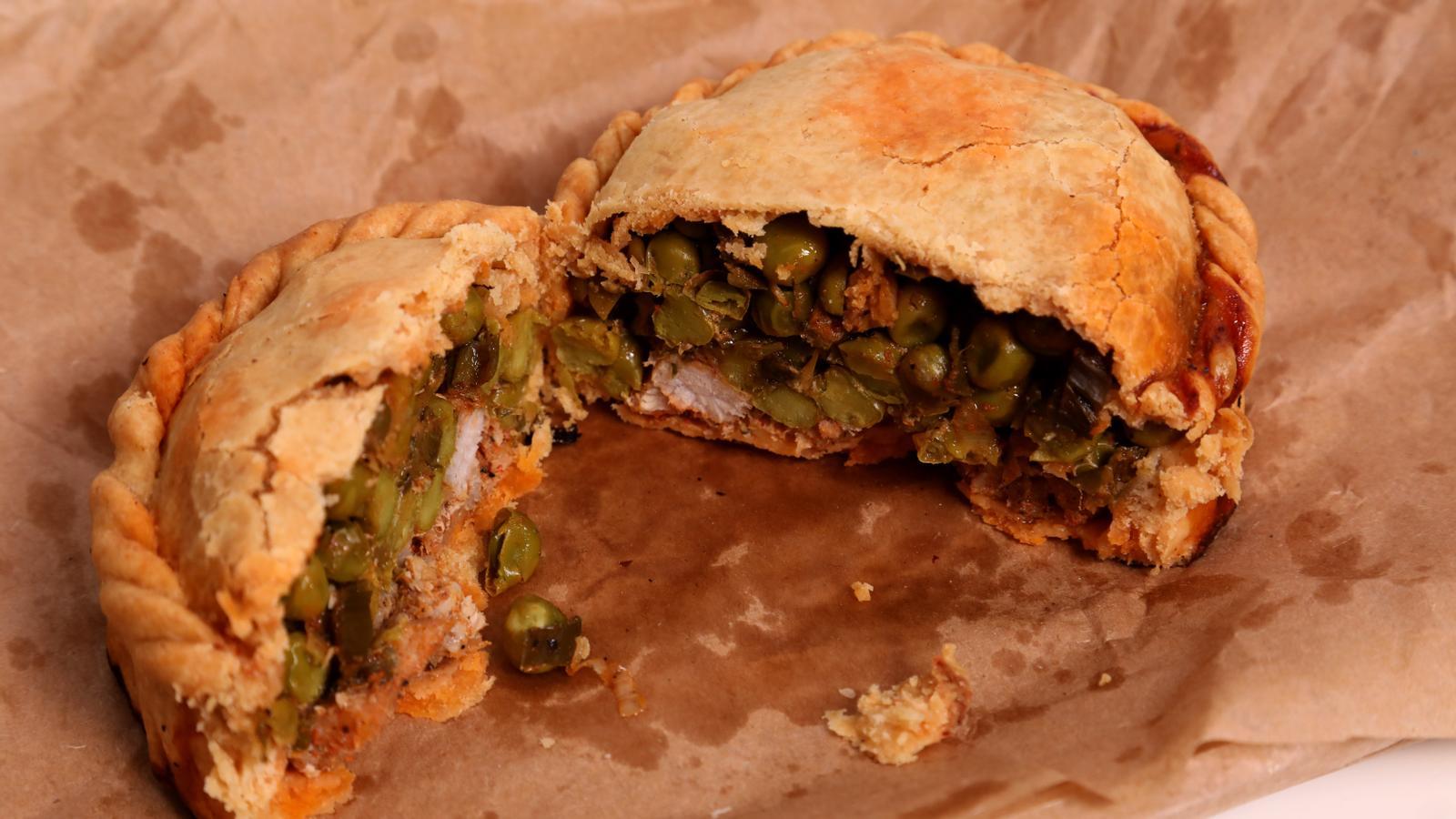
PalmWith the arrival of Holy Week, in many homes on the Islands, a well-known scene has been repeated. The kitchen has become the center of everything, with accumulated trays and baked empanadas that have been succeeding each other to the point that, often, production has ended up exceeding any initial forecast. Amidst this rhythm, it may be that a moment has arrived when someone, half jokingly, half seriously, has posed this question: “For whom are all these empanadas?”. Orally, the phrase generates no doubt. No one gets stuck or sees any problem. But when it has to be written, even in a WhatsApp, perhaps we do hesitate a little: ‘por quién’ or ‘para quién’?
This hesitation is entirely usual. The distinction between the prepositions ‘por’ and ‘para’ is one of the issues that generates the most doubt when writing, especially among speakers of eastern Catalan, such as those from the Islands and Barcelona. In these dialects, the difference has been diluted in spontaneous language, and ‘por’ tends to occupy almost all contexts. On the other hand, in other varieties, such as Valencian and Tortosino, the distinction remains much more alive.
In formal registers
In any case, in the formal registers of the standard language, it is considered pertinent to maintain this opposition. The good news, however, is that there is no need to memorize an endless list of cases: it is enough to have a clear general idea of what the grammar conveys.
From the outset, 'para' is used to indicate destination or arrival point. When we say we have bought a book "for Pau" or that there were empanadas "for everyone," we are introducing the recipient or beneficiary of the action. Deep down, there is an idea of direction, of a journey (even if abstract) that culminates in a final term.
On the other hand, 'por' is used, among other meanings, to express cause or motive. This is what we find in phrases like "they awarded him the prize for his latest book" and "we make empanadas out of tradition." In these cases, there is no recipient: the complement serves to explain why something happens.
With this basic opposition, the initial doubt is resolved without much difficulty. The most appropriate form is 'for whom are these empanadas,' because what is being asked for is the recipient. We do not want to know the reason why they were made, but to whom they are directed.
The difference is perceived even better if we contrast very similar phrases. Thus, it is not exactly the same to say "I have made empanadas for the family" as "I have made empanadas for the family." In the first case, the family can be interpreted as the motive (for example, because it was their turn, because someone had asked for it, or out of obligation). In the second, however, the family is the one who should receive them.
Now, this distinction that works quite clearly with a noun becomes complicated when we move to constructions with infinitives. In these contexts, the traditional Fabrianense norm established a more precise distribution, but perhaps also more difficult to apply intuitively.
According to this criterion, 'por' must be used when the sentence depends on a verb of voluntary action with an agentive subject. This is the case in phrases like "we called the mother to talk for a while" and "the team traveled to Valencia to play a basketball game." It is also the usual preposition in metadiscursive expressions (that is, when we refer to the act of constructing discourse) such as 'to begin' or 'to end'.
Instead, ‘para’ is used in other types of final constructions: when they depend on a noun (“it is a book to learn how world geopolitics works”), on an adjective or participle (“thyme soup is ideal to cure stomach ache”), and on a quantitative (“there will not be enough money to cover expenses”). In these cases, the idea of purpose is not linked to a concrete and immediate action, but has a more general value.
However, current regulations are more flexible. The Gramàtica de la llengua catalana from the Institut d’Estudis Catalans admits that, in these contexts with infinitives, one can choose to either maintain the distinction or neutralize it. This means that we can say that he called his mother “to talk to her” or “to talk to her”, and we can also say that that book is “to learn how geopolitics works” or “to learn it”.
Two possible paths
In practice, then, this opens up two possible avenues: to follow the classic distinction or to simplify and always use a single form before the infinitive. In both cases, the most important thing is consistency: within the same text, it is advisable to maintain the same criterion.
There are, finally, some contexts in which ‘por’ and ‘para’ can be alternated without significant differences in meaning. This is the case with expressions of opinion (“para mí / por mí ya está bien”) or certain concessive constructions (“para la edad que tiene / por la edad que tiene, está muy bien”). In these uses, the choice of one form or the other does not substantially alter the interpretation.
All this is not to say that the exclusive use of ‘por’ by speakers of Eastern Catalan is inappropriate in everyday colloquial speech. On the contrary: it is an widespread and natural solution, and in most situations the context already avoids any ambiguity. However, when we write, especially if the context is formal, keeping this distinction in mind allows us to be more precise, which the reader will always appreciate.
