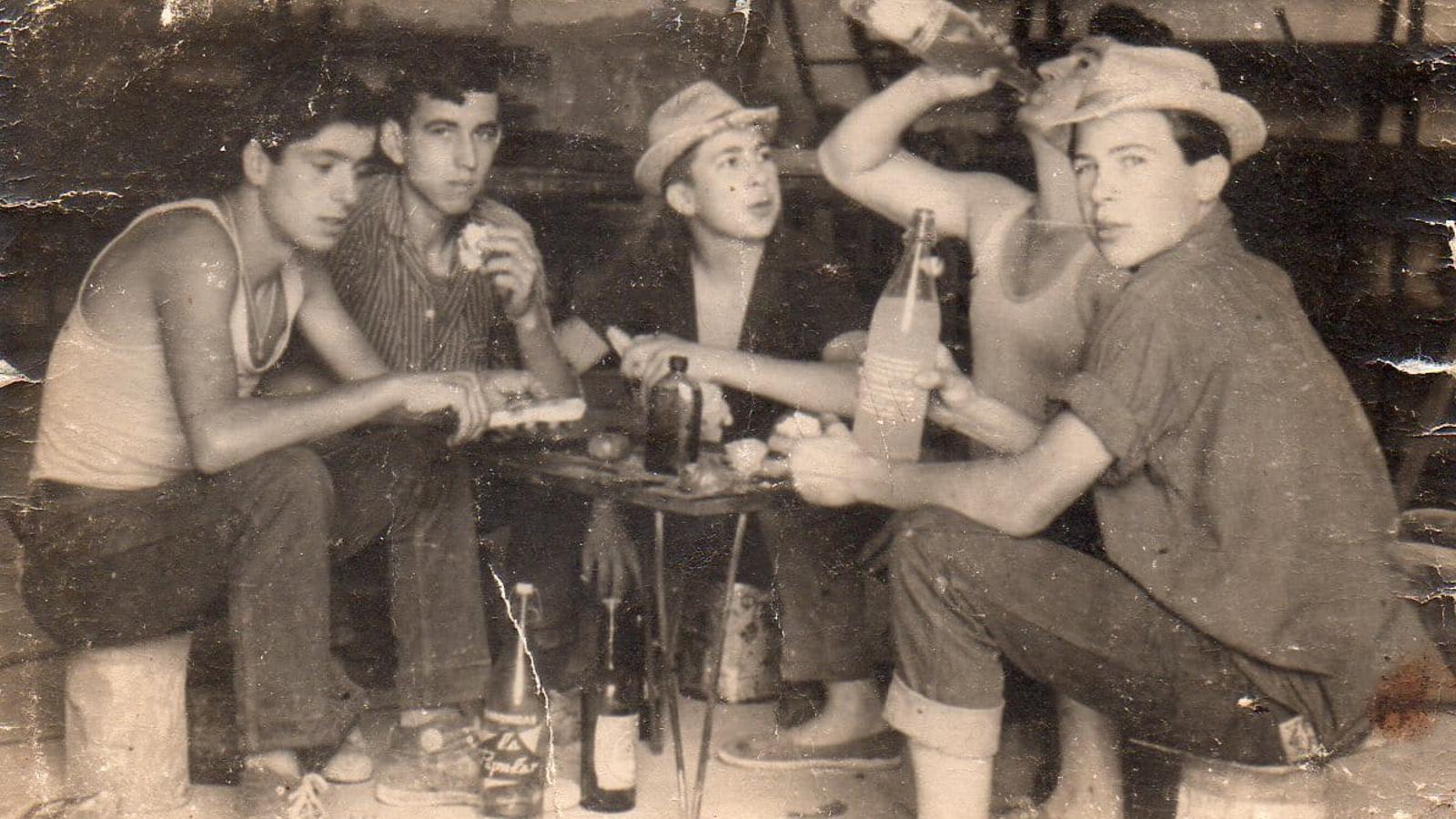
The joy of living of the workers of the tourist boom
In the 60s and 70s the construction of hotels in the Balearic Islands was a source of prosperity for stonemasons, blacksmiths, carpenters, tilers and plasterers, who thus forgot the hard work in the fields of their parents. Now the sector has become precarious and is sustained above all with African and Latin American workers
PalmaAt 82 years old, Joan Pons Gost from sa Pobla looks at the calluses on his hands and reviews his five decades working as a stonemason. “I learned the trade in 1957, at 13 years old. I had lost my father when I was very young, and to help the family economy, I started as a laborer in different renovations that were being done within the same municipality of sa Pobla. With a cart, they sent me up and down to fetch material. Later they taught me how to make cement and lay blocks.”
A few years later, the construction fever of the boom in tourism required a lot of labor. “I,” says Pons, “went to build the Los Príncipes hotel in Platja de Muro. That was a sandy area where there was nothing, and suddenly it filled up with hotels. Back then, we stonemasons had work in abundance. Almost all of us were from sa Pobla and Sineu. There were very few outsiders. Every day, a few of us would carpool to get to the construction site. There was a lot of camaraderie among us.” The working days were exhausting: “A hotel could be finished in two years at most. Immediately we would start building another one. We would end up working 10 hours straight, Saturdays included. It didn’t matter if it rained, was windy, or was scorching hot. Back then, safety measures in construction were very precarious, but luckily we didn’t have any serious accidents.”
The song Paradise of love (1964) by Los Javaloyas was the soundtrack of that era of prosperity that made people forget the ‘years of hunger’ of the postwar period. The chorus said “cada día es fiesta en Mallorca”. “We stonemasons –the man from Sa Pobla asserts– were very happy to see that more tourists came every year. For us, those records were synonymous with work. We worked by the piece, for work completed”. The weekend was the most awaited moment. “It was when we received the envelopes with the money. We jumped for joy. Later we started getting paid through a bank account. I was able to build myself a house in Muro, which is where I got married. And then I bought a second home in Can Picafort. To achieve that, however, my wife and I saved a lot. Now people spend it all on trips”.
The Sineuer Joan Roig, as a young man (left), at the iron workshop in Sineu (60s) .Arxiu Joan RoigThe Sineuer Joan Roig (right), at the iron workshop in Sineu (60s).Arxiu Joan Roig
Pons retired 20 years ago. “Now health problems are coming back to me. I mainly have rheumatism. In any case, I feel proud to have been able to earn a living doing something I liked, even though it was arduous”. Today the trade has changed a lot. “Before, you earned much more. Furthermore, you started as an apprentice and went on learning the technique, which guaranteed a more artisanal product”. 70 years after the outbreak of the tourism ‘boom’, the local from Sa Pobla has mixed feelings. “It is what gave me food, but, given the current overtourism of Mallorca, we could have built fewer hotels. It saddens me to see how we have destroyed the island”.
Sineu, factory of craftsmen
The boom in tourism also provided plenty of work for blacksmiths, carpenters, tilers, and plasterers. These are trades that make up what was once known as the craft sector, which acted as an industry parallel to agriculture. In Mallorca, Sineu was its capital, with the train serving as the conveyor belt for goods – it was in operation from 1878 to 1977. “I –says Joan Roig, 75 years old– started as a blacksmith in one of the three workshops that were in the town. There were about twenty of us workers. At 14, being just a young lad, they sent me to weld parts at a hotel in Camp de Mar (Calvià). The hotel was not yet finished and already had tourists staying there. From 1968 onwards was when more were built throughout the island.”
The man from Sineu keeps great memories of those years. “We lived better. We enjoyed working, but we worked many hours, 60 each week. We got along very well with the master builder. We blacksmiths were mainly involved in the decoration of hotel interiors, making stair railings, lamps, candelabras, and wrought iron torches, among other things. It was a job that was very well paid and allowed me to buy a house and a car”. That modus vivendi contrasted with that of the previous generation. “My father was a farmer. He had a small farm and saved what he could. My mother was dedicated to making mattresses, a trade that has already disappeared. She would go from house to house to remake the beds. She would unpick the fabric mattresses and, with a rod, card the sheep's wool stuffing to recover its original volume and firmness”.
Pre-tourist Mallorca was a world of great austerity. “Before, you couldn't eat as much as today. They gave me pieces of potato in noodles or rice, since meat was a luxury”. For Roig, the sun and beach industry was like manna from heaven. “Working in the fields was very sacrificial. It was a sector that only allowed the subsistence of families. At most, they could sell what they grew in small quantities. Tourism, on the other hand, gave the possibility of making money”. The icebox would become a true symbol of the new times of prosperity. “On holidays, my father would put a bottle of wine and a melon in a basket that he would place for a while in the cistern so they would be cooler”. Roig retired 14 years ago, at 61 years old. “I was lucky –he admits– to work in a time of great prosperity. Now, with the very low wages that are paid, the youngest have it tough. My generation was able to live off tourism. The current one barely gets by on it”.
Tilers and plasterers
The 77-year-old from Campanet, Pere Reynés, also makes a positive assessment of the 50 years he spent as a tiler. “In Campanet,” he says, “there were many, about thirty. A neighbor who had learned an innovative technique in Cuba, where he had emigrated for a season, taught us. Until I was 14, I went to school and dedicated myself to harvesting almonds. The tiler’s trade opened the door to another Mallorca for me. My father was a pine cutter and charcoal burner, and my mother was a seamstress.” Reynés started working for a company in Pollença: “The activity was frantic. I tiled quite a few hotels, promenades like the one in Can Picafort and Peguera, and swimming pools and jacuzzis for villas. Many of my colleagues were from the Peninsula. It paid well.”
Reynés retired 14 years ago, at the age of 63. “Now my company, which reached a hundred employees, only has about ten. They have everything subcontracted to foreign companies, from Bulgaria, Scandinavia, and even China.” This man from Campanet is shocked by the current situation in Mallorca. “I was already telling my colleagues ten years ago: there is no shortage of houses here, there is an excess of people.” Another trade highly in demand during the boom was that of the plasterers. Toni Socias, a 76-year-old from Sa Pobla, dedicated himself to it from a very young age. “At 13, I learned the trade from two masters in the town. I didn’t like going to the countryside to work with my parents. I started by plastering private houses in Sa Pobla and the surrounding areas. Over time, I ended up setting up my own company. It was the era of the runaway construction of hotels in the port of Alcúdia, Playa de Palma, and Can Picafort.”
Joan Roig, 75 years old, worked as a blacksmith for over 40 years.A. J. T.
At the peak of work, Socias had about sixty workers on staff. "In one season, we could plaster three hotels. It was backbreaking work that left your back and arms exhausted, but it was very well paid. You were paid by the meter completed. All my workers were able to buy a house. Nowadays, having a salary does not guarantee you a good future like before. Everything I have is thanks to tourism. I would not have prospered as much if I had only limited myself to renovating private houses." Now, Socias's company is run by his son. "The trade has changed a lot and young people are reluctant to learn it. At the company, we have many Pakistanis. For 30 years, they have been the best experts in the world at installing plasterboard, which is what is most in style today instead of plastering."
Among the young people working in construction today is Camilo Podestá, a 22-year-old from Sant Joan. "To be able to pay for my Landscape Architecture degree studies, for a few months a year I work as a stonemason on the renovation of a mansion in Palma. I earn 9 euros an hour. It is very hard work physically and mentally because sometimes some foremen treat you very badly." Out of the twenty workers there are, only two are Majorcan. "The vast majority are from Africa and Latin America and are between 50 and 60 years old. When you learn the details of their lives, you are astonished. They have lived through very hard experiences. They only want to work to send money home. Here they live crowded into rooms. They have no connection to Mallorca. Some have started a family on the island. Others are clear that, upon retiring, they will return to their country."
As their Latin etymology indicates, artisans (menestrals) were the 'servants' (ministri) of handmade art. Their mechanization took place well into the 20th century, with the arrival of electricity. Those who worked for the tourism boom had previously worked for the peasantry. They were primarily stonemasons, blacksmiths, carpenters, tilers, and plasterers. There were others who could not dedicate themselves to construction due to their specialty. Some, such as mattress makers, did not have their own workshop and carried out their activity at the home of the client who hired them. There were also itinerant ones who passed periodically through the villages to carry out repairs. Among them stood out pot menders, umbrella makers, coppersmiths, yoke makers (who fixed the yokes of beasts of burden), chair makers, and knife sharpeners, who sharpened knives, scissors, razors, and all kinds of cutting tools.
In the wineries, barrel makers, who made wine barrels, were highly sought after. Equally required were the carters, who transported all kinds of merchandise, and the tinsmiths. The latter manufactured many objects necessary for daily life. They did this with tin, a material dating back to the 15th century. At markets and village fairs, they also offered their services to repair utensils that had been damaged. Among the most popular tin pieces were toys, which were made with metal parts on which a color drawing was printed. With the appearance of shopping centers and new materials, especially plastic, tin objects became obsolete, so the trade of tinsmith no longer had any meaning.
Artisan workshops, also known as studios, proliferated in an era when there were no large companies like today. Outside of the artisan trades, there were people with higher education, who were dedicated to the liberal professions. These were teachers, notaries, doctors, pharmacists, and farriers. In the absence of a teacher in the village, the priest could perform their duties.
Industrialization, technological advancement, and later globalization would condemn many artisan trades to disappearance. Those craft jobs constituted an ethnological heritage with a very rich language of their own. In 1965, in the midst of a Mallorca already committed to the sun and beach industry, Carmen Polo, Franco's wife, inaugurated the Menestralia center on the outskirts of Campanet. Located on the island's main road, its attraction was a medieval neo-castle, a very typical tourist architecture of the era (other examples would be the Foro de Mallorca, in Binissalem, and Can Alorda and Gordiola, in Algaida). Gabriel Mateu Mairata, who would later be the Falangist mayor of Campanet, commissioned the building from the architect of the moment, the Palma-born Josep Ferragut. Apart from a restaurant, Menestralia housed a museum and a blown glass factory with demonstrations for tourists.