Rodrigo Cuevas unleashes euphoria at the Nits de Tanit festival in Ibiza
The Asturian artist debuts in Ibiza with the tour of the album 'La belleza'
-
CAT -
CAST -
DE
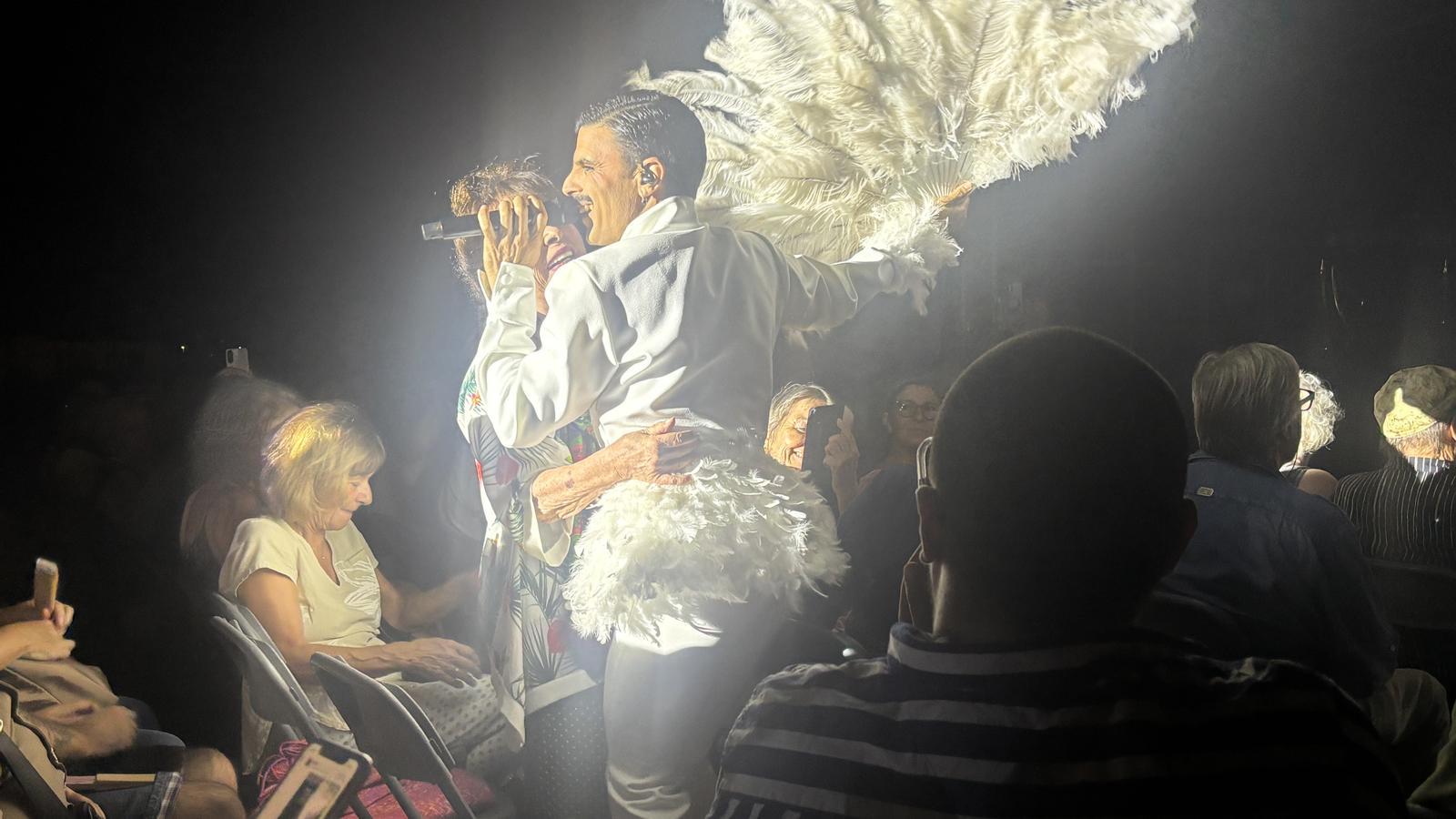
IbizaRodrigo Cuevas can be refined like a dandy; an activist; the most involved neighbor in the village festivals and pecking like a whitewashed sparrow at the door of a toilet. Friday evening Cuevas unleashed euphoria in his debut in Ibiza at the Nits de Tanit festival, accompanied by his inseparable Mapi Quintana, Juanjo Díaz, Tino Cuesta and Rubén Bada. The first applause of the night was received by Massiel, a collaborator on the opening track, 'Un mundo feliz'. Cuevas went down to the stalls to sing with her, and he didn't stop, until the apotheosis finale with the whole band and the dancers singing the vitalist 'La fiesta' among the audience, with verdiales Malagueños who sound as if they were makineros. "How can it be that an artist as gay as Rodrigo Cuevas pleases my parents", said a girl who had convinced her parents to go to the concert. Before the performance, the mother recalled a recital by the violinist Ara Malikian. Afterwards, moved, she described Cuevas as "amazing".
In the presentation show of their latest album, The beauty, Cuevas addresses the audience as if he were at home: in front of all those who attack women's rights, the LGTB collective, and migrant people, the Asturian artist explains that he has founded his own cabaret, La Panoya Dorada, to speak with the audience, progressive like him, only about what he wants. In Ibiza, he went on stage, set up in front of the UIB headquarters at the old Comandancia, with his homework done: he said that the only thing he wanted to talk about was "corn" and beauty. But later he warned that anyone who had missed the main festival to go to his concert was "a tacky", and praised the volunteers who make popular festivals possible.
A meeting of friends in a cider house
The highlight of the repertoire were the ten songs from La belleza. The concert was divided into four blocks, each with its own spectacular costumes, like the first one, full of white feathers. After 'Un mundo feliz', another new song was played, 'BLZA', a reflection on beauty and its ravages. The second block is the most theatrical: the entire company appears gathered in a chigre (cider house), where Cuevas makes all sorts of sexual comparisons with flowers before performing the bolero 'Xardineru'. Shortly after, he got the audience up to dance a paso doble to 'Sácame a bailar'. Cuevas culminated this part with his tribute to the drag artist Alberto Alonso Blanco, known as Rambal, murdered in 1976. For Cuevas, Rambal is one of the people who risked it all, even their own lives, for the advancement of collective rights. Now, we must be aware that these are the foundations of our rights and honor them. "Making a fool of oneself is a responsibility," said Cuevas, because partying is also political.
The third part began with 'La playa', a critique of the clichés about the virtues of the north. 'Veleno' also played, a collaboration with the Galician musician Baiuca, also known for his fusion of electronic and traditional music. And in the final stretch, before the explosion of 'La fiesta', two songs played, with a deathly tone, because Cuevas does not turn his back on death: 'El día que nací yo',the version of the song by Imperio Argentina, and 'Una muerte ideal',a tribute to idols, including Rocío Jurado, Lina Morgan, Concha Velasco, Juan Gabriel, and Nino Bravo.
