Antoni Vera: "If Palma does not redistribute vulnerable students, it must be because the schools do not want to"
Minister of Education and Universities

-
CAT -
CAST -
DE
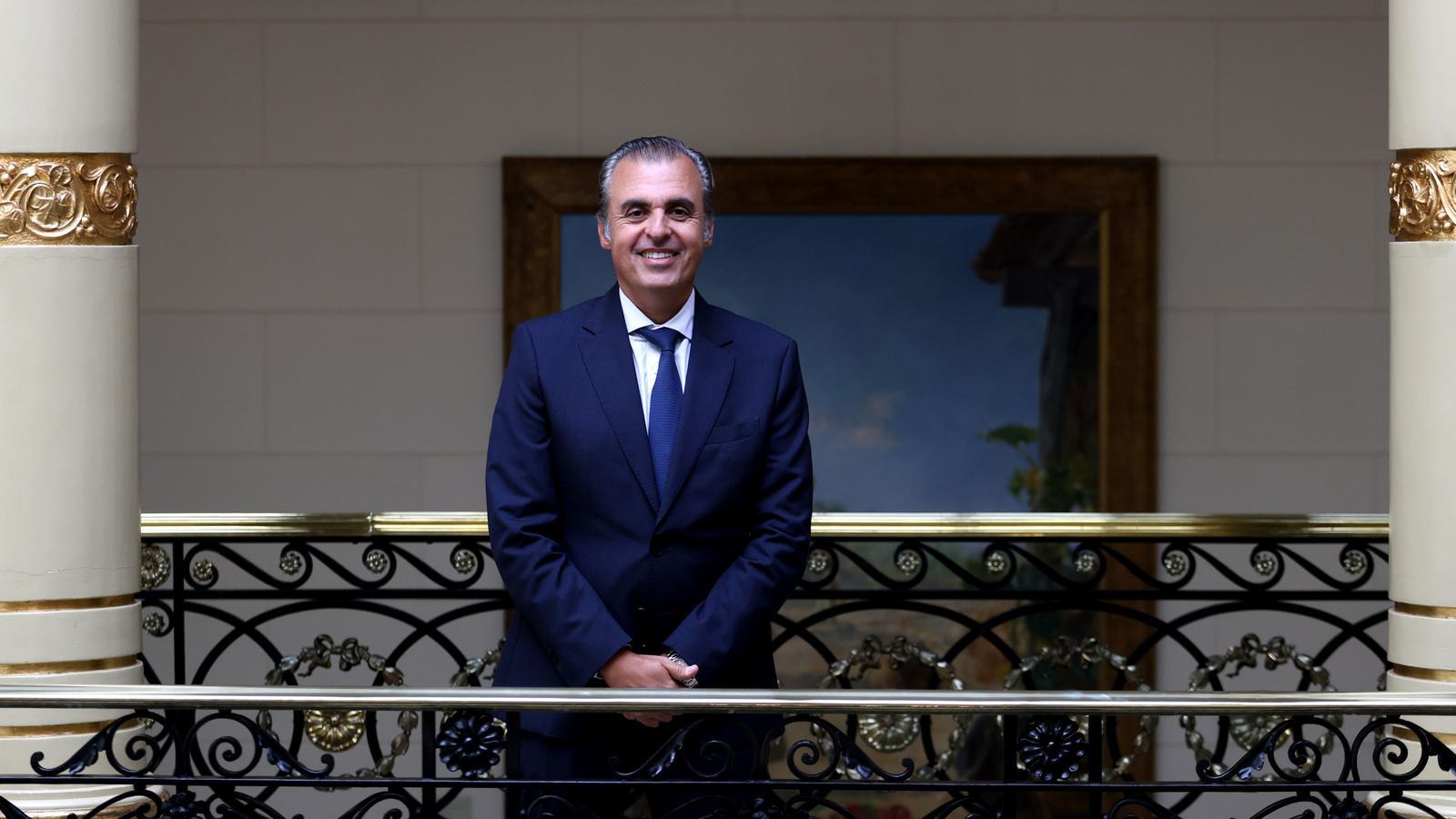
PalmaAntoni Vera faces the final year of the legislative term at the head of the Department of Education and Universities with a track record marked by the boost to subsidized private schools, attempts to accelerate educational infrastructure, and the emergence of private universities in the Balearic Islands. Born in Palma in 1973, the minister reaches the final stretch of his mandate with some of the main educational debates still open and with the desire to highlight the work done during these three years.
If you had to summarize in two sentences what educational system you want to leave behind in 2027, what would it be?
— I believe that, if we look back from when we started and what we will leave behind at the end of this stage, we have achieved important socio-labor and educational improvements and have marked a before and after with educational infrastructure. We have a very clear roadmap regarding the infrastructure that needs to be built. Besides that, two things that personally mattered a lot to me: changing the educational curricula and ensuring that all public centers have a school canteen, because addressing vulnerability is extremely important.
In three academic years, public education has lost almost 3,500 students and charter schools have gained nearly 2,300. Is this difference solely attributable to the subsidizing of 0-3 year old spots?
— It is the main cause. There is a part that concerns 0-3 year old places, which is the largest. Many have been subsidized. And another part is the subsidization of vocational training (FP) to reach more students and fight against dropout. Obviously, there has also been some increase... But the great increase in subsidized education has been due to the 0-3 and vocational training sectors. At the same time, has there been a loss of students? Yes, in public centers and also in subsidized ones, if we analyze Secondary Education, Baccalaureate, and Preschool 3-5. The loss of students is everywhere.
If the demographic decline explains the loss of students, why is the loss so unequal and affects public schools more than charter schools?
— For a simple reason. The charter school system is smaller. There are fewer centers. It is true that where there are more centers is in Palma and it is where it fluctuates the most, but the public system is an education completely established and majority in the Part Forana, in Menorca, in Ibiza and Formentera. The loss of students, when there is a demographic decline, evidently, affects the public system more because it has more supply.

We do not know what the educational system will be like in ten years, why is it necessary to grant educational concessions for ten years?
— To provide stability to the center, its teaching staff, a pedagogical line, and the families. We must take into account that every year there is enrollment and schooling. If there are centers that do not reach the minimum, the classroom is closed, and two are unified to make one. Despite the expansion of agreements, it does not mean it will be for ten years. Every year it is reviewed and classrooms are reduced or expanded when necessary. In Inca, for example, the semi-private sector has helped us to serve all the students; if we had not been able to expand semi-private classrooms, we would have had a very serious problem. Public education in Inca could not handle everything, because students from compulsory secondary education (ESO) and Baccalaureate arrive from other towns and it is under pressure.
In the event of an economic crisis and if you had to close classrooms, would you close public or charter schools first?
— It would be eliminated from where it was surplus. I hope we do not find ourselves in that situation. If I have a public or charter classroom where there are no students, it is closed. We have maintained as many as possible. A maintenance plan for public classrooms with low ratios was carried out, and impeccable work has been done to preserve them, despite the demographic decline.
We are finishing the legislature and Palma continues without an agreement for the balanced distribution of vulnerable students between public and charter schools. Who is vetoing this agreement and what have you done to unblock it?
— It is not that there is any veto. I, if there is an agreement between the City Council and all the charter and public schools, will be the first to be delighted. But for there to be a municipal agreement, everyone must be in agreement. The Ministry can act as an arbitrator, but everyone must want it. The public schools are ours, the City Council is somewhat independent, but the schools must want it. Everyone must want it.
And the centers don't want it, then?
— Well, it hasn't been proposed exactly like that, but I understand that if Palma does not redistribute vulnerable students, it must be because the schools do not want to or because there may also be other issues.
The Balearic Islands are worsening in all three PISA competencies. You advocate for recovering contents and limiting screens. If in three or six years the results do not improve, will you be willing to acknowledge that the problem was not just about contents?
— There is also the context or the fact that the matter in question has not been addressed. Madrid has 15.5% newcomers; the Balearic Islands, 19%. Madrid has the best PISA results and has surpassed Castile and León, which admittedly does not have newcomers. Madrid has the same percentage as Valencia and they have failed...
There are also those who argue that it is because of the 'fucking Catalan'.
— I do not agree with that, because Galicia is up north and also has two languages. The problem of the drop in reading comprehension is not because of that, but because screens do not help. Languages cannot be learned with screens: paper and pen are needed. Reading books must be recovered. A secondary school student must know how to underline a reading book, read a novel, and search for the important concepts in it. It is also necessary to regulate AI in education. Our context, I know it is complicated: we have many newcomers, constant arrivals of students, but we must start to consolidate goals for each grade and stage. Now there is a lot of diversity between one school and another and we must start to unify the level.
Now we not only have students who do not know Catalan, but professors who do not master it. What would you say to someone who thinks that Catalan could end up being lost too, in your own words “in the last bastion of the language”?
— We have the obligation to guarantee Catalan as the vehicular language of the centers. However, at a given moment, we have to cover very technical positions that are currently filled with people who do not have a master's degree or Catalan. These positions need flexibility, but not because they should be without Catalan forever: later, knowledge of it must be demonstrated. However, positions for teachers or Catalan professors are not released through the urgent procedure, precisely because we cannot control the levels of those who take them. As of now, we must ensure that the professionals arriving at the schools have the level of Catalan and that they accredit it.
Beyond the PALIC and cultural programs, what have you done this term so that Catalan gains a real presence in the classrooms?
— We have done much more than what they did in eight years of the Pact. Because in eight years as a Catalan teacher at my center, no one even said ‘good morning’ to me. Apart from those of PALIC and linguistic revitalization, we are creating material and resources. The centers need something to work with because now they have no material. The study of the language requires it, especially at the earliest ages. The centers are desperate to have resources to work with and to engage students with Catalan, because they had not been given anything. At the Publications Center, the COFUC boxes from when I was there are still there.
You presented a ten-year infrastructure plan. Were you too ambitious?
— I don't think so. It is clear that by the end of the ten years there will be actions that will not have been carried out, but perhaps they will have been reformulated. We are now in annual work dynamics. Three new infrastructures this academic year, two more will be incorporated during the year. We know that next year there will be five more. We do not stop: visits, new works, we will lay foundation stones. We still have a legislature and a half left. We must trust in it.
Is it fair that those who design education are air-conditioned and most of the centers are not?
— Totally agree, it is not fair. But we have many old educational centers without air conditioning. As an Administration, we cannot just take air conditioners and put them in the classrooms. What we have to do is look at woodwork, thermal insulation, look at ceilings, solar panels, with climate control that is efficient with the environment. A series of centers that have had air conditioning for years come to mind. The town halls have not performed maintenance on them and, because of that, the installation breaks down. We go there to fix it, we offer to take it on, the technician goes there and the first thing they tell you is: “This does not work, it must be changed”. We cannot go any faster, we do not have more staff.
You have created a Baccalaureate of Excellence for students with the best academic records. Why have you not promoted a program for Baccalaureate students with greater learning difficulties, if the goal was to provide better attention to diversity?
— In Baccalaureate, curricular adaptations can now be made. We have put into operation the Baccalaureate for adults, intended for students over 18 years of age, and this year we are implementing it in Menorca and Ibiza. The Excellence Baccalaureate was not invented by us; it is done in other communities.
Isn't the message being given that the ordinary school cannot serve students with higher performance?
— Of course they are well cared for. But perhaps an ordinary school will not be able to bring out all the potential they might have, because it has to attend to and teach the same subject matter to the majority of students. Let the students in the Excellence Baccalaureate do it. I do not think it is dramatic that there is an excellence group in Mallorca, in Menorca, and in Ibiza. If there were an Excellence Baccalaureate throughout the Balearic Islands, it would not make sense.
If you had a child today who wants to study Medicine, would you recommend that they study at the UIB or at the CEU? Why?
— Let's see, I would like him to go wherever he wanted. I have always advised my children, sometimes it has gone well, sometimes it has not.
And you, knowing both projects, what would you choose?
— As of now, I do not know.... The CEU has just started in the Balearic Islands and needs maturation, and the UIB has been around for many years. The UIB Faculty of Medicine today has viability thanks to our decree that facilitates the compatibility between the healthcare activity of professionals and teaching.
You say that this term you have negotiated everything with the educational community. The unions and other stakeholders, however, say that the Department of Education limits itself to informing them of its decisions. Who is lying?
— We have the responsibility of Government. And we have set our policy, because we had commitments such as the free choice of school. If they tell me that we do not reach a consensus, it is because, clearly, there are things that we carried in our electoral program and we have fulfilled them. On the other hand, there are other matters that we can talk about... the Teaching Staff Decree, as much as they say it was without consensus... they voted for it in all the public education boards.
Do you want to be a minister again in 2027?
— It has been exciting. Education is the most intense department. The decisions you have to make affect many people and that is dizzying, because it is not the same as when I was in the fields of culture, where what you decide affects a smaller group. I am a party person and I will be where they tell me to be.
