The silent change that has revolutionized the Faculty of Law of the UIB
Two years after the arrival of Aina Salom's dean team, the center promotes a new culture of proximity with the students, teaching innovation and promotion of Catalan

PalmaJust a few years ago, the UIB Faculty of Law had an image that many associated with a traditional way of understanding legal studies. The Jovellanos building, with its solid concrete and long corridors, was perceived by part of the university community as a distant space, not conducive to student life and marked by a classical academic culture. Two years after the arrival of the team led by Dr. Aina Salom at the Dean's Office, the picture is different.

The transformation is not explained by major immediate structural changes, but by a change in culture and way of doing things. At least that is how the dean herself, Professor Margalida Capellà, and the president of the Law Students' Association, Toni Ponce, describe it. All three agree on one idea: the Faculty has tried to get closer to the students and become a more participatory, approachable space connected with reality. "We needed to put the student at the center and activate student life," summarizes Salom.
Participation in the university community
This objective translated into concrete measures. One of the first was to promote the creation of the Law Students' Association, a tool that has made it possible to channel students' demands, proposals, and initiatives. Complementary activities have also multiplied, from debates on current issues to seminars, conferences, and projects linked to the professional world.
For Ponce, the change is evident. He explains that after the pandemic, the perception had spread that the relationship between the Faculty and the students had cooled. "In Law, there was a more distant culture," he assures. According to him, the new dean's team has helped to reverse this situation. Ponce particularly highlights the agility with which the Dean's Office responds to students' requests. Both the Students' Association and the Debate Association maintain a constant relationship with the governing team. "Any reasonable request we have made has been addressed very quickly," he states.
A similar perception is shared by Professor Margalida Capellà. She considers that proximity is one of the main characteristics of the current term. "The students have a very direct relationship with the dean. They have her phone number," she points out. As she explains, today's students no longer only go to the Dean's Office when they have problems and complaints. This new dynamic has been reflected in initiatives that have gained strength in recent years. This is the case of the United Nations simulations, an activity that already existed, but which has experienced notable growth. This year, about fifty students have participated in an experience that recreates the functioning of a UN assembly and allows for the development of public speaking, negotiation, and debate skills.
Mock trials, in Catalan
Precisely, practical training is another of the pillars on which this new stage has been articulated. Salom believes that future jurists must have contact with professional reality before finishing their studies and, therefore, the Dean's Office has strongly promoted mock trials. The initiative, developed with the participation of active professionals and with the institutional support of the Government, has allowed students to experience situations very similar to those they will find in the exercise of the profession. This year, moreover, the Faculty has carried out the first mock trial entirely in Catalan, an experience that the dean defines as a source of pride.
Teaching innovation is another of the concepts that appear repeatedly in the discourse of the dean's team. The Faculty is currently working on an update of the study plan that will incorporate a specific subject of Skills for Jurists. The objective is to strengthen competencies that go beyond strictly normative knowledge: the ability to debate, argue, exercise critical thinking, and make responsible use of artificial intelligence.

The challenges of technology
The advent of AI, in fact, is seen as one of the great challenges of the future. Capellà admits that many students question the usefulness of some excessively memoristic content in the face of tools capable of generating information instantly. For this reason, she advocates for a university increasingly focused on reflection, argumentation, and the development of human intelligence. "What we need to work on is human intelligence, and this is only developed with human knowledge," maintains the professor. At the same time, the dean is committed to recovering tools such as oral exams, which are particularly relevant in a profession where the spoken word continues to be a fundamental tool.
One of the areas in which the Dean's Office has placed the most emphasis is the promotion of the language. According to Salom, one of the first lines of work was to contribute to linguistic normalization within the Faculty. From this have emerged initiatives such as the optional subject of Legal Catalan and the incentive that, when revising teaching guides, professors opt for Catalan. However, there is still a way to go. Capellà recalls that the percentage of professors who teach in Catalan remains low. The challenge, he points out, is to ensure that new professor appointments contribute to strengthening the presence of the language.
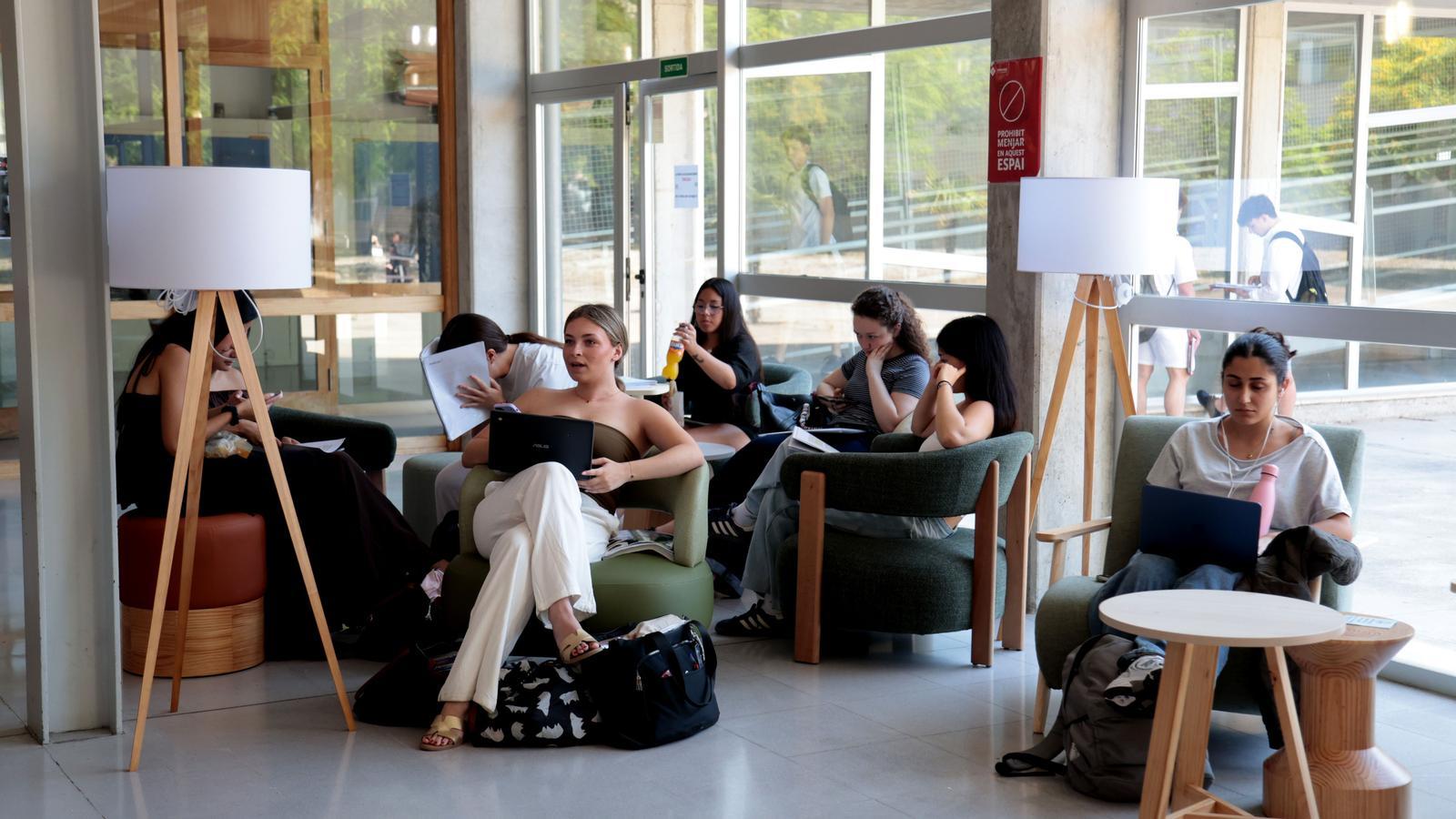
The transformation has also become visible in more everyday aspects. The incorporation of new furniture has contributed to creating spaces for meeting and coexistence. Sofas, armchairs, tables, and lounge areas have turned some areas of the Faculty into places where students spend time. Salom points out that, in a context where public universities compete with private centers that offer increasingly well-maintained environments, the quality of spaces is also part of the university experience.
The Faculty of Law faces important challenges: increasing the presence of Catalan, deepening teaching innovation, and adapting to AI. But the shared feeling among those who live the day-to-day life of the center is that something has begun to change. "You cannot transform a way of doing things rooted for years overnight," says Toni Ponce. "But we are on the right track," he states.
