Health hides the doctor's strike tracking data: "Ask the union"
Even though they have them to deduct days from the salary, IB-Salut has not made them public and endorses the figures from Simebal, considered close to the Government

-
CAT -
CAST -
DE
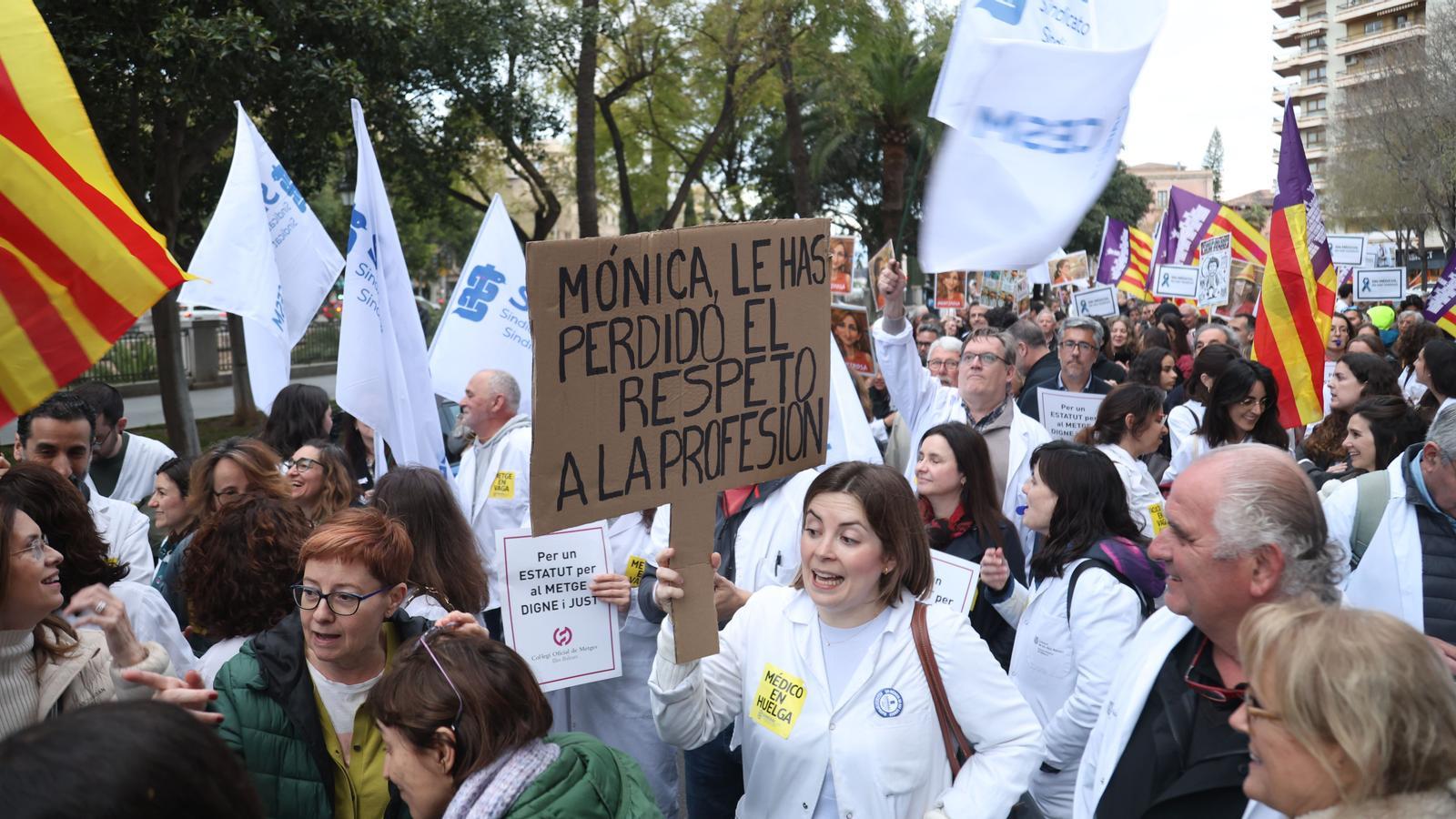
PalmaThroughout the period in which doctors have been on strike against the Ministry's Statute, IB-Salut has maintained a constant attitude of not offering its own monitoring data on the impact of the mobilizations on the medical staff. Instead of publishing official percentages on the professionals' adherence to the stoppage, the Administration has limited itself to reporting on the affected healthcare activity, detailing suspensions of consultations, diagnostic tests, and surgical interventions, as well as rescheduling derived from the situation.

IB-Salut has systematically referred to the figures disseminated by the medical union Simebal, the only source on the monitoring of strikes by healthcare professionals. "Ask Simebal," the Health Communication department has repeatedly said. The Government has maintained this practice throughout the labor dispute, without the Administration providing any statistical alternative of its own that would allow for independent comparison or verification of the data, as other autonomous communities have done. It is the same case as with demonstrations for any reason: there are the figures of the organizers and then those of the police and the Spanish government delegation.
This situation has generated bewilderment and questions among various sources in the healthcare sector consulted, who do not quite understand why the Government has not opted to make its own monitoring indicators public, a common practice in other labor disputes.
Politicization
In this context, the spotlight is also placed on the role of Simebal. Although it is a union with broad and transversal support among the medical collective, various sources in the sector describe it as a trade union organization with a clearly conservative tendency and aligned with the political color of the current Ministry of Health, or even further to the right. This perception, according to the same sources, is relevant at the moment when the administration decides to use its data as the main public reference during the conflict.
The estimates disseminated by Simebal have usually placed strike follow-up at high levels, with percentages in the hospital setting reaching 80%, while in primary care the figures have been more moderate, approximately around 40%. This data, however, has not been contrasted with an equivalent official balance by Ib-Salut, which has not published follow-up series.
The sources consulted by ARA Balears consider that this informational asymmetry can have effects on the public perception of the conflict, as the narrative about the impact of the strike is conditioned by a single union source. In this sense, they warn that the lack of transparency can generate doubts about the real magnitude of adherence, while others consider that it is simply a change in communication criteria by the Administration in this type of situation.
It is also pointed out that IB-Salut has continued to publish data on the healthcare impact of the strikes, such as the number of medical procedures suspended or postponed, but without translating them into global tracking percentages. This difference between healthcare information and labor participation data is, according to sector sources, one of the points that generates the most controversy. This is because it can be misleading to state, for example, that 2,000 primary care visits have been cancelled without contextualizing how many are usually made in a day.
For the moment, IB-Salut maintains its communication line based on the healthcare impact, while criticism persists for the lack of transparency in the real tracking of mobilizations that have strained waiting lists.
