The understanding between the PP and Vox in Madrid makes the Balearic leaderships uncomfortable
The right-wing parties join forces so as not to let a single vote escape even if it makes them enter into contradictions. It is a response to the left's alliance strategy so as not to lose momentum

-
CAT -
CAST -
DE
PalmaNo one doubts anymore that the general elections of November 29th have become a plebiscite: Sánchez yes or Sánchez no. The parties have organized themselves into blocs, have put aside their acronyms, and have accepted contradictions to maximize results. This logic is accentuated in the Balearic Islands, because there are only eight seats at stake in Congress and six senators by direct vote (two are chosen by the Parliament). The left has managed in recent weeks to articulate a joint candidacy for the upper house. In response, the PP and Vox have agreed for the first time on lists for the Senate. But the understanding on the right has made the territorial structures of both parties uncomfortable.

The agreement in the Islands ends the prophylaxis that Marga Prohens has maintained regarding Vox throughout the legislative term. The president was the only PP baron who, in 2023, managed to get the far-right to support her from outside the Government. Later, she designed a strategy that consisted of making the essential concessions to Gabriel Le Senne's party in exchange for the first two budgets of the legislative term, as explained by ARA Balears. From then on, she prioritized distancing herself from them to present herself as a centrist option with a regionalist accent to the voter. In the general policy debate of last October 21st, she claimed to have stood up to Vox on various linguistic issues: “Laws, decrees, and budgets have fallen to defend the language of these Islands”. The fact that six days later an agreement was announced between the two parties to run together in the Senate clashes with this strategy. “They are and will be the same,” reproached the PSIB spokesperson, Iago Negueruela, in the following plenary session.
The agreement signed between the leaderships of Génova and Bambú establishes that the Popular Party will not run for the Senate in three provinces –Gipuzkoa, Tarragona, and Girona– and Vox, in six, among which are the Balearic Islands. In exchange, the PP has had to yield the number two spot for Mallorca in the Senate to Vox. The fact that the far-right has chosen for the position a candidate with no roots in the Islands has proven even more uncomfortable for the PP. It is the Valencian Belén Bordils, former press chief for the former Vox Minister of Justice in the Valencian Community, Elisa Núñez. The PP has argued in recent days that, at least, their acronyms are not diluted on the ballot. However, various party leaders do not hide that this agreement strains them. “It is clear that the decision was made by the national leadership and we had nothing to do with it,” assure government sources. In fact, the Balearic PP had already announced its number two for Mallorca in the Senate before the negotiations in Madrid finished: the Director General of Social Affairs, Marina Fiscaletti. Only two days later, Génova pushed her aside to appease Vox. “She was excited; I hope they compensate her in the regional elections,” recounted a PP official.
“The PP has had to swallow a bitter pill with the imposition of a Vox candidate from another autonomous community,” summarizes political scientist Guillermo Bezzina. “The achievement of joint lists with Santiago Abascal’s party is difficult for the Balearic PP to explain, because it breaks the narrative of distancing themselves from the far-right during the legislature,” he says.
Vox chooses profiles from outside the Islands
In this regard, Vox considers that it has gained ground on the Balearic populars. “Prohens has had to show her true colors and agree on lists with us,” asserts a member of the executive, who believes that the pact benefits them. However, the terms of the agreement have also raised eyebrows among the Balearic ranks of Vox. Various party sources admit that the decision to remove the Vox acronym from the lists for the Islands for the Senate has generated discontent. Especially after learning that the only Vox candidate who will run will be a 'parachute candidate'. “We prioritize the national strategy, but there is some surprise that the candidacy was not drawn up from the Islands,” explains a party official. “We would have liked, at least, that the only person who will enter the Senate be someone from Vox in the Balearics,” he continues. Added to this is the fact that the head of the Vox list for the Balearics for Congress is also unknown to the party leadership in the Islands: the doctor of Science and Technology Maribel Cerezo.

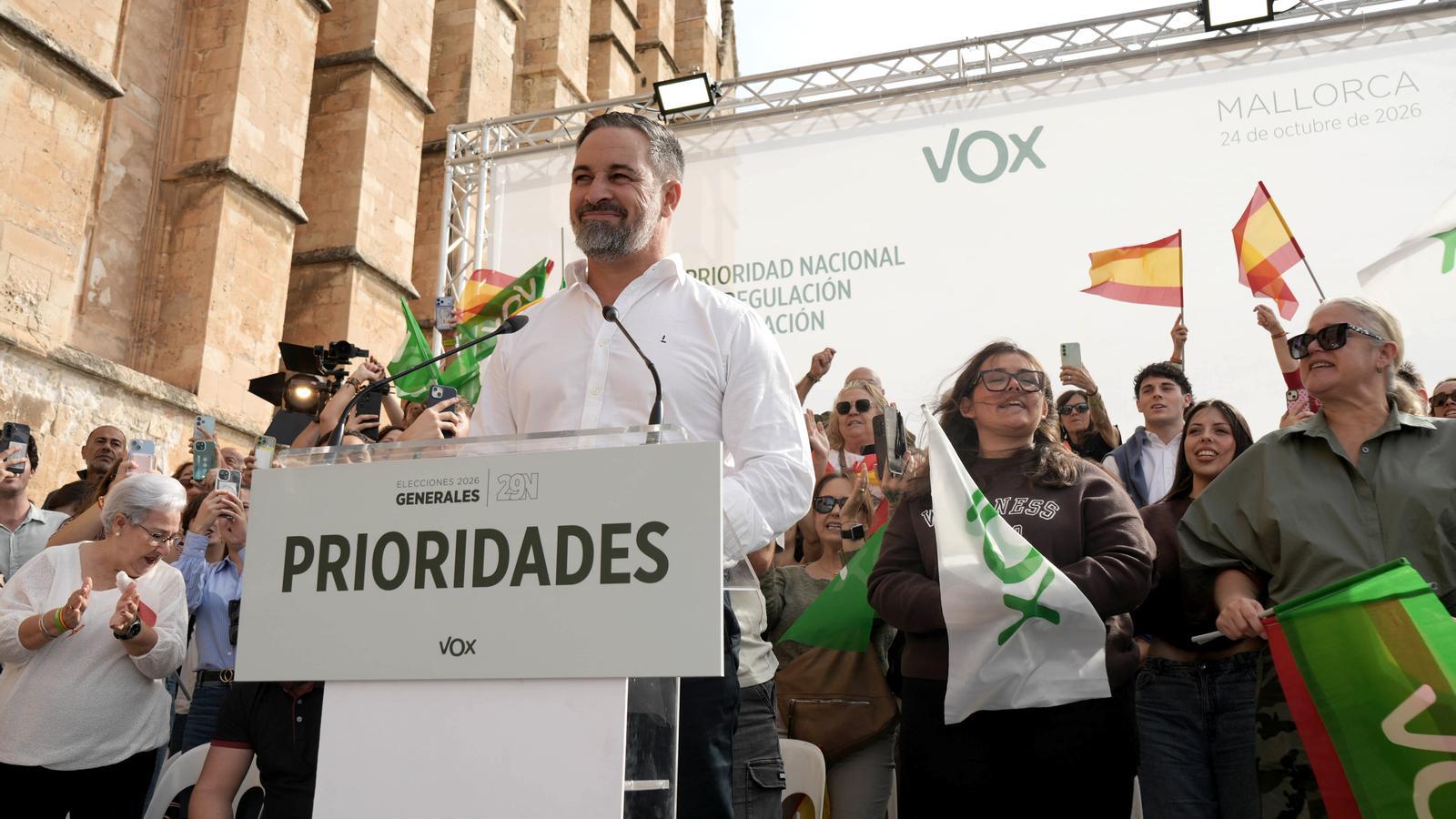
If the agreement between the PP and Vox is uncomfortable for both sides, how is it that it was finally made? The right-wing parties were dragged into it by the left's maneuver. Although the PP spokesperson in Congress and number one for Mallorca in the Senate, Sebastià Sagreras, labeled the PSIB's agreement with Ara Més and the Broad Front to run together in the Senate as a sign of “weakness”, the alliance worried the party. Government sources explain that they relied on internal polls which, with all of the left united, warned of the risk that the PP could lose almost all the senators in the Islands. “Those from Menorca and Formentera, for sure, and the second one from Mallorca was also at risk,” these sources point out. After Vox leader, Santiago Abascal, held rallies on all the islands, and the one in Ibiza –where the PP has been hegemonic until now– was especially crowded (with 1,500 people, according to the Spanish government delegation), the Balearic PP admitted that it “had to go with Vox”. However, despite the displeasure of the party's officials, the sources rule out that the pact could harm them in the short term. “The key to everything here is to remove Pedro Sánchez from the Moncloa: it is what our voters and those of Vox have in common and, therefore, I do not believe that going together will harm us,” points out an official from the Executive.
Political scientist Julián Claramunt agrees with him. “The voter is intelligent and understands that the agreement is strategic: the right-wing voter wants to oust Sánchez and will not care about the contradictions the right assumes to achieve it, and it is even possible that they will reward them,” he continues. In the same vein, he issues a warning. Since it is unusual for two parties at a peak in the polls to reach an agreement of these characteristics, the fact that it occurs “demonstrates that, if they govern, they want to make structural changes, such as touching the Constitution and reaching major agreements that also require a majority in the Senate.” “It is a sign of the ambition they have,” he adds.
Bezzina, on the other hand, focuses on the regional elections. “This agreement gives ammunition to the left, which will say that voting for the PP is voting for Vox, and this ballot proves it,” he explains. “It is a weakening of the Balearic PP’s discourse to differentiate itself from Vox, but above all in regional, not state terms, although it is true that the voter has a short-term memory and it may be that, by the time the regional elections arrive, they will no longer remember it,” he nuances.
The left seeks to resist
“All this is happening because we are facing very important elections, the most important in decades,” adds Claramunt. “What is on the table is not a simple project of management change and associated projects, but two models of country confronted in a very polarized international scenario,” he says. But if the PP and Vox seek to unite efforts with an eye on victory, the left moves from the logic of resistance. In relation to the Ara Més-Front Ampli agreement for Congress, which includes up to eight parties (MÉS per Mallorca, Més per Menorca, Ara Eivissa, Esquerra Unida, Sumar, Podem, Recortes Cero and Progreso Verde), the expert considers that “the only options to get the seat involve going together.” If the PSIB is added to the equation in the lists for the Senate, the feeling of “weakness” is magnified. “When there are different ideological families that join together, such as the Spanish left and the nationalist one, a new family is generated, but strategically, because the alternative is not to exist,” he concludes.
In the case of the Ara Més-Front Ampli coalition, Bezzina highlights the broad internal consensus it has generated. "Four years ago the first deputy was achieved with the Sumar-MÉS pact, and it has been heavily questioned by the grassroots during the legislature, although the assemblies have decided to maintain it," he explains. "Now, the membership chooses to go in a coalition again with a very broad majority," he adds. This is explained, he assures, because the sovereignty movement is aware that it "needs" the pact with the Spanish left to obtain representation. "The possible contradictions between the parties will not penalize them electorally, because the voter is aware that this is the only way they have to reach the Congress of Deputies," points out the political scientist.
