Aging in the Balearic Islands: rent takes up the whole pension and dependency accumulates 192 days of waiting
CCOO denounces that women earn 280 euros per month less than men, that 49% of retirement pensions remain below the minimum wage and that healthcare spending does not reach the state average

-
CAT -
CAST
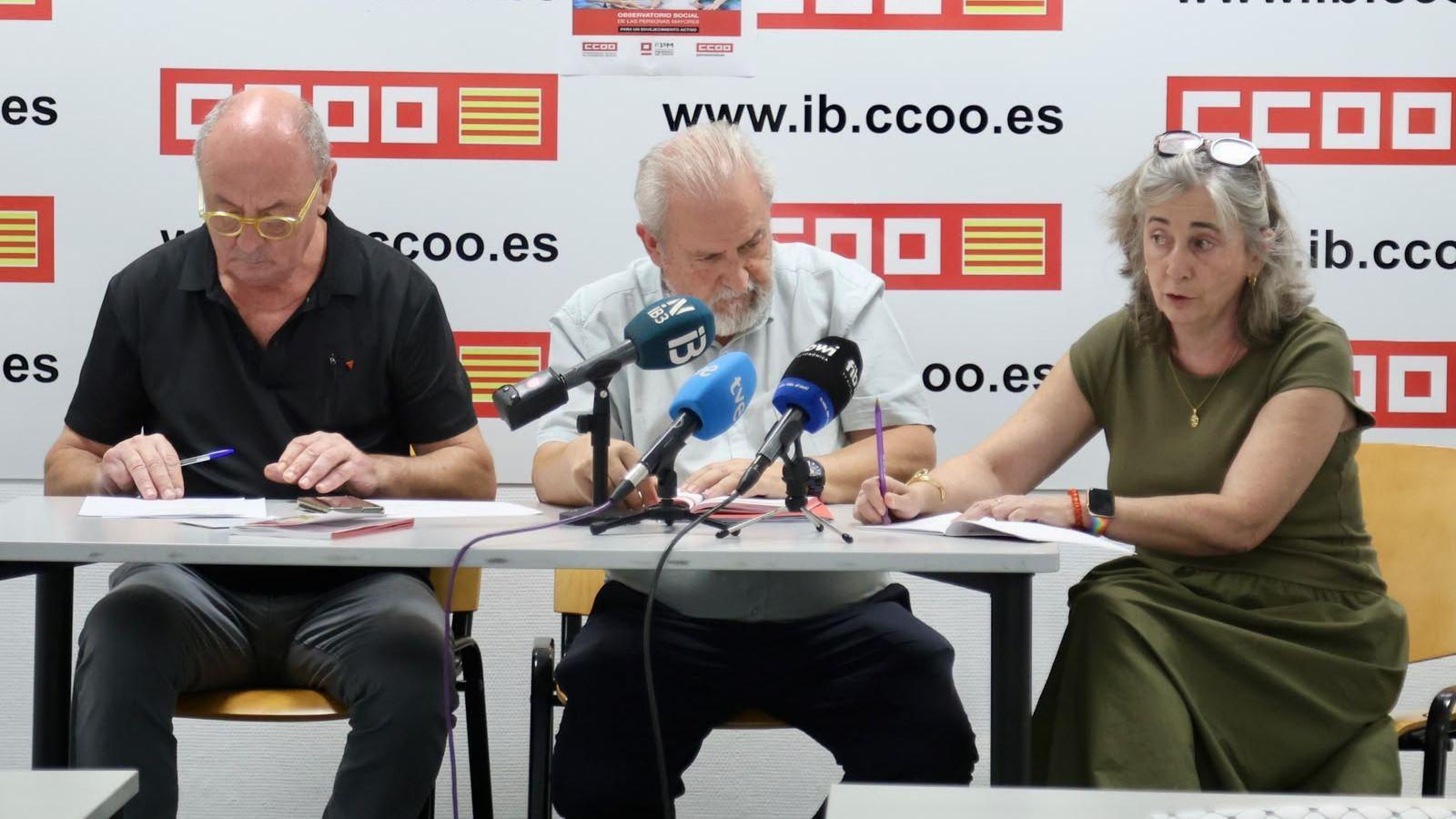
PalmaAging in the Balearic Islands is becoming increasingly difficult for many people, who see that their pension is not enough to pay the rent and that they have to wait months to access dependency aid. The rent for a 65-square-meter apartment costs 1,308 euros per month on average, an amount that is above the average pension in the Islands, which is 1,283.90 euros. Furthermore, 11,375 people are waiting to have their degree of dependency assessed and the processing of files takes up to 192 days. These are some of the data presented by CCOO in the Social Observatory For active aging, with which the union focuses on the economic difficulties and the shortcomings of public services that affect the elderly.

"From the age of 65 it is practically impossible to find affordable housing with an average pension," warned Yolanda Calvo, general secretary of the CCOO island union of Mallorca. The average rental price is 20.13 euros per square meter. Therefore, a person living in a rented apartment of 65 square meters has to spend 1,308.45 euros every month. The average pension does not even cover this expense, without counting electricity, water, food, and any other necessity. "Many people who receive these pensions are forced to share housing to be able to cover the expenses," pointed out Calvo. The situation is even more complicated for people with low pensions. In the Balearic Islands there are 6,061 non-contributory retirement pensions, with an average of 619.64 euros per month, and 2,268 non-contributory disability pensions, which reach an average of 701.91 euros. Furthermore, 49% of retirement pensions are below the interprofessional minimum wage.
280 euros less
The difference between men's and women's pensions remains considerable. In the Balearic Islands, women receive an average of 1,306.63 euros per month, while men reach 1,586.86 euros. That is 280 euros less each month. They are also the majority among people receiving the lowest pensions: they represent 71% of the beneficiaries of minimum pensions.
Ignacio García, Organization Secretary of the CCOO State Federation of Pensioners, has argued that this inequality cannot be attributed solely to differences in career paths. Women also worked during the Franco regime, but they often did so without the same conditions as men to contribute and generate pension rights. For this reason, the union is demanding measures to compensate for an inequality that persists when retirement age arrives.
García has also rejected messages that call into question the continuity of the public pension system. "When I started working, they were saying that too, and I am collecting my pension," he recalled. In Spain, there are more than 10.5 million pensions, with an average of 1,347.57 euros. In the Balearic Islands, the 217,205 registered pensions have an average amount of 1,283.90 euros, while widowhood pensions stand at 881.73 euros.
Six months without dependency
The difficulties in making ends meet are not the only problem denounced by CCOO. The union also warns of delays in dependency care, which leave thousands of people waiting for an assessment or a benefit. In the Balearic Islands, there are 11,375 people on a waiting list and files are processed in an average of 192 days, according to data from August 31, 2026. Mateu Bosch, general secretary of pensioners of CCOO of the Balearic Islands, has warned that the time that passes until aid arrives can aggravate the situation of dependent people and their families. According to the data presented, there are 35,529 people in the Islands receiving dependency aid. Of the total, 27,673 receive a benefit for family care, 77.89%, while only 819 have a benefit linked to a service, 2.30%.
For CCOO, these figures highlight the burden that still falls on families, instead of guaranteeing a sufficient network of professional services. García has criticized a model that he has described as low-cost and which, as he explained, is repeated in the autonomous communities. He gave as an example the financial aid to pay for a private nursing home: if a place costs 2,500 euros per month and the benefit is 700 euros, the family must assume the difference. Bosch has placed at 206 days the time that passes in the Balearic Islands from the moment a dependency situation is diagnosed until the aid is granted. The union demands to reduce delays and strengthen services so that people do not have to wait months to receive the care they need.
The union also demands more resources for public healthcare. Healthcare spending in the Balearic Islands represents 5.4% of GDP, below the 6% of the national average. CCOO asks to increase it to 7% to strengthen healthcare and respond to the needs of an increasingly aging population. The data presented place the rate of people waiting for consultations in the National Health System at 60.5 per 1,000 inhabitants and the surgical waiting rate at 12.2 per 1,000 inhabitants. Bosch has also demanded more transparency regarding referrals between public and private healthcare and has questioned that it is not known with sufficient precision how many patients move from one system to the other.
They return to their places of origin
The rising cost of housing also influences the decisions of many people who retire in the Balearic Islands. Bosch explained that some of those who arrived in the Islands to work there end up returning to their places of origin when they get older. In many cases, they keep a house there and can live there more easily than in the Balearic Islands, where the price of rent makes it difficult to get by on a pension.
In the Islands, 16.8% of the population is 65 years old or older. Life expectancy from this age is 19.5 years for men and 23 years for women. For García, the goal should not only be to live more years, but to do so in dignified conditions. "Add life to years, and not just years to life," he defended.
