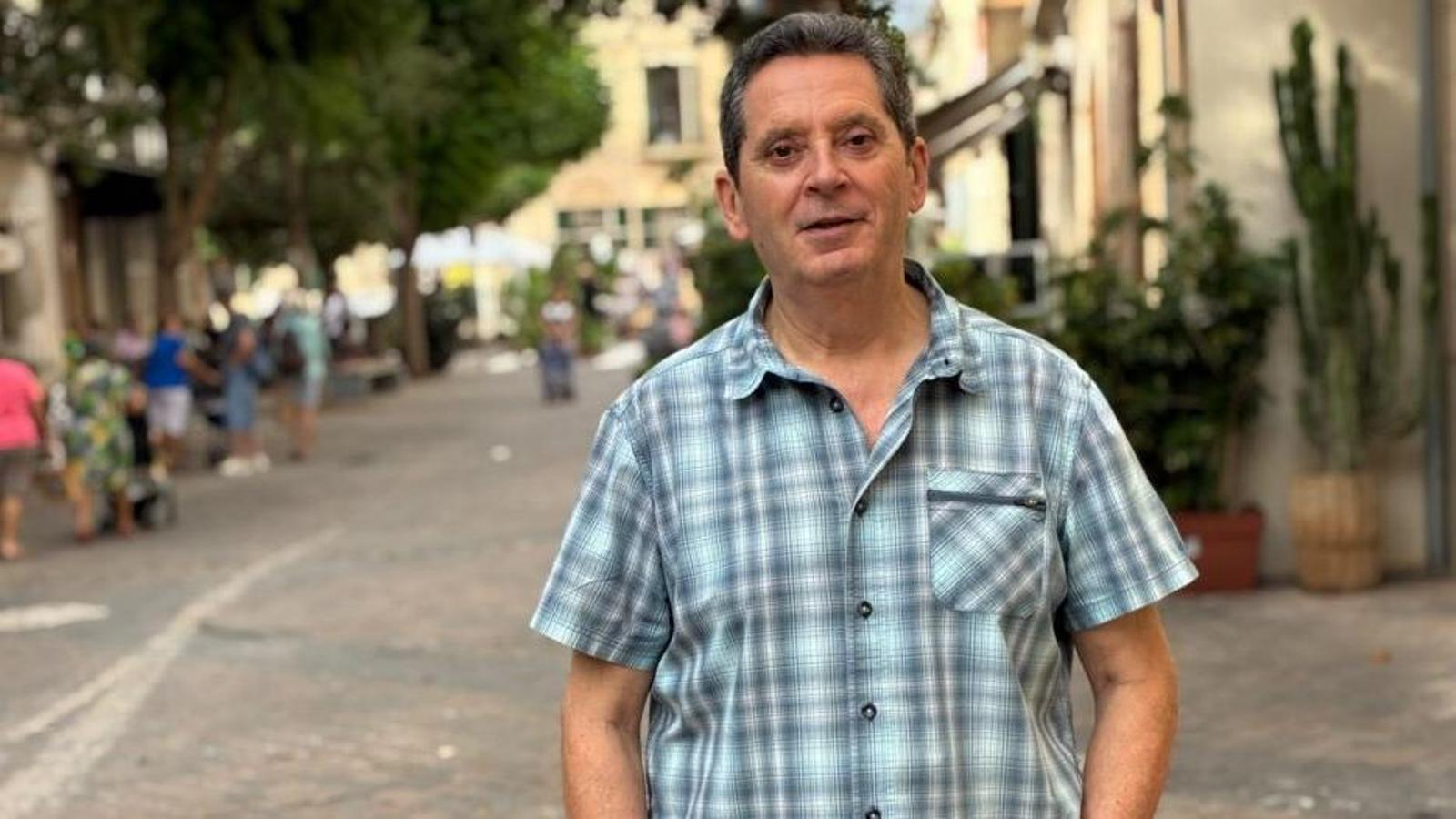
Toni Gornals Mesquida: "I wanted to be the same as before, but Parkinson's does not allow you to"
-
CAT -
CAST -
GER
PorreresOne day in the summer of 2020, at the age of 59, shortly before retiring as a teacher, Toni Gornals Mesquida Pubil (Porreres, 1960) received news that would change his life. A "new companion" would be by his side for life and it had a name as familiar as it was unexpected. Who hasn't heard of or pronounced the word Parkinson's upon seeing a trembling hand? We speak with this man from Porreres who faces a chronic and progressive disease with extra energy and without canceling any of the plans he had always thought of doing upon retirement. On the contrary, he signs up for everything to keep the disease at bay.
How did you receive the news?
— I had a chill that ran through my whole body. I got scared, I started to overthink it... I didn't understand it and I questioned this new illness. And why me? And what is Parkinson's? And what am I supposed to do from now on? How should I face it? With the passage of time and with the help of specialists, family, and the people around me, my attitude towards the disease, and the information that has been reaching me through different means, the answers have emerged, but also new questions and doubts.
And how did you face it?
— At first I didn't say I had Parkinson's because I couldn't and because I didn't want to have the disease. If I didn't make it public and it stayed only for me and my family, it seemed to me that I didn't have it so present and that it didn't affect me. Later, when I had already accepted it, I told my friends, the people closest to me, but I still didn't make it too public, because I didn't want anyone to feel that they had to treat me differently or feel pity for me for what I had to live through. I wanted to be the same as before, but I wasn't and I am not. Parkinson's doesn't allow you to. And when you accept that you are not like before is when you don't mind telling it, because you are already well aware of it and you don't think that the people who know you will change the way they see you or treat you, but rather that it can help you, feel empathy, and support you in carrying out all those activities, recommendations and way of facing the day to day that can help me to be better. Furthermore, now I think that I can also help, within my possibilities, other people who, like me, suffer from the disease.
People link Parkinson's to body tremors, especially of the hands...
— Yes, it is very common, but now that I have the disease as a travel companion, I know that Parkinson's is not just tremors, nor are tremors always Parkinson's. In fact, what I have is stiffness on the left side of my body. I don't have tremors. It seems that for every three people affected by Parkinson's, one does not present tremors. For me, the stiffness started in my arm, I wouldn't move it when I walked and I had difficulty grasping objects, and initially, the physiotherapist thought it was severe tendonitis in my shoulder.
And what is Parkinson's?
— It is a neurodegenerative disorder of the nervous system that occurs due to the loss of neurons in a part of the brain called the "substantia nigra," which are responsible for producing dopamine, a chemical substance essential for controlling movement. Its deficiency causes body stiffness, slowness of movement, and balance and coordination problems, which were the trigger for seeking medical consultation. It should be added that it is quite common for the aforementioned symptoms to be asymmetric, that is, to affect one side more than the other.
You were diagnosed with the first symptoms, could they have diagnosed you sooner?
— Yes, with time, I have been able to verify that there are various symptoms that can appear before the diagnosis. Even neurologists state that these symptoms can begin quite a few years before suffering from the movement problems characteristic of the disease. I, for example, would highlight that my mood, a few years before the diagnosis, had changed. I was a more apathetic person, more absent, and I was almost always more tired than usual. Furthermore, the movement of my left arm when I walked was not entirely natural. But you never relate it to this disease. Therefore, yes, perhaps, they could have diagnosed me sooner.
Based on your experience, when would you recommend anyone to see a specialist? What symptoms might appear?
— The symptoms I mentioned earlier are possible symptoms that can start earlier. Furthermore, I know there are other possible symptoms such as chronic constipation and sleep disorders, that is, sudden movements or shouting while dreaming, but I did not experience them. Although I now know much more about the disease than I did before, I am not a specialist. However, I believe that if a person exhibits a couple of these symptoms, they can consult their general practitioner, who will then refer them to a specialist if they consider it appropriate.
Lately, there has been talk of dopamine and not only linked to Parkinson's...
— Yes, dopamine is a neurotransmitter that regulates motivation, pleasure, and movement control. It is very important because it is decisive when it comes to managing emotions, in addition to motor control. In fact, before the treatment, the people close to me commented that they saw me as distracted, lacking enthusiasm, with little drive, and that I got emotional very easily.
Once you had accepted that you had Parkinson's, how did you face returning to your day-to-day life...
— The first thing you consider and propose to yourself, logically, is to be better. I must avoid being too tired, stressed, or nervous, since it would worsen the symptoms, and I must try to be as well as possible emotionally and lead as normal a life as possible. This is easy to say, but I do not know if it is as easy to do. But the truth is that, after some time, thanks to the pharmacological treatment prescribed by the neurologist, a made-to-measure treatment with levodopa, and my attitude and predisposition towards the illness made me face it with more strength, courage, and positivity.
And what is this bespoke treatment like?
— Levodopa treatment is a dopamine replacement therapy. The neurologist establishes the daily dose and the ideal frequency of medication administration for each specific patient. The symptoms of the disease reappear when the last dose taken loses its effectiveness. The effect of levodopa is not immediate and, furthermore, after a few hours it begins to wear off. This oscillation regarding the effect of the treatment is known as the off phase and the on phase of the disease. We must try to ensure that the on phase is the one that predominates during most of the day and night to feel as well as possible. In my case, currently, the frequency between doses is 5 hours, which means that most of the time I am in the on phase, without manifesting the symptoms characteristic of Parkinson's disease.
Treatments aside, you mentioned earlier that the patient's attitude and predisposition also play a relevant role. Is that so?
— My experience is that taking medication is not enough to get better. If we want to mitigate possible problems and symptoms derived from the illness, constant physical exercise will be a good ally. I currently play table tennis twice a week; I use a stationary bike and an elliptical trainer, and lift weights every other day; I do exercises directed by a physiotherapist and focused on improving coordination, movements, and balance; I go swimming in the summer... Depending on each person's possibilities, one should combine aerobic, strength, balance, flexibility, and mobility exercises, always low-impact, of course. Furthermore, I usually do household chores, such as going grocery shopping, cleaning the house, doing the laundry and using the dishwasher, hanging out the clothes... which keeps me active, in addition to constantly going up and down stairs.
And you also sing…
— Yes, I do other activities that help me when dealing with the illness, such as choral singing, listening to music, reading, writing, solving word searches or crosswords… I think choral singing is an activity that helps me improve cognitively, emotionally, and when socializing, since you express emotions, memorize, project your voice, and are part of a group. It also helps to strengthen the voice and reduce problems when swallowing food (dysphagia), because both choral singing and swallowing share the same muscles.
And are visits to the doctor's office frequent? Apart from the neurologist, are there other specialists who help you?
— The neurologist, of course, in the first instance: diagnosis, treatment, and monitoring of the disease. Currently, I go to Doctor García Caldentey, for a consultation every four or five months, a specialist who adjusted my medication, helped me understand the disease, and informed me from the very first moment about what I could do on my part to be better. As for other specialists, I go to a physiotherapist specialized in improving the symptoms typical of Parkinson's, who prepares a one-hour session for me every week in Palma and some weekly sessions to do at home. The opinion of a psychologist may also be required if symptoms of depression or anxiety were to appear.
It is evident that you have taken this with optimism…
— I did not go looking for the disease. That would be the last thing. But, since it has touched me and I have to live with it, I can certainly try to ensure its company affects me as little as possible. And for that reason, I try to be relaxed, sleep well, among other things I have mentioned before. I believe that, with the appropriate medication, adjusted to each patient, with perseverance regarding physical exercise, with mental activity, and with a proper diet, a person with Parkinson's can lead a more or less normal life. And that is how I see it at this moment in my life, because that is how I feel, that is how I am, and that is how I want to face it, without forgetting that I suffer from a neurodegenerative disorder, currently without a cure, and therefore it is foreseeable that, as time goes by, the disease will progress and some of its symptoms will reappear or be added. But, for now, that is a supposition. I will not be able to corroborate it until it happens to me, if it happens at all. And we must trust in the research on the subject and the scientific and medical advances.
You say that you can lead a more or less normal life. What do you mean?
— What I mean is that even though I lead a relatively normal life, the disease is very present because I cannot keep up the same pace, doing things with the same speed as before suffering from it. I can do practically everything but more slowly: getting dressed, bending down, turning around, moving about… I perform all the movements, but with more slowness and I cannot make sudden movements. If I have to get up after being seated for a certain amount of time, the first steps are always slow and the body needs a short distance to activate itself. For example, if we are in a bar or a restaurant, when I get up I always think that the people who see me walking these first steps, and are unaware of the disease, may think that I have had a little too much to drink, since my movement is not natural due to the stiffness.
Finally, would you like to add anything?
— Yes, it is very interesting for anyone who has this disease to join the Balearic Parkinson's Association, a non-profit entity that works to improve the quality of life for those affected by the disease. To this end, the Association offers specialized attention to its users, organizes a whole series of sports, educational, recreational, and informative activities, and offers advice, guidance, and support for their family members. I think it is fundamental and enriching to be part of a group of people who share a similar problem. The interaction and collaboration between us will always be beneficial for both parties.
